
Can a pilling blazer or a mismatched team really safeguard your client’s confidence during a high-value transaction? In the high-stakes world of finance, your team's appearance is the first indicator of your institution's attention to detail. Selecting the right corporate clothing for financial services means moving beyond basic suits to a strategy that solves modern logistical headaches. We understand the frustration of managing high staff turnover only to see uniforms go to waste, or watching once-sharp garments lose their shape and bobble after just six months of wear.
Finding sizes that fit a diverse workforce while maintaining a unified brand identity across national branches is a common struggle for procurement managers. This guide explores how to combine traditional authority with 2026 fabric technology to build lasting trust and improve staff morale. You'll learn how to source durable, high-performance attire that reduces your long-term cost per wear, ensuring your team looks as professional as the advice they provide. We will break down the transition from tired, traditional uniforms to a modern, cohesive image that reflects the excellence of your brand.
Key Takeaways
- Learn why visual consistency is non-negotiable for banks. It's a critical tool for building immediate authority with your clients.
- Identify the core components of modern corporate clothing for financial services, from classic blazers to technical formal shirts.
- Evaluate fabric performance metrics. This ensures your garments don't look tired or bobble after only six months of use.
- Explore ways to modernize the banker look by integrating smart-casual pieces that keep your team approachable yet professional.
- Discover how to manage a national uniform rollout effectively while maintaining high standards for branding.
The Strategic Value of Corporate Clothing in the Financial Sector
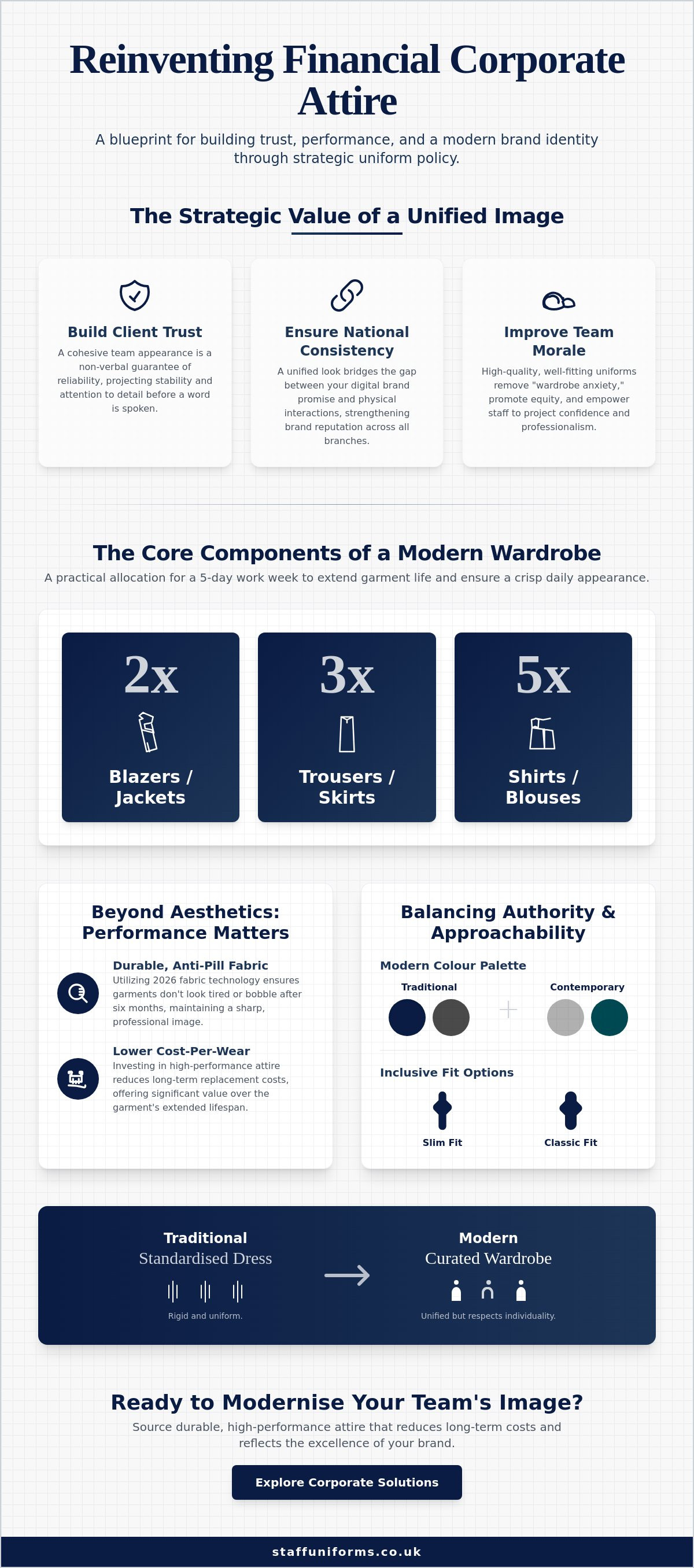
Trust is the primary currency of every financial transaction. In an industry built on risk management and long-term security, visual cues are essential tools for building immediate client confidence. Corporate clothing for financial services serves as more than just a dress code; it's a non-verbal guarantee of reliability and stability. When a client enters a branch or meets a wealth manager, they're looking for signs of discipline and attention to detail. A cohesive team appearance provides that reassurance before a single word is spoken.
For national banks, building societies, and insurance firms, visual consistency is non-negotiable. It bridges the gap between a digital brand promise and a physical human interaction. Mismatched attire or "tired" garments create a sense of fragmentation that can undermine a brand's reputation. Conversely, a unified look suggests a disciplined, well-managed institution. We're seeing a significant shift from the rigid "standardised dress" of the past toward a curated "branded wardrobe." This modern approach respects individual needs while maintaining brand integrity, reflecting 2026 values of quality, longevity, and professional pride.
Establishing Authority in a Digital-First World
In our digital-first world, face-to-face consultations are becoming rarer and more significant. Physical presentation reinforces security during these high-stakes meetings. While digital competitors offer speed, high-street branches offer a physical anchor. Professional attire signals that your institution is a permanent, reliable fixture in the client's financial life. The history of power dressing shows us that clothing has always been a tool for projecting authority and success. In wealth management, this authority is vital for securing long-term partnerships and navigating complex financial landscapes with confidence.
The Impact on Team Morale and Inclusion
High-quality garments do more than impress clients. They empower your staff. A well-designed wardrobe removes "wardrobe anxiety," allowing employees at all levels to focus entirely on their roles rather than their outfits. When you provide high-quality corporate clothing for financial services that fits all body types and sizes comfortably, you promote equity across the workforce. This inclusivity is a key driver of internal morale. Staff who feel proud of their appearance are more likely to project the confidence your clients expect. It's a simple, functional equation: better garments lead to better performance and a stronger sense of belonging.
Essential Components: Building a Cohesive Financial Uniform Policy
Building a successful policy requires a careful balance between aesthetic appeal and functional logistics. The foundation of any high-tier corporate clothing for financial services program begins with corporate suits. While navy and charcoal remain the gold standard for projecting stability, modern palettes are increasingly incorporating softer greys and deep teals to reflect a more approachable brand personality. These contemporary shades provide a fresh look while maintaining the traditional authority that banking clients expect.
When calculating the garment allocation per staff member, practicality is the most important factor. A reliable ratio for a five-day working week typically includes two blazers or jackets, three pairs of trousers or skirts, and five shirts or blouses. This rotation significantly extends the lifespan of each garment and ensures a crisp appearance every day. It's a strategic investment that directly impacts how clients view your team's expertise. Indeed, research on clothing and perceived competence suggests that even subtle differences in attire can significantly shift a client's judgment of an advisor's capability and trustworthiness.
Tailored Suiting and Blazers
A diverse workforce requires a flexible approach to fit. Offering both slim-fit and classic-cut jackets ensures that every team member feels comfortable and confident in their role. It's vital that trousers and skirts are crafted from the same dye-lot fabric to maintain a perfectly matched appearance across your national branches. Blazers have emerged as a versatile middle ground; they provide enough formality for client-facing consultations while offering the flexibility needed for back-office tasks. If you're looking to refine your current policy, you can view our core range of tailored options designed specifically for the financial sector.
Formal Shirts and Blouses
Performance is just as important as presentation. We recommend easy-iron fabrics that resist creasing, ensuring staff look sharp from the first morning meeting to the final client sign-off. Formal shirts and blouses are also the ideal vehicle for brand-specific colors or patterns. Subtle piping or patterned linings can reinforce your corporate identity without overwhelming the professional aesthetic. Because many financial environments are temperature-controlled, choosing breathable cotton-rich blends is essential for all-day comfort. This attention to fabric specification reduces staff complaints and ensures your corporate clothing for financial services remains a point of pride rather than a burden.
Beyond Aesthetics: Fabric Performance and Technical Specifications
Procurement decisions for financial institutions shouldn't focus solely on the initial purchase price. The most accurate way to measure value is through the "Cost Per Wear" (CPW) metric. A cheap blazer that loses its shape after three months has a significantly higher CPW than a premium garment that remains crisp for two years. When we source corporate clothing for financial services, we prioritise technical specifications that guarantee a lower long-term cost. This approach ensures your budget works harder while your team maintains a high-standard appearance every day.
Fabric selection for 2026 revolves around two primary categories. Wool-rich blends are the preferred choice for senior management and wealth advisors. They offer a natural drape and superior breathability that synthetic alternatives can't match. For high-volume roles, high-performance polyester-viscose blends provide the necessary durability. These fabrics are engineered to resist pilling and maintain their structure through rigorous daily use. We also pay close attention to fabric weight, or Grams per Square Metre (GSM). A weight of 270 to 310 GSM provides the ideal balance for year-round comfort in temperature-controlled banking environments.
Crease-recovery technology is another essential feature for the modern professional. Financial experts are often on the move, transitioning from trains to boardrooms. Fabrics with high twist yarns naturally spring back into shape, ensuring your staff don't look dishevelled after a long commute. It's these granular details that separate a basic uniform from a professional tool for success.
Durability and Longevity Standards
We verify fabric resilience using the Martindale rub test. This process simulates natural wear to see how many "rubs" a fabric can take before the fibres break. For office-based staff who spend hours at a desk, high-rated fabrics are critical to prevent trousers from thinning at the seat. Machine-washable tailoring is another practical requirement. It reduces the financial burden on staff and ensures garments are cleaned regularly without the need for expensive dry cleaning. High-quality dyes are equally important. They prevent the premature fading that often occurs on elbows and pockets, keeping the uniform's colour depth consistent for longer.
Sustainability in 2026 Procurement
Sustainability is now a core pillar of corporate ESG goals. Modern collections increasingly utilise recycled polyester and ethically sourced wool to meet these requirements. These materials offer the same performance as virgin fibres but with a significantly lower environmental footprint. Transitioning to durable, high-quality garments is the most effective strategy for reducing textile waste in the financial sector. By choosing pieces that last, you align your corporate identity with a responsible, forward-thinking business model.
Modernising the Banker Look: Balancing Authority with Approachability
Traditional "stuffy" banker stereotypes are fading. Modern clients expect a balance of expertise and accessibility. Introducing smart-casual elements into your corporate clothing for financial services strategy doesn't mean compromising on authority. It's about "Modern Authority." This concept utilizes unstructured blazers and tailored chinos to create a look that's sharp yet approachable. These pieces allow staff to move seamlessly between formal meetings and collaborative office spaces without feeling overdressed. An unstructured blazer, for example, lacks the heavy internal padding of a traditional suit jacket. It offers a more natural silhouette that feels less like a "costume" and more like a functional tool for the modern professional.
Adapting the look for different roles is essential for brand clarity. A front-desk teller requires high brand visibility to guide clients effectively. This is often achieved through crisp formal shirts and branded scarves or ties. In contrast, a senior partner might opt for a premium wool-rich blazer to signal a higher tier of consultation. Accessories serve as subtle signals of rank or department. You might use specific silk tie patterns to denote premier banking staff or different scarf colours to distinguish between insurance and mortgage teams. This allows for a visual hierarchy within the team while keeping the overall brand image unified across national branches.
The "Smart-Professional" Hybrid
Pairing formal shirts with high-quality knitwear is an effective way to soften a team's aesthetic. V-neck sweaters or cardigans provide warmth and comfort while keeping the collar and tie visible. This is a popular choice for corporate clothing for financial services in regional offices where a full suit might feel too formal for the local community. Consistency is still key. Casual elements must be made from the same high-standard materials as the rest of the collection to avoid a fragmented look. Fit is the ultimate differentiator between "casual" and "professional." A tailored chino looks professional because it follows the lines of the body; a baggy or poorly hemmed one does not. When garments are cut precisely, even a more relaxed outfit projects competence and attention to detail.
Gender-Neutral and Inclusive Styling
In 2026, a uniform policy must be inclusive. This means providing garment options that respect modern identity and comfort preferences. Offering a wide range of sizes and lengths as standard isn't just a courtesy; it's a requirement for managing a diverse workforce effectively. A flexible policy allows for personal expression within a professional framework, such as allowing staff to choose between trousers or skirts regardless of role. When staff feel their identity is respected by the clothes they wear, their morale and pride in the brand increase. You can explore our versatile collections to find styling options that reflect your institution's commitment to inclusion.
Implementation and Branding: Streamlining Your National Rollout
Establishing a unified look across hundreds of branches requires more than just a bulk order. It demands a precise logistical strategy that ensures every employee, from Penzance to Perth, receives a garment that fits perfectly and represents the brand accurately. Successful corporate clothing for financial services rollouts depend on this level of detail. We recommend a "sizing set" program as the foundation of your implementation. By sending a full range of sizes to each regional hub, staff can try on garments in person. This simple step eliminates the guesswork of self-measuring and significantly reduces the volume of returns after the final delivery.
Managing a national rollout involves coordinating complex timelines to ensure a synchronized "go-live" date. This is where the expertise behind custom staff uniforms UK becomes invaluable. A staged delivery process allows for quality checks at every milestone, ensuring that the visual impact is consistent across the entire estate. When your team transitions to a new wardrobe simultaneously, it creates a powerful internal and external message of renewal and institutional strength.
Custom Branding and Personalisation
Logo application in the financial sector requires a subtle touch. While bold branding works for retail, finance demands elegance. Subtle embroidery on a shirt cuff or a discreetly placed woven label on a blazer lapel reinforces the brand without distracting from the professional aesthetic. Tax-tabbing is another critical consideration for UK-based firms. By adding a permanent, visible corporate tag to garments, you can often ensure compliance with HMRC rules regarding uniforms as a non-taxable benefit. To maintain this standard long-term, we provide a "Brand Style Guide." This document gives staff clear instructions on how to wear and care for their attire, ensuring your brand identity remains sharp across the country.
Managing the Uniform Lifecycle
The procurement journey doesn't end once the first boxes are unpacked. You need a robust system for managing new starters and replacement items. An efficient online ordering portal allows branch managers to request specific items as needed, maintaining that hard-won brand consistency year-round. Security is also a priority when garments reach the end of their life. We assist in setting up secure recycling programs for old uniforms, ensuring that branded items don't fall into the wrong hands while supporting your institution's sustainability goals. This comprehensive approach protects your brand, your budget, and the environment. Email Sales@staffuniforms.co.uk · Tel 0333 090 8552 to begin planning your 2026 wardrobe strategy.
Secure Your Institution’s Professional Future
Modernising your team's appearance is a strategic investment that pays dividends in client trust and internal morale. By blending traditional authority with high-performance fabric technology, you ensure that your institution's visual identity remains sharp across every branch. We've explored how a curated branded wardrobe reduces waste, lowers your long-term cost per wear, and adapts to the evolving smart-professional landscape of 2026. Transitioning to a high-standard policy for corporate clothing for financial services doesn't have to be a logistical burden when you have the right partner.
Our team specialises in managing complex national rollouts with expert UK-wide delivery. We provide high-performance fabrics tested for 50+ washes and specialist logo embroidery that maintains the elegance of your brand. Whether you're refreshing a local building society or a global insurance firm, we're here to handle the lifecycle of your uniform with expertise and efficiency. It’s time to move beyond standard dress codes and embrace a wardrobe that reflects your business’s excellence.
Build your professional brand with our Corporate Suiting Collection
Frequently Asked Questions
What is the best fabric for financial service suits?
Wool-rich blends are the superior choice for senior management because they offer natural breathability and an elegant drape. For high-volume frontline roles, we recommend high-performance polyester-viscose blends. These materials provide the durability needed for daily office use while resisting pilling. Selecting a fabric weight between 270 and 310 GSM ensures your team stays comfortable in temperature-controlled environments throughout the year.
How many sets of uniforms should I provide for each staff member?
You should provide enough garments to cover a full five-day working week to prevent premature wear. A typical allocation includes two jackets or blazers, three pairs of trousers or skirts, and five shirts or blouses. This rotation allows for regular cleaning and ensures each item has time to recover its shape. It's a practical strategy that significantly extends the lifespan of your corporate clothing for financial services investment.
Are corporate uniforms for banks tax-deductible in the UK?
Corporate uniforms are generally tax-deductible for businesses in the UK if they're required for work and carry a permanent, distinctive company logo. These garments must not be suitable for everyday private use. To ensure compliance with HMRC regulations, many firms use tax-tabbing or embroidery. We recommend consulting with your financial advisor to confirm how these rules apply to your specific procurement strategy and staff benefits.
How can we modernise our financial uniform without losing professional authority?
Modernise your team's look by introducing "Modern Authority" pieces like unstructured blazers and tailored chinos. These items offer a more relaxed silhouette than traditional suits while maintaining a sharp, professional edge. You can use accessories like branded scarves or silk ties to keep the look cohesive. This approach bridges the gap between formal heritage and the approachable service modern clients expect from their financial advisors.
What is the difference between embroidery and tax-tabbing for corporate wear?
Embroidery involves stitching your logo directly into the fabric, typically on a shirt pocket or blazer lapel. Tax-tabbing is a small, woven label sewn into the exterior seam of a garment. Both methods serve to identify the clothing as a professional uniform, which is vital for tax compliance. While embroidery is more visible, tax-tabbing offers a more subtle branding option for high-end tailored suits.
How do we manage uniform sizing for a large, national team?
Implement a sizing set program at regional hubs to ensure every team member finds their perfect fit before you place the final order. This method is far more reliable than asking staff to provide their own measurements. It significantly reduces the logistics of handling returns and exchanges across multiple branch locations. Providing a wide range of standard lengths and sizes ensures your entire workforce feels comfortable and professional.
What are the most durable colours for financial service clothing?
Navy and charcoal grey are the most durable and professional colours for the financial sector. These shades are excellent at hiding minor marks and maintain their colour depth even after frequent cleaning. While black is traditional, it can show lint and dust more easily than navy. Using high-quality dyes ensures these dark tones remain rich and don't fade prematurely in high-traffic areas like elbows or seats.
Can we include smart-casual items like polo shirts in a financial uniform?
You can include polo shirts in your corporate clothing for financial services policy for specific back-office roles or community-facing events. While formal shirts remain the standard for consultations, high-quality polo shirts offer a practical alternative for technical staff or casual Fridays. Ensure these items are made from premium cotton-pique fabrics and feature subtle branding to maintain a level of professionalism that aligns with your institution's reputation.