
What if the cheapest uniform you buy this year actually ends up being your most expensive line item by December? Many procurement managers feel the sting of budget garments that lose their shape after three washes or arrive with inconsistent branding across departments. It's a frustrating cycle where you save on the initial invoice but pay the price in high replacement frequencies and a diluted brand image. Securing cost-effective workwear solutions uk requires looking beyond the unit price to the total cost of ownership. You aren't just buying clothes; you're investing in the vital tools your team needs to succeed.
You don't have to sacrifice your professional appearance to protect your bottom line. We'll show you exactly how to master the art of reducing uniform spend while enhancing garment durability and brand impact. This guide breaks down how to navigate 2026 market shifts, including the recent 15% surge in cotton prices and the strict new EU regulations regarding environmental claims. We'll explore a practical framework for selecting high-performance fabrics for everything from medical scrubs and hospitality aprons to corporate suits. You'll gain a clear strategy to achieve a lower cost-per-wear and a simplified ordering process that keeps your workforce looking sharp and feeling proud.
Key Takeaways
- Learn how to calculate the true Cost-Per-Wear to identify real value beyond the initial purchase price of your garments.
- Discover why specific fabric blends often outperform 100% cotton in high-intensity commercial environments for better durability.
- Secure cost-effective workwear solutions uk by utilizing tiered bulk pricing and maintaining core range consistency to avoid costly rebrands.
- Identify the best logo application methods to ensure your branding remains professional and intact throughout the entire lifecycle of the uniform.
- Streamline your procurement process by consolidating your needs, from medical scrubs to hi-vis safety vests, into a single, manageable account.
Defining Cost-Effective Workwear: Beyond the Initial Price Tag
Procurement managers often confuse "cheap" with "cost-effective." In reality, true cost-effective workwear solutions uk are defined by the intersection of durability and performance. If a garment fails after a few months, your initial saving evaporates instantly. You then face the logistical burden of re-ordering, re-branding, and re-distributing. This creates a hidden cost cycle that drains your budget and your time. Professional-grade Workwear is engineered for industrial or commercial intensity. It differs significantly from retail "fast fashion" items that aren't built for daily high-temperature laundering or the physical demands of the workplace.
When you choose professional-grade garments, you're investing in a tool that supports your business operations. Low-quality alternatives often lead to inconsistent branding as different batches vary in color or fit. High-quality options maintain their integrity, ensuring your team looks unified and professional for much longer. This reliability reduces the administrative strain of managing constant replacements and helps you maintain a predictable annual spend.
The Cost-Per-Wear Metric
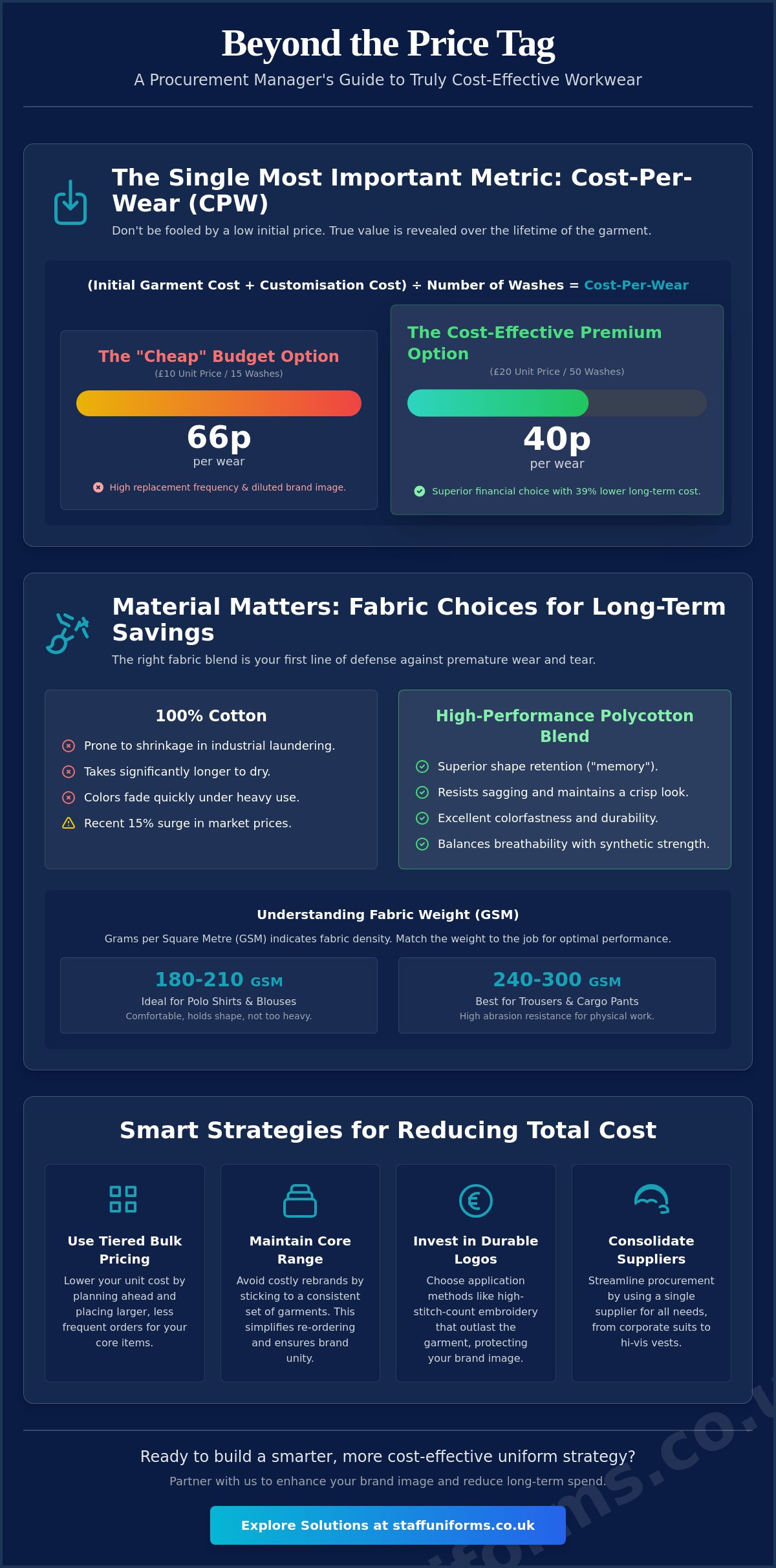
Efficient procurement relies on data, not just price tags. The Cost-Per-Wear (CPW) formula is the most reliable way to measure value. To calculate it, take the (Initial Garment Cost + Customisation Cost) and divide it by the Number of Washes it survives before looking unprofessional. This metric provides a clear picture of how cost-effective workwear solutions uk actually perform over time.
- Budget Option: £10 unit price / 15 washes = 66p per wear.
- Premium Option: £20 unit price / 50 washes = 40p per wear.
The premium option is the superior financial choice despite the higher entry price. Using this metric allows you to justify higher quality for high-intensity roles where clothing is subjected to constant movement or harsh environments. It eliminates the "false economy" of low-cost purchasing and aligns your budget with actual garment performance.
The Impact of Brand Perception on ROI
Your team's attire is a silent ambassador for your business. Faded, pilling, or ill-fitting uniforms signal a lack of attention to detail to your clients. This can erode trust before a word is even spoken. Framing professional attire as a marketing asset changes the conversation from "how much does this cost?" to "how much value does this add?".
High-quality corporate suits and tailored blouses do more than just look good; they boost staff morale. When employees feel respected by the quality of their gear, they take more pride in their work. This often leads to better staff retention and a more cohesive company culture. Investing in durable, professional-looking uniforms is a strategic move that pays dividends in both external reputation and internal productivity.
Material Matters: Fabric Choices that Drive Long-Term Savings
Selecting the right fabric is the most critical decision in securing cost-effective workwear solutions uk. While 100% cotton is often perceived as a premium choice, it frequently fails in high-intensity commercial environments. Cotton is prone to shrinkage, takes longer to dry, and fades quickly under industrial laundering. With cotton prices seeing a 15% surge in early 2026, many procurement managers are shifting toward high-performance blends. Polycotton, typically a 65% polyester and 35% cotton mix, offers a superior balance. It retains the breathability of natural fibers while gaining the "memory" of synthetic polyester, which prevents sagging and maintains a crisp, professional silhouette over dozens of wash cycles.
Durability is also tied to the fabric's weight, measured in Grams per Square Metre (GSM). A higher GSM doesn't always mean better quality, but it does indicate the density of the weave. For items like workwear trousers or cargo pants, a weight of 240-300 GSM provides the necessary abrasion resistance for physical labor. Conversely, a polo shirt at 180-210 GSM offers enough substance to hold its shape without becoming uncomfortably heavy. Understanding these technical specifications ensures you don't over-specify for light duties or under-specify for technical roles, both of which lead to wasted budget.
Polycotton vs. Technical Synthetics
Modern technical synthetics are quickly becoming the standard for hospitality workwear and service roles. Unlike traditional fabrics, these materials feature advanced moisture-wicking properties that pull sweat away from the skin. This keeps staff comfortable during long shifts, which directly impacts productivity and morale. For UK businesses, a layered approach is most efficient. Use lightweight synthetics for summer and transition to heavier softshell or waterproof jackets for winter. This prevents the need for a total uniform overhaul every six months, as core items like polo shirts remain consistent year-round.
Durability Standards and Industrial Washing
Uniforms in sectors like healthcare or food service require frequent 60-degree washes to maintain hygiene standards. Lower-grade fabrics will degrade rapidly at these temperatures, causing logos to peel and seams to fray. Look for garments featuring fabric treatments like Teflon coating. This invisible barrier provides essential stain resistance, allowing spills to be wiped away before they set. Industrial-grade garments are specifically tested to survive 50 or more high-temperature wash cycles while maintaining their structural integrity. Investing in these tested materials is a proactive way to lower your annual replacement rate. You can explore our full range of durable, sector-ready polo shirts and technical workwear to find the right match for your team's specific environment.
Strategic Procurement: Bulk Buying vs. Managed Accounts
Procurement strategy is the engine room of cost-effective workwear solutions uk. While selecting the right fabric is vital, the method of acquisition determines your long-term administrative overhead. Tiered bulk pricing offers an immediate mathematical advantage for UK businesses. By committing to larger volumes, you reduce the unit cost of every item, from hospitality aprons to softshell jackets. However, the real value lies in 'Core Range' consistency. Choosing products with a guaranteed 3-5 year lifecycle prevents the costly need for total re-brands when a specific line is discontinued. It's about securing a predictable supply chain that respects your budget and your brand.
Holding a dedicated stock buffer is another strategic move. Instead of placing small, reactive orders that incur high shipping fees, maintain a small inventory of your most common sizes. This ensures immediate availability for new starters, allowing them to feel part of the team on their first day. It also protects you against temporary supply chain fluctuations, ensuring your operations never grind to a halt due to a lack of professional attire. When you treat uniform procurement as a long-term logistics plan rather than a series of one-off purchases, you eliminate the hidden costs of panic-buying.
The Pitfalls of Discount Hunting
Hunting for 'end of line' discounts is a common trap. While a 40% saving on remnant stock looks good on a spreadsheet, it's a false economy for permanent teams. When you hire a new staff member six months later, you won't be able to match their uniform to the rest of the department. This leads to a fragmented brand image that can confuse customers. It's far more efficient to standardise your colour palettes. By sticking to classic navy, black, or charcoal for items like chef jackets or beauty tunics, you maintain multi-vendor flexibility and ensure your team always looks unified.
Managed Services and Wardrobe Management
For larger workforces, the transition from transactional buying to a managed uniform account is a game-changer. Managed services significantly reduce the administrative burden on HR and procurement teams. Through dedicated online portals, staff can order their own healthcare uniforms or workwear trousers within pre-set budgets. This decentralised approach eliminates the middleman and reduces the risk of ordering errors. Consolidated invoicing also saves the finance department time and money by replacing dozens of small receipts with a single, transparent monthly statement. It's a professional, streamlined way to manage the entire lifecycle of your corporate identity.
Reducing Total Cost of Ownership: Care and Maintenance
Procurement doesn't end when the delivery arrives at your warehouse. To achieve true cost-effective workwear solutions uk, you must manage the post-purchase lifecycle with the same precision as the initial buy. Most businesses lose significant budget through premature garment failure caused by incorrect care. Providing a 'Uniform Care Guide' to employees is a low-cost, high-impact financial strategy. It ensures that custom staff uniforms are laundered at the correct temperatures and dried away from direct heat sources. This simple educational step can extend garment life by up to 30%, directly delaying your next capital outlay.
Maintenance is particularly vital for high-value technical items. For equipment like waterproof jackets, a 'Repair over Replace' policy is far more economical than a full replacement. Small zip repairs or seam resealing can be handled for a fraction of the cost of a new technical garment. This approach keeps your team protected while keeping your annual spend predictable and controlled.
Embroidery vs. Print: The Longevity Debate
Your choice of branding method is a major factor in long-term costs. While screen printing or vinyl transfers are often cheaper upfront, they are prone to cracking and peeling after repeated high-temperature washes. Embroidery is the gold standard for durability. It typically survives the garment itself, making it the most cost-effective choice for high-rotation items like polo shirts and fleeces. For technical fabrics where you don't want to puncture the membrane, 'Transfer Printing' serves as a middle-ground. It allows for high-detail logos on softshell jackets while maintaining the fabric's performance integrity.
Implementing a Uniform Exchange Policy
Logistical costs often hide in the internal distribution process. Implementing a 'one-in, one-out' exchange policy is a practical way to track usage and prevent unnecessary wastage. This system requires staff to return a worn-out item before a new one is issued. It provides immediate visibility into which departments are 'high-wear' areas. If your logistics team is replacing workwear trousers twice as fast as your maintenance team, you can investigate if the fabric specification matches the physical demand.
Tracking allocation by employee also helps identify training needs for garment care. For decommissioned gear, especially hi-vis safety vests, consider garment recycling programmes. This aligns with the 2026 EU "Empowering Consumers for the Green Transition" Directive, which bans generic environmental claims unless backed by recognized standards. By managing the end-of-life process, you ensure compliance and demonstrate corporate responsibility. To find garments built for this level of longevity, you can view our full workwear range here.
Partnering with The Staff Uniform Company for Sustainable Savings
Choosing a supplier isn't just about finding a vendor; it's about selecting a strategic partner who understands the high-stakes nature of your corporate identity. At The Staff Uniform Company, we specialise in delivering cost-effective workwear solutions uk that balance technical performance with aesthetic excellence. Our expertise spans diverse sectors, ensuring that your team's attire serves as a functional tool for success. Whether you're managing a front-of-house hospitality team or a technical maintenance crew, we provide the logistical support and product quality required to keep your operations running smoothly. We view every garment as an investment in your business's reputation and your employees' professional pride.
Our Approach to Value Engineering
We don't just sell garments; we engineer uniform programmes designed for longevity. Our process involves analysing your specific environmental challenges to recommend the most durable fabric weights and blends. This prevents the common mistake of under-specifying for physical roles, which leads to the high replacement frequencies that drain annual budgets. We maintain rigorous quality control standards to ensure consistent branding across every item, from beauty tunics to hi-vis safety vests. Our pricing model is intentionally transparent. You won't find hidden customisation fees or unexpected surcharges here. We believe in building trust through clarity and reliability, ensuring you can forecast your spend with total confidence.
Next Steps for Your Business
Consolidating your procurement through a single-source provider is one of the most efficient ways to reduce administrative overheads. Our extensive range allows you to manage everything from healthcare scrubs and nurse dresses to chef jackets and workwear trousers under one contract. This consolidation simplifies your supply chain and provides greater leverage for tiered bulk pricing across your entire organisation. With a robust UK-wide delivery infrastructure, we support multi-site organisations with the same level of precision and care as a single-location business.
It's time to move beyond transactional buying and start investing in the long-term health of your brand. We invite decision-makers to review their current replacement cycles and identify exactly where budget is being lost to low-quality alternatives. Our team is ready to help you transition to a more sustainable, manageable, and professional uniform model that respects your bottom line. You can consult our specialists for a cost-effective workwear audit today to begin refining your procurement strategy for 2026 and beyond. We'll help you build a wardrobe that your staff are proud to wear and your finance department is happy to approve.
Future-Proofing Your Procurement Strategy
Transitioning to a high-performance uniform model is a strategic investment that pays dividends in both staff morale and brand reputation. By shifting your focus from the initial invoice to the Cost-Per-Wear metric, you unlock sustainable savings that low-quality alternatives simply can't match. Implementing a core range and providing clear care instructions ensures your team remains unified and professional long after the first wash. Achieving cost-effective workwear solutions uk is about choosing durable quality that survives the rigours of daily commercial use. It's time to stop reacting to garment failures and start planning for long-term excellence.
The Staff Uniform Company has been supplying specialist garments across the UK since 2017. We bring deep expertise in the healthcare, hospitality, and corporate sectors to every partnership we form. Our national coverage and service-oriented approach mean we're more than just a vendor; we're a strategic partner dedicated to your business's success. Optimise your uniform budget with a professional workwear audit and discover a more efficient way to manage your corporate identity. We're ready to help you build a durable, professional image for your workforce that stands the test of time.
Frequently Asked Questions
What is the most cost-effective way to brand a uniform?
Embroidery is the most economical choice for permanent staff uniforms due to its superior durability. While the initial setup might cost more than basic printing, embroidered logos don't crack or peel after repeated high-temperature washing. This longevity ensures you don't have to replace a perfectly good garment just because the branding has degraded. It's a key component in maintaining cost-effective workwear solutions uk.
How many sets of uniforms should each employee have?
We recommend a minimum of three to five sets for full-time employees. This "one on, one in the wash, one in the drawer" system prevents over-laundering of a single garment. By rotating five sets, you significantly reduce the wash-frequency per item, which extends the overall lifespan of the kit. This rotation strategy lowers your annual replacement costs and keeps the team looking crisp.
Does bulk buying workwear always save money?
Bulk buying saves money when applied to a "Core Range" of products with guaranteed long-term availability. Buying large quantities of seasonal or end-of-line stock is often a false economy because you won't be able to match the uniform for new starters later. Focus on tiered pricing for consistent items like polo shirts and cargo pants to maximize your procurement budget without risking brand fragmentation.
How can I make my staff uniforms last longer?
Implementing a strict laundering protocol is the most effective way to extend garment life. Wash items at the lowest effective temperature and avoid tumble drying, which breaks down fabric fibers and elastic over time. Providing staff with a simple care guide ensures they treat their attire as a professional tool. Small habits, like fastening zips before washing, prevent snagging and mechanical damage to the fabric.
Is embroidery more expensive than printing in the long run?
No, embroidery is typically cheaper in the long run because it survives the entire lifecycle of the garment. Printed logos often begin to fade or peel after 20 to 30 washes, especially in industrial environments. Embroidery maintains its professional appearance for 50 or more cycles. For high-rotation items like healthcare scrubs or hospitality aprons, the durability of embroidery provides a much better return on investment.
What fabrics are best for durable, low-cost workwear?
Polycotton blends, specifically the 65% polyester and 35% cotton mix, offer the best value for UK businesses. This fabric provides the breathability of cotton with the hard-wearing, shrink-resistant properties of polyester. It’s an ideal choice for cost-effective workwear solutions uk because it holds its shape and color through rigorous use. For technical roles, modern recycled polyester offers similar durability with enhanced moisture-wicking capabilities.
How do I calculate the ROI of a new staff uniform?
Calculate ROI by tracking the "Cost-Per-Wear" rather than the purchase price. Divide the total cost of the garment and its customization by the number of weeks it remains in a professional condition. If a more expensive technical jacket lasts two years while a budget version fails in six months, the premium option delivers a significantly higher return. Factor in reduced admin time and improved staff morale for a complete picture.
Can sustainable workwear be cost-effective for UK businesses?
Yes, sustainable options are increasingly viable as fabric technology improves garment longevity. While materials like recycled polyester often carry a 10% to 15% price premium, their durability often matches or exceeds standard synthetics. With the 2026 EU directive regulating environmental claims, investing in verified sustainable fabrics helps future-proof your procurement against changing compliance standards and enhances your brand’s reputation.