
If your team's uniforms look worn out after just a few months, you aren't just losing money on replacements; you're losing the trust of your clients. Cheap garments often lead to a cycle of constant reordering that drains your annual budget. You likely recognize the frustration of seeing seams fail or fabrics thin after only a few industrial wash cycles, leaving your staff looking unprofessional and feeling uncomfortable in restrictive gear.
This 2026 UK procurement guide shows you how to select durable work trousers for staff that stand up to heavy industrial wear while maintaining a sharp, cohesive brand image. We'll help you move beyond the "shabby" look to find high-performance solutions that offer a lower cost-per-wear over the financial year. You will discover the latest in fabric technology, such as Ripstop and Cordura reinforcements; we also clarify how to meet essential safety standards like EN ISO 13688:2013 without sacrificing the comfort your workforce demands. We've broken down the technical specifications and sustainability trends to make your next procurement decision simple, logical, and effective.
Key Takeaways
- Learn how to identify high-quality materials like Ripstop and polycotton blends that prevent small tears from spreading and maintain structural integrity.
- Understand why investing in durable work trousers for staff reduces long-term costs by avoiding the "shabby" appearance caused by frequent industrial washing.
- Discover how to balance professional aesthetics with functional needs, such as crease-resistance for corporate roles or enhanced flexibility for hospitality teams.
- Implement a professional sizing programme and clear laundering protocols to extend the lifespan of your garments and maximise your return on investment.
- Explore the "Full Look" strategy to ensure your team's trousers perfectly complement branded hospitality shirts and polo shirts for a unified professional image.
Defining Durable Work Trousers for Staff in 2026
Durability in 2026 isn't just a buzzword. It's a technical requirement for any high-functioning team. True durable work trousers for staff combine three essential pillars: fabric tensile strength, reinforced construction at stress points, and superior colour retention. While the history of Workwear shows a focus on basic protection, modern procurement demands garments that withstand industrial laundering without losing their professional silhouette. A pair of trousers that looks "shabby" after ten washes isn't just a garment failure; it's a brand failure.
Cheap alternatives fail because they focus on the transaction rather than the lifecycle. When seams split or fabric thins after six weeks, your initial saving evaporates instantly. The 2026 UK market has shifted toward technical fabrics like Ripstop and Cordura, alongside ergonomic designs that move with the body. These aren't luxury additions. They're functional necessities that prevent the premature degradation of the uniform. Your staff's attire is the most visible part of your corporate identity. If their trousers are pilling or faded, it sends a message of stagnation to your clients. High-quality attire acts as a vital tool for business success by reinforcing your expertise at every touchpoint.
The Economics of Durability: Cost-per-Wear
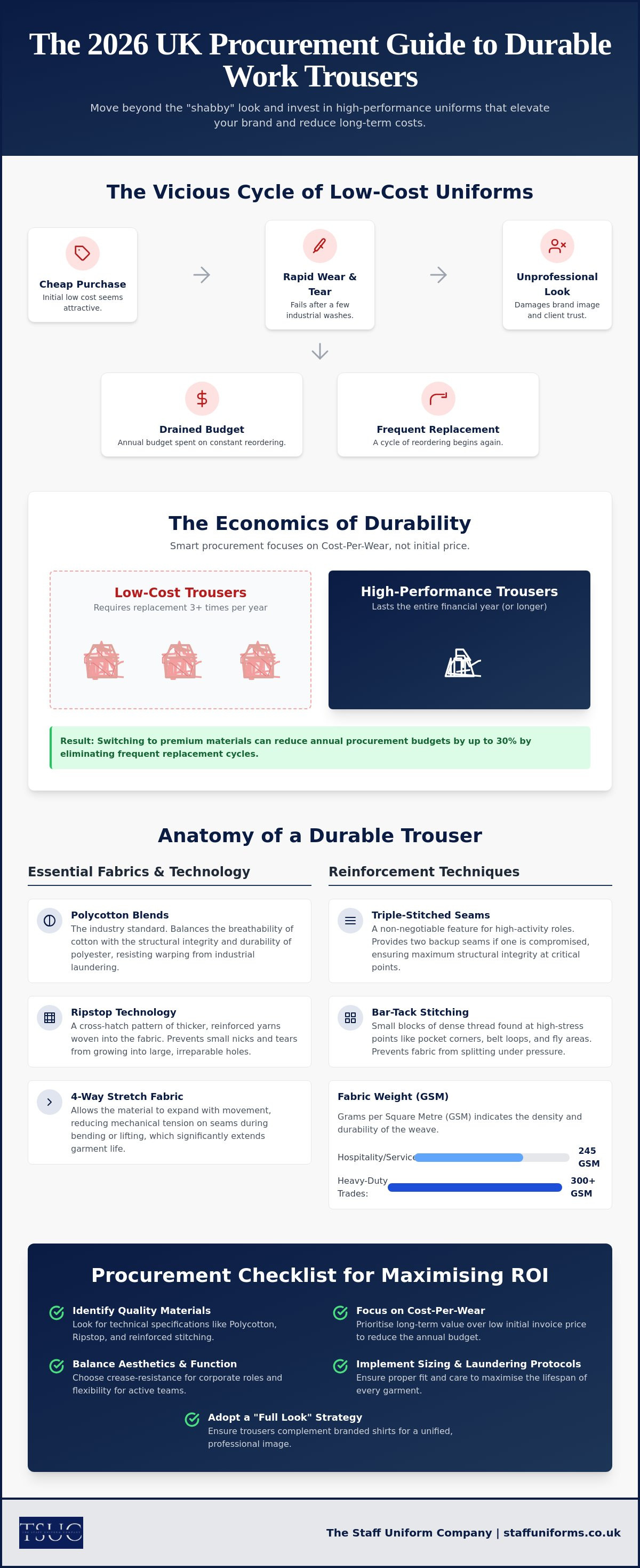
Smart procurement managers look at the cost-per-wear rather than the invoice price. A low-cost trouser often requires replacement three times within a single financial year. By contrast, high-performance garments use triple-stitched seams and bar-tack reinforcements to extend their lifespan significantly. Some industry specialists suggest that switching to premium-grade materials can reduce annual procurement budgets by up to 30% by cutting the frequency of replacement cycles. This longevity also supports sustainability goals by reducing textile waste in the supply chain. It's a strategic move that aligns financial efficiency with environmental responsibility.
Staff Morale and the Psychology of Quality
The quality of a uniform directly impacts how your team performs. Well-fitted, durable work trousers for staff provide the physical comfort necessary for long shifts in technical or service roles. If a garment is restrictive or fits poorly, staff feel hindered and undervalued. This often leads to higher turnover rates. A "one-size-fits-all" approach typically compromises durability because the fabric is stretched beyond its intended limit. Investing in ergonomic designs and accurate sizing ensures the garment lasts longer while boosting employee pride. When your team looks professional, they act professional. High-quality standards improve internal morale and enhance external perceptions of the business simultaneously.
Essential Fabrics and Reinforcements for Long-Lasting Workwear
Procuring durable work trousers for staff requires an understanding of textile engineering. You aren't just buying clothes; you're investing in equipment. Polycotton blends remain the industry standard because they balance breathability with structural integrity. This fabric doesn't just feel better; it resists the warping and thinning that often plagues 100% cotton garments after repeated commercial laundering.
Ripstop technology is another critical feature for high-performance environments. It uses a cross-hatch pattern of thicker yarns to prevent small nicks from becoming gaping holes. For roles involving frequent bending or lifting, technical 4-way stretch fabrics offer a strategic advantage. By allowing the material to expand during movement, these fabrics reduce the mechanical tension on seams, which significantly extends the life of the garment. Weight matters too. Grams per Square Metre (GSM) indicates the density of the weave. While 300 GSM is standard for heavy-duty trades, a 245 GSM weight is often ideal for hospitality or service environments where staff need agility without sacrificing strength. When you select high-quality Workwear Trousers & Cargo Pants, these technical specifications determine whether your investment lasts six months or two years.
Reinforcement Techniques That Matter
Triple-stitched seams are non-negotiable for high-activity roles. They provide a secondary and tertiary fail-safe if one thread is compromised. Bar-tack stitching, those small blocks of dense thread at pocket corners and fly areas, prevents the fabric from splitting under pressure. If your team works in manual sectors, look for reinforced hems and knee pad pockets. These additions protect the areas most prone to abrasion, ensuring the trousers don't wear through before the rest of the uniform.
Colour Fastness and Industrial Laundering
A uniform that fades quickly looks unprofessional and old. Reactive dyes are essential for maintaining a deep, consistent colour after 50 or more industrial wash cycles. These dyes bond chemically with the fibres rather than just sitting on the surface. To ensure fabric stability, look for pre-shrunk or stabilised materials that won't warp in commercial dryers. Martindale rub test scores are the ultimate metric for fabric abrasion resistance because they provide an objective, laboratory-verified measurement of how many cycles of friction a material can endure before the fibres fail.
Choosing the Right Trousers for Your Specific Industry
Selecting durable work trousers for staff requires a nuanced approach that accounts for the physical demands of different roles. A logistics manager needs utility and visibility, while a front-of-house host requires elegance and movement. One size does not fit all industries. In healthcare, for example, the priority is hygiene and thermal stability. Trousers must be composed of easy-care fabrics that withstand high-temperature industrial washes to ensure disinfection. These garments must remain structurally sound even after repeated exposure to commercial cleaning agents, ensuring they don't lose their shape or fit over time.
In logistics and warehouse environments, functionality is the primary driver. Workers need strategically placed cargo pockets to store scanners and tools, alongside high-visibility accents for safety in high-traffic zones. These environments are physically abrasive. Trousers in this sector require reinforced hems to prevent fraying when rubbing against heavy safety boots. By selecting industry-specific designs, you ensure the garment supports the worker's specific tasks. This reduces the likelihood of fabric failure caused by improper use, such as overstuffing pockets not designed for weight or tools. It's about matching the tool to the job.
Hospitality vs. Corporate: A Style Comparison
Many hospitality workwear suppliers now recommend slim-fit stretch trousers for front-of-house teams. These offer a tailored appearance that matches a high-end boutique aesthetic while providing the 4-way stretch flexibility needed for fast-paced service. In contrast, corporate environments are moving away from the restrictive nature of traditional corporate suits toward more versatile, durable chinos. These chinos maintain a sharp, crease-resistant silhouette but offer better longevity for staff who move between desks, travel, and client meetings. They bridge the gap between formal presentation and practical daily wear.
Industrial Utility: Cargo Pants and Safety
In technical and manual sectors, multi-pocket functionality is essential. Holster pockets are particularly useful for trades that require immediate access to fixings, though they can be bulky for general warehouse work. Integrating safety features is also critical. Your choice of durable work trousers for staff should complement existing hi-vis vests or waterproof jackets to create a unified safety system. Always ensure the trousers meet specific UK standards, such as EN ISO 13688:2013 for general protective clothing. This maintains workplace compliance and protects your workforce while ensuring the garments don't fail under the pressure of industrial use.
In heavy industrial environments like oil and gas or power generation, where technical reliability is a core requirement, partnering with experts such as OG VALVES LTD. ensures that hardware meets the same rigorous standards as the durable workwear protecting your staff.
The Procurement Checklist: Maximising Uniform Lifespan and ROI
Procurement doesn't end when the delivery arrives at your facility. To achieve a genuine return on investment, you must manage the entire lifecycle of your durable work trousers for staff. Even the highest-quality technical fabrics fail if they're poorly fitted or incorrectly maintained. A structured approach to garment management ensures your team stays professional while your annual replacement costs remain low. It's a strategic process that moves from initial sizing to long-term inventory control.
Regular inspections are a vital part of this cycle. By identifying early signs of wear, such as a loose thread or a thinning knee panel, you can address issues before they lead to total garment failure. Establishing a rolling stock of custom staff uniforms UK is also essential. This ensures that when a pair of trousers finally reaches the end of its functional life, a replacement is immediately available. It prevents staff from wearing "shabby" or damaged gear while waiting for a new procurement cycle, which protects your brand's visual standards. If you're ready to upgrade your team's gear, you can view our range of Workwear Trousers & Cargo Pants to find the right fit for your sector.
Implementing a Staff Sizing Programme
Fit is a primary driver of durability. Ill-fitting trousers often wear out twice as fast at the inner thigh and hem due to unnecessary friction and dragging. To prevent this, implement a professional sizing programme using physical size sets and fit-guides. Don't rely on staff self-reporting their sizes; measurements should be verified to ensure accuracy. It's also critical to offer specific male and female cuts. Trousers designed for the correct anatomy reduce stress on seams and fabric, significantly extending the life of the uniform while improving employee comfort during long shifts.
Washing for Longevity
Industrial laundering is necessary for hygiene, but it can be abrasive. Establishing clear washing guidelines for your staff is the easiest way to preserve fabric integrity. For most polycotton blends, 40°C is the "sweet spot" that removes dirt without degrading the synthetic fibres. Avoid using bleach or harsh chemical softeners, as these break down the reactive dyes and weaken the material over time. When it comes to drying, air drying is the best option for longevity. If you must use machinery, a low-heat tumble dry helps maintain a crease-free finish without causing the fabric to shrink or warp.
Elevating the Team: Pairing Durable Trousers with Professional Hospitality Tops
A uniform isn't complete until every element works together. While durable work trousers for staff provide the necessary protection and longevity for the lower body, the upper garment carries your brand's primary visual weight. This "Full Look" strategy ensures your team projects a unified, high-end identity. It moves the conversation from functional equipment to a comprehensive tool for business success. When the top and bottom half of a uniform are perfectly aligned, it creates a visual impact that reassures clients of your company's expertise and attention to detail.
Consistency is key for professional pride. Matching trouser colours with branded hospitality shirts creates a cohesive aesthetic that defines your corporate identity. Integrating high-quality logo embroidery on the chest or sleeve adds a final layer of sophistication. This attention to detail improves internal morale; staff feel like part of a dedicated team rather than just employees in generic gear. High-quality standards in your attire improve external perceptions and build immediate trust with your customer base. It's about creating a professional silhouette that remains sharp throughout a demanding shift.
Standout Hospitality Pairings
- The Classic Pique Polo: This is a versatile, durable option for casual dining and hotel staff. The dense knit holds its shape after repeated wear and provides a traditional yet approachable look.
- Modern T-Shirts: Sustainable cotton blends offer a relaxed yet professional vibe. These are ideal for modern cafes or technical service roles where agility is the priority.
- Slim-Fit Hospitality Polos: These are specifically designed to match our stretch durable work trousers for staff. They create a contemporary, streamlined silhouette that moves with the wearer without bunching or pulling.
Completing Your Procurement
Efficiency in procurement often comes down to consolidation. Choosing a single supplier for both trousers and tops ensures colour consistency across your entire team. Different manufacturers use different dye lots; sourcing everything from one place prevents the "mismatched" look that occurs when blacks or navies don't quite align. Bulk ordering your hospitality staff uniforms also simplifies your logistics and ensures you have enough rolling stock for new starters or replacements. We manage the entire lifecycle from initial concept to final delivery, ensuring your corporate identity is handled with expertise and care.
Browse our full range of Hospitality T-Shirts & Polos to complete your team uniform
Strategic Procurement for Long-Term Success
Selecting the right durable work trousers for staff is a strategic decision that impacts your bottom line and your brand's reputation. By prioritising technical fabrics like Ripstop and implementing a rigorous sizing programme, you eliminate the hidden costs of frequent replacements. A well-maintained uniform doesn't just look professional; it serves as a vital tool that boosts employee morale and ensures workplace safety across your entire organisation. Consistency in your attire reinforces your expertise at every client touchpoint.
As a specialist UK supplier since 2017, we understand the specific functional requirements of the healthcare, hospitality, and corporate sectors. Our garments feature durable fabrics designed to withstand 50+ industrial wash cycles while maintaining their colour and structural integrity. Trusted by businesses nationwide, we manage the entire lifecycle of your uniform to ensure quality and consistency. It's time to move beyond transactional purchasing and embrace a partnership that values excellence.
Explore the Hospitality T-Shirts & Polos Collection to create a cohesive, high-performance look for your team today. Investing in quality now ensures your workforce remains comfortable and your corporate identity stays sharp for years to come.
Frequently Asked Questions
How many pairs of work trousers should I provide per staff member?
You should ideally provide three pairs of trousers per full-time employee. This "rule of three" allows for one pair to be worn, one to be in the wash, and one to be clean and ready for the next shift. Providing fewer pairs often leads to accelerated fabric fatigue because the garments are washed too frequently and don't have time for the fibres to recover between wears.
What is the most durable fabric for work trousers in a hospitality setting?
A high-quality polycotton blend with a weight of approximately 245 GSM is the most reliable choice for hospitality. This fabric combines the natural breathability of cotton with the structural strength and colour retention of polyester. It resists pilling and fading much better than 100% cotton, ensuring your team looks sharp even after months of fast-paced service and repeated laundering.
Do stretch work trousers last as long as traditional heavy-duty cargo pants?
Modern technical stretch fabrics often outlast traditional rigid materials in active roles. Because the material moves with the wearer, it significantly reduces the mechanical stress placed on critical seams like the crotch and seat. While thickness is important, the flexibility in durable work trousers for staff prevents the sudden tearing caused by fabric tension during bending or squatting.
How do I ensure my staff uniforms remain professional after many industrial washes?
Select garments treated with reactive dyes and follow a consistent 40°C washing protocol. Reactive dyes bond chemically to the fibres, which prevents the "greyed out" appearance common in cheaper alternatives. You should also avoid bleach and harsh softeners that degrade synthetic fibres. Using pre-shrunk fabrics ensures the trousers maintain their original silhouette and fit without warping in commercial dryers.
Are cargo pants appropriate for a front-of-house hospitality role?
Slim-fit cargo pants are an excellent choice for modern, casual dining or gastropub environments. they provide a practical solution for staff who need to carry payment terminals or order pads without the bulk of traditional trade trousers. For more formal boutique settings, however, a durable chino or a tailored stretch trouser is usually preferred to maintain a more refined and high-end brand image.
How do I choose the correct trouser sizing for a diverse team?
Implement a sizing programme using physical size sets rather than relying on self-reported measurements. Every manufacturer's fit varies slightly, so allowing staff to try on samples is the only way to guarantee an accurate fit. It's also essential to offer specific male and female cuts. Trousers designed for the correct anatomy sit better on the body, which prevents premature wear at the hems and thighs.
What are the benefits of polycotton over 100% cotton for durability?
Polycotton is far more resistant to abrasion, shrinking, and creasing than pure cotton. The polyester component acts as a durable "skeleton" that helps the garment maintain its shape through harsh industrial laundry cycles. While 100% cotton offers high breathability, it tends to thin and tear much faster under physical stress. Polycotton provides the best balance of long-term structural integrity and daily comfort.
Can I get my company logo embroidered on workwear trousers?
Yes, embroidery is a highly durable way to reinforce your corporate identity on workwear. It's typically positioned on the pocket flap or the upper thigh where it remains visible but doesn't hinder movement. Embroidery is superior to heat-transfer printing for trousers because it can withstand high-temperature washes and constant friction without peeling or cracking over time.