
A single ill-fitting garment on a front-of-house staff member can diminish your brand value more than a poor marketing campaign. You likely understand that a unified team appearance builds immediate trust, but the reality of managing formal shirts for a growing workforce often involves fighting fabric degradation and inconsistent sizing. It's exhausting to watch high-investment clothing lose its crisp finish after only 15 industrial laundry cycles, leaving your team looking dishevelled and unprofessional. Recent industry data indicates that businesses lose thousands of pounds annually simply by replacing garments that couldn't withstand the rigours of daily wear.
We're here to help you solve these procurement challenges for good. This 2026 guide will help you master the art of selecting professional garments that balance premium corporate aesthetics with the rugged durability required for the UK's demanding work environments. We'll explore the latest fabric innovations that reduce ironing time, sizing strategies that eliminate staff complaints, and specific ways to improve staff pride through better-fitting workwear that actually lasts. By the end of this article, you'll have a clear roadmap for building a cohesive, high-performance uniform policy.
Key Takeaways
- Understand how premium attire acts as a strategic tool for corporate branding while significantly boosting staff morale and professional pride.
- Master the technical nuances of fabric weaves and material blends to procure formal shirts that balance high-end aesthetics with long-term durability.
- Learn how to standardise your professional image across a diverse workforce by selecting the optimal silhouettes for a consistent, universal fit.
- Discover procurement strategies to maximise garment longevity and ensure your workwear investment survives 50+ industrial wash cycles.
- Explore precision customisation techniques, from chest to cuff embroidery, to effectively position your brand and elevate your team’s visual identity.
The Strategic Role of Formal Shirts in Corporate Branding
Formal shirts represent more than just a dress code requirement; they're the visual foundation of your company's identity. In 2026, we're seeing a decisive shift away from the ultra-casual office culture that peaked in 2022. Recent industry data shows that 68% of UK client-facing businesses have reinstated stricter dress protocols to restore professional boundaries and project stability in a volatile market.
Investing in high-quality attire addresses the human element of your workforce. When an employee puts on a well-fitted shirt, their self-perception shifts. This isn't just theory. A 2024 study on enclothed cognition found that staff wearing professional garments performed task-based roles with 14% higher accuracy than those in casual wear. Understanding the history of the dress shirt reveals its evolution from a functional undergarment to a symbol of status and competence that clients still respect today.
First Impressions and Brand Consistency
Visual details matter in high-stakes environments. A crisp collar and well-pressed fabric signal an attention to detail that clients equate with your service quality. For national workforces, precise colour matching ensures a unified front from London to Edinburgh, reinforcing brand recognition at every touchpoint. Corporate attire serves as a silent non-verbal communication tool that establishes authority and professionalism before a single word is spoken.
The Psychology of the Uniform
Providing formal shirts as part of a curated kit reduces decision fatigue for your team. By removing the daily burden of choosing an outfit, you allow staff to focus their mental energy on high-value tasks. This approach transforms the garment into a badge of professional pride rather than just a requirement. It fosters a sense of belonging that is often lost in fragmented, hybrid work environments.
- Consistent branding builds immediate customer trust by signalling reliability.
- Standardised kits eliminate socioeconomic pressure among staff members.
- Durable, high-quality formal shirts ensure longevity, which protects your procurement budget over a 24-month cycle.
The move back to structured professionalism in 2026 reflects a desire for clarity. Your staff aren't just employees; they're brand ambassadors. Providing them with the right tools, starting with their attire, is a strategic business decision that pays dividends in both morale and client perception. It's about ensuring that every member of the team feels equipped to represent the business at the highest level.
Material Science: Choosing the Right Weaves and Fabrics
Selecting the right fabric isn't just about aesthetics; it's a technical decision that impacts your bottom line. In 2026, fabric performance is measured by its ability to maintain a crisp look through a 10-hour shift. High-quality formal shirts must balance breathability with structural integrity. Research indicates that the impact of professional attire extends beyond first impressions, influencing employee focus and psychological readiness for the workday.
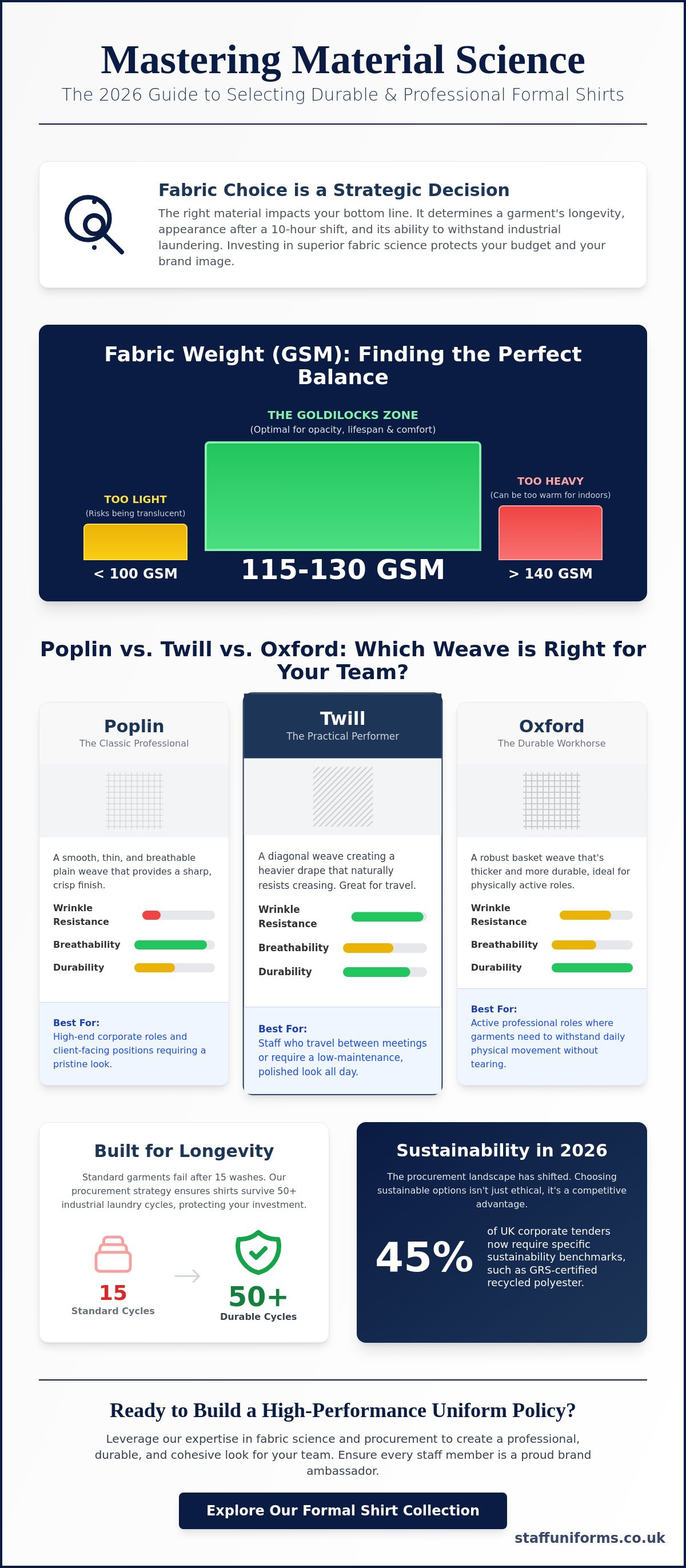
Fabric weight, measured in Grams per Square Metre (GSM), dictates both opacity and lifespan. For corporate environments, a GSM between 115 and 130 is the "Goldilocks" zone. Anything below 100 GSM risks being translucent, especially in white fabrics, while anything over 140 GSM may feel too heavy for heated office spaces. Durable procurement focuses on this middle ground to ensure garments survive the 50-wash cycle standard without losing their shape.
Poplin, Twill, and Oxford: Which is Best for Your Team?
Poplin is the classic choice for high-end corporate roles. It's a plain weave that's thin, breathable, and smooth to the touch. While it provides a sharp finish, it's prone to wrinkling. Twill is the practical alternative. Its diagonal weave creates a heavier drape that naturally resists creasing, making it ideal for staff who travel between meetings. Oxford is the workhorse of the group. With its robust basket weave, it's thicker and more durable, suiting active professional roles where the shirt needs to withstand physical movement without tearing.
Sustainability and Performance in 2026
The procurement landscape has shifted. By 2026, over 45% of UK corporate tenders require specific sustainability benchmarks. We're seeing a massive move toward GRS-certified recycled polyester and organic cotton blends. These "poly-cotton" mixes are often superior for uniforms because they combine the breathability of cotton with the colour-fastness and strength of polyester. They don't shrink, they dry faster, and they require less energy to launder.
Modern "Non-Iron" technology has also evolved. Unlike the stiff, chemical-heavy versions of the past, 2026 garments use vapour-phase technology to alter the molecular structure of the cotton. This keeps the shirt smooth without sacrificing the soft hand-feel. When sourcing, always look for the OEKO-TEX Standard 100 certification. It guarantees that no harmful substances were used during the dyeing or finishing processes, ensuring staff safety and skin comfort. If you need to see how these fabrics perform in person, you can request a sample pack to compare the weaves yourself.
- Moisture-wicking: Essential for front-of-house staff in high-pressure environments.
- Easy-Iron: A cost-effective alternative to non-iron that still reduces maintenance time.
- High-Twist Yarns: Used in premium shirts to increase durability and reduce pilling.
Fit and Silhouette: Standardising Style for a Diverse Workforce
Achieving a cohesive corporate identity across a national team requires more than just selecting a brand colour. It demands a strategy for varied body types. Providing a single "standard" cut often leads to a significant portion of staff feeling uncomfortable or appearing untidy. To solve this, procurement managers in 2026 are increasingly moving toward "fit families" that offer consistency in fabric and colour while allowing for silhouette variations.
Understanding the nuances between fits is essential for a polished look. Slim fit options provide a contemporary, streamlined silhouette that reduces excess fabric; they're ideal for staff in modern office environments. Tailored fits serve as the versatile middle ground, offering a tapered waist that suits approximately 70% of the UK workforce without being restrictive. Classic fits remain a staple for comfort, providing extra room in the chest and arms for maximum range of motion throughout a ten-hour shift.
Gender-specific tailoring is a non-negotiable factor for professional comfort. Women’s formal shirts are designed with specific darting and adjusted button spacing to eliminate the "gape" at the chest, a common issue with unisex garments. When staff feel the garment is designed for their body, morale improves and the brand is represented with greater confidence.
Finding the Right Fit for Every Body Type
Precision in bulk ordering starts with a comprehensive size guide. We recommend using a digital sizing tool or physical fit sets to reduce return rates by up to 25%. Modern formal shirts often incorporate 2% to 3% elastane. This small addition of stretch fabric significantly impacts staff mobility, especially for roles that involve reaching or repetitive movement. Ensuring your shirts accommodate different physiques is just as vital as choosing the right business suit for your team to create a complete, professional aesthetic.
Collar and Cuff Details That Matter
Small details dictate the level of formality and brand alignment. The choice of collar should reflect your corporate logo and tie policy. Spread collars are the standard for 2026, accommodating larger tie knots and framing the face well. Point collars offer a more traditional, vertical look that suits narrower ties or open-collar styles. For cuffs, practicality usually wins in the workplace:
- Single Adjustable Cuffs: These feature two buttons, allowing staff to adjust the tightness based on their wrist size or watch thickness.
- Double (French) Cuffs: These are reserved for executive-level representation or high-end hospitality roles. They require cufflinks, which can be branded to add an extra layer of corporate identity.
- Mitred Cuffs: A squared-off corner on the cuff provides a sharper, more technical appearance than rounded versions.
By offering a choice in silhouette while maintaining strict fabric standards, businesses ensure every employee looks like part of the same team, regardless of their individual build.
Procurement and Maintenance: Maximising Garment Longevity
Longevity isn't an accident; it's a deliberate procurement strategy. High-quality formal shirts must survive the rigours of professional life without losing their structural integrity or professional finish. Procurement managers often face the trap of lower upfront costs, but a 24-month lifecycle analysis proves that durability is the only true way to protect your budget.
Durability in the Industrial Wash Cycle
The 50-wash benchmark is the standard for industrial durability in the UK workwear market. To meet this, we focus on technical construction details that cheap alternatives ignore. Look for reinforced seams with high stitch counts and buttons secured with a cross-stitch pattern; these features prevent fraying and loss during high-heat cycles. Colour fastness is equally vital to prevent the "grey-out" effect that often ruins white shirts after just three months of use. This level of durability should extend across your entire team, so consider pairing your tops with the best workwear trousers for durability to ensure a consistent lifespan for the whole uniform.
Managing a National Uniform Rollout
Scaling a uniform programme across multiple UK sites requires precision and a reliable partner. An all-in-one supplier manages everything from initial design to final mile delivery, which removes the administrative burden from your internal teams. We recommend implementing a "wardrobe" system. By providing each staff member with five formal shirts, you create a rotation that reduces the laundering frequency for each individual garment. This simple logistical shift can increase the fabric's lifespan by up to 35% over a two-year period.
Before committing to a full rollout of 500 or more units, always request "wash-test" samples. Put these samples through your specific industrial laundry process 20 times. This allows you to observe shrinkage rates and fabric pilling before the capital is spent. A shirt that costs £25 and lasts two years is significantly more cost-effective than a £12 shirt that requires replacement every six months. To ensure these standards are met, provide your staff with clear care instructions. We provide laminated guides that explain why avoiding fabric softeners preserves moisture-wicking properties and keeps the brand image sharp.
Ready to upgrade your team's professional image with garments built to last? View our durable formal range
Customisation: Elevating Formal Shirts with Professional Branding
Customisation transforms formal shirts from simple garments into powerful assets for brand recognition. A well-executed logo acts as a silent ambassador for your business; it builds immediate trust with clients and fosters a sense of unity among your team. Research indicates that 92% of UK consumers perceive companies with branded uniforms as more professional and reliable than those without. At The Staff Uniform Company, we treat customisation as a precision task rather than an afterthought.
Positioning your brand is a strategic decision. The left chest remains the most popular choice, used by approximately 85% of our corporate clients for its high visibility during handshakes and meetings. For firms seeking a contemporary or premium edge, cuff embroidery offers a subtle, high-end touch that's visible when writing or presenting. Collar embroidery is another modern alternative, often selected by tech firms and creative agencies to stand out in a crowded market. We use high-tensile polyester threads that provide 100% colour fastness, ensuring your logo stays vibrant through every wash.
Selecting the right thread colours is vital for maintaining brand integrity. We don't guess your colours; we match them. By aligning our thread library with your specific Pantone references, we ensure your corporate palette is replicated exactly across every garment. Our bespoke branding process is designed to be effortless for procurement managers. We handle the technical digitisation of your artwork, provide digital proofs for approval, and manage the entire production line in-house to maintain strict quality control.
Embroidery vs. Print for Formal Attire
Embroidery is the gold standard for formal corporate wear. Unlike screen printing, which can crack or peel on fine cotton blends, embroidery offers a durable, three-dimensional finish that lasts the lifetime of the shirt. We use specialised stabilisers during the process to protect the fabric's integrity; this prevents the puckering often seen in lower-quality work. This attention to detail ensures your formal shirts retain their crisp, professional shape. For a deeper look at branding methods, read our guide on custom staff uniforms UK.
Next Steps for Your Corporate Identity
We provide a comprehensive all-in-one service that covers everything from initial design consultation to national delivery across the UK. Our goal is to make the procurement process as transparent and efficient as possible for busy professionals. Whether you're a small boutique firm or a national corporation, we've got the capacity to scale with your needs. Our team is ready to help you select the perfect fabric and branding combination to reflect your professional pride. Explore our range of formal shirts and blouses to begin your brand transformation.
Future-Proof Your Corporate Identity
Selecting the right technical weaves and precision branding isn't just about aesthetics; it's a strategic investment in your team's professional pride. By prioritising garment longevity and smart procurement, you reduce long-term replacement costs and ensure your workforce remains comfortable throughout the day. High-quality formal shirts serve as a vital tool for business success, bridging the gap between functional workwear and a powerful brand message. Staff Uniforms has been a trusted partner for UK businesses since 2017, providing the expertise needed to manage complex uniform requirements with ease.
We're specialists in high-definition logo embroidery and bespoke branding that stands the test of time. Our service includes expert procurement support and reliable national delivery, ensuring your order arrives exactly when it's needed. We've streamlined the entire process from initial design to final delivery so you don't have to worry about the logistics. It's time to equip your team with a uniform that reflects the excellence of your business.
View our range of professional formal shirts and blousesFrequently Asked Questions
What is the most durable fabric for a formal work shirt?
A polyester-cotton blend is the most durable fabric for formal shirts in a high-intensity work environment. These blends combine the breathability of cotton with the hard-wearing resilience of polyester. This specific ratio ensures the garment maintains its structural integrity for over 50 wash cycles. It resists pilling and abrasion better than 100% cotton alternatives. Choosing a high-denier weave further extends the lifespan of your team's professional wardrobe.
How many formal shirts should I provide for each staff member?
We recommend providing five shirts for every full-time staff member. This allocation allows for a fresh garment each working day and reduces the frequency of domestic laundering. Providing a full week's rotation prevents premature wear and tear on individual items. For part-time employees working three days, a minimum of three shirts ensures they always have a crisp, professional appearance without rushing mid-week laundry tasks.
What is the difference between an "Easy-Iron" and a "Non-Iron" shirt?
Easy-Iron shirts require a light press after laundering to achieve a crisp finish. In contrast, Non-Iron shirts undergo a specific chemical treatment that prevents fabric creasing during the wash and dry cycle. This treatment creates a permanent bond within the fibres. While Non-Iron options save significant time for employees, Easy-Iron fabrics often feel slightly softer against the skin. Both choices help maintain a sharp corporate image throughout long shifts.
Can I get my company logo embroidered on formal shirts?
You can certainly have your company logo embroidered on formal shirts to enhance brand recognition. Embroidery provides a three-dimensional, premium finish that lasts the entire life of the garment. We typically position logos on the left chest or collar for maximum visibility. Our precision machinery ensures that 100% of your brand's colour palette is matched using high-quality threads. This creates a cohesive, professional look that builds trust with your clients.
Should I choose slim fit or classic fit for my team?
Offering a mix of both slim fit and classic fit is the best approach for a diverse workforce. Approximately 60% of modern professionals prefer a tailored or slim fit for a contemporary silhouette. However, classic fit remains essential for staff who require a fuller cut or greater range of motion. Providing choice ensures every team member feels comfortable and confident. This boost in morale directly impacts their daily performance.
How do I ensure a consistent look across a diverse workforce?
Achieving a consistent look requires selecting a unified colour palette and standardising your branding across different garment styles. You should choose a core fabric and colour that's available in men's, women's, and various fit options. This ensures that 100% of your team looks coordinated regardless of their individual size or style preference. Maintaining identical embroidery placement across all garments reinforces your brand's attention to detail and professional standards.
Are 100% cotton shirts suitable for industrial laundering?
100% cotton shirts aren't suitable for industrial laundering processes. High-temperature commercial washes can cause natural fibres to shrink by up to 5% after the first cycle. These environments also lead to heavy creasing that's difficult to remove without professional pressing. For businesses using industrial laundry services, we recommend synthetic blends. These fabrics withstand temperatures of 60 degrees Celsius while maintaining their shape and colour for much longer periods.
What is the best collar style for a corporate uniform?
The semi-cutaway collar is the most effective choice for a corporate uniform due to its extreme versatility. It looks professional when worn with a tie and maintains its structure when worn open-necked. This style accommodates 90% of tie knot sizes, from a four-in-hand to a half-Windsor. Choosing a fused collar ensures the points stay sharp throughout the day. It's a reliable option that suits almost every face shape in your workforce.