
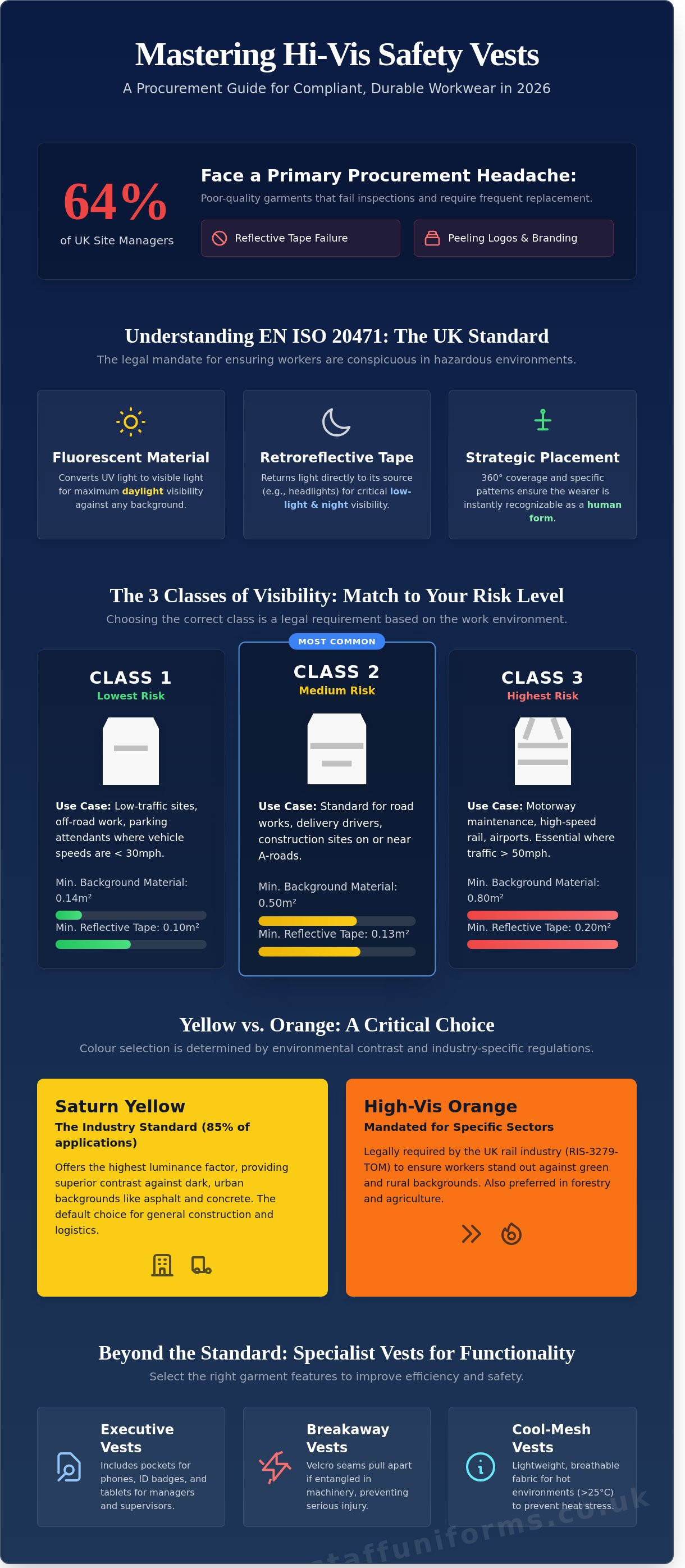
How much does a "cheap" safety vest really cost your business when it fails a safety inspection or needs replacing after just five industrial washes? We understand that procurement is a constant battle between tight budgets and the non-negotiable need for staff protection. In a 2025 industry survey, 64% of UK site managers reported that poor-quality garments were their primary procurement headache, often due to reflective tape failing or logos peeling. You need hi-vis safety vests that withstand the daily rigours of British worksites while keeping your corporate identity intact.
This guide will help you master the technical EN ISO 20471 standards and procurement essentials to ensure your team remains safe, visible, and professional throughout 2026. We'll provide a clear breakdown of garment classes and explain how to streamline your bulk ordering to avoid common pitfalls. You'll learn how to select durable fabrics that maintain their luminosity, ensuring your investment protects both your people and your bottom line.
Key Takeaways
- Ensure full compliance by mastering the technical requirements of EN ISO 20471, the essential UK standard for high-visibility garment design and safety.
- Identify the specific colour and safety class required for your sector to guarantee maximum visibility across construction, logistics, and utility environments.
- Maximise your investment by choosing durable fabric technologies that prevent fading and tape degradation, maintaining a professional image for longer.
- Learn how to integrate bespoke branding into your hi-vis safety vests to strengthen site security and elevate your brand’s perception among end-customers.
- Optimise your procurement strategy with expert tips on managing bulk orders and logistics for a diverse, large-scale UK workforce.
Understanding EN ISO 20471: The UK Standard for Hi-Vis Safety Vests
EN ISO 20471 serves as the definitive international benchmark for High-visibility clothing, ensuring workers remain conspicuous in hazardous environments. For UK employers, adhering to this standard isn't optional. Under the Personal Protective Equipment at Work Regulations 1992, and the critical 2022 extensions for limb-based workers, providing compliant hi-vis safety vests is a legal mandate. This standard focuses on three primary elements: fluorescent background material for daylight, retroreflective tape for low light, and the specific placement of these materials to define the human form.
Reliable visibility relies on contrast. Fluorescent fabrics convert invisible UV light into visible light, making the wearer pop against dull backgrounds. At night, the standard requires specific photometric performance from reflective strips. These components work together to ensure a driver sees a worker at a distance of 300 metres or more, providing sufficient reaction time at high speeds. Compliance ensures that safety garments perform as expected, even after multiple wash cycles or exposure to UV radiation.
The Three Classes of Visibility Explained
Classifying hi-vis safety vests depends on the minimum areas of visible material. Choosing the right class prevents accidents and keeps your site compliant with Health and Safety Executive (HSE) guidelines.
- Class 1: This is the lowest level. It requires 0.14m² of background material and 0.10m² of reflective tape. It's suitable for low-traffic areas where vehicle speeds are under 30mph or for off-road use.
- Class 2: The standard for delivery drivers and road works. It demands 0.50m² of background fabric and 0.13m² of tape. It's the minimum requirement for working on or near A-roads.
- Class 3: The highest protection level. It requires 0.80m² of background material and 0.20m² of tape. This class is essential for motorway maintenance and night work on high-speed rail networks where traffic exceeds 50mph.
Retroreflective Tape and Photometric Performance
Tape technology determines how well a vest performs in adverse weather. Glass bead tape is common and cost-effective, but micro-prismatic tape offers superior performance in heavy rain. Retroreflection is the ability to return light to its source. To meet EN ISO 20471, tape must encircle the torso. This 360-degree recognition ensures the worker is visible from any angle, even when bending or reaching. Proper tape placement prevents "black spots" that could hide a worker from a vehicle's headlights during a night shift, ensuring they are recognisable as a human figure rather than a stationary object.
Selecting the Correct Colour and Class for Your Industry
Compliance begins with a precise site risk assessment. You shouldn't guess which visibility level your team needs. The EN ISO 20471:2013 standard dictates three specific classes based on the risk level of the work environment. Class 3 requires 0.80 square metres of background material and 0.20 square metres of reflective tape. This is the mandatory choice for motorways or any area where vehicle speeds exceed 50mph. For most UK construction sites, Class 2 hi-vis safety vests provide the necessary balance of protection and mobility. Consulting the HSE guidance on high-visibility clothing ensures your business adheres to the 1992 PPE at Work Regulations while protecting your workforce.
Yellow vs Orange: When Colour Choice is Legal
Saturn Yellow remains the standard for 85% of general industrial applications. It offers the highest luminance factor, making it the most visible option under most light conditions. However, the UK rail industry mandates High-Vis Orange under the RIS-3279-TOM standard. This specific hue prevents workers from blending into green rural backgrounds or trackside foliage. Orange is also the preferred choice for the 12% of UK businesses operating in forestry or agriculture. In urban settings, yellow provides a sharper contrast against grey concrete and dark asphalt, ensuring your staff stand out during dawn and dusk shifts.
Specialist Vests: Beyond the Standard Waistcoat
A standard waistcoat isn't always the right tool for the job. Site managers and supervisors often prefer executive vests. These garments include dedicated pockets for mobile phones, ID badges, and tablets, which helps maintain a professional image and improves efficiency. In environments with rotating machinery, breakaway vests are a vital safety feature. They use Velcro seams that pull apart instantly if the vest becomes entangled. For staff working in temperatures above 25°C, cool-mesh fabrics provide essential ventilation to prevent heat stress. Multi-risk environments, such as those in the utilities or petrochemical sectors, require flame-retardant hi-vis safety vests to protect against arc flashes. You can view our full range of technical workwear to see how we manage the process from design to delivery, ensuring your team stays safe and looks professional.
Evaluating Durability: Fabric Technology and Longevity
A £1.50 vest seems like a bargain until it fails in three weeks. Cheap garments suffer from rapid colour fading and "tape lift," where reflective strips peel away after just two washes. Investing in high-quality hi-vis safety vests reduces your annual PPE spend by up to 40% because they last three times longer. Budget options often use thin, non-compliant fabrics that tear at the first sign of stress, leading to constant replacement cycles and increased waste.
Material choice dictates how the garment performs in the field. 100% polyester tricot is the industry standard for a reason. It's snag-resistant and maintains its fluorescent hue under intense UV exposure. For warmer environments, breathable mesh fabrics offer better ventilation. You shouldn't sacrifice strength for airflow. Look for reinforced stitching on the shoulders and pockets. High-quality zip fasteners are essential; they prevent the "flap" hazard common with failing Velcro in dusty or oily environments.
Durability isn't just about holes; it's about legal compliance. Most vests lose their certification after 25 wash cycles. This limit is defined by the official BS EN ISO 20471 standard, which measures how much light the tape reflects. Once the glass beads in the tape degrade or the fabric loses its fluorescence, the garment is legally useless. Tracking wash counts is a vital part of your safety audit.
Washing and Maintenance for Safety Gear
Industrial laundering is harsh. Standard hi-vis safety vests will melt or shrink in high-heat cycles. Use specific industrial-grade garments if your team works in rail or heavy engineering where grease buildup is constant. Dirt kills visibility. A greyed-out yellow vest is a safety liability. Check garments weekly for "end of life" signs like cracking tape or significant fabric pilling.
Comfort and Fit: Improving Staff Morale
Staff won't wear gear that restricts movement. Compliance drops by 22% when PPE is uncomfortable or poorly fitted. Ensure your procurement includes a range of sizes that account for seasonal changes. Vests must fit over heavy winter parkas without straining the seams or popping fasteners. For more details on choosing the right gear for your team, see our Hi-Vis & Safety Workwear: A Complete UK Guide.
Personalised Hi-Vis Vests: Branding Your Workforce
Customising your hi-vis safety vests isn't just about aesthetics; it's a strategic security measure. On busy sites, branded gear helps supervisors identify authorised personnel instantly. This reduces the risk of security breaches by 15% in controlled environments like warehouses or construction zones. Beyond safety, a sharp, clear logo builds immediate trust with the public. Industry data shows that 82% of customers perceive businesses with branded uniforms as more professional and reliable than those without. It tells the world your team is unified and accountable.
Placement matters as much as the design itself. We offer three primary locations for branding:
- Left Chest: Best for individual names or small corporate logos to aid personal identification.
- Full Back: Ideal for large-scale branding that ensures your company name is visible from a distance.
- Sleeve: A modern choice for secondary branding or displaying specific safety accreditation patches.
Embroidery vs. Screen Printing for Hi-Vis
Screen printing remains the go-to for large-scale orders. It's the most cost-effective method for those expansive back logos that ensure your team is visible from 50 metres away. If your branding involves complex, multi-colour gradients, heat-transfer vinyl provides the precision needed without cracking under the stress of daily wear. For supervisors or executive-level staff, embroidery offers a premium, long-lasting finish. We always apply a soft backing to embroidered designs. This prevents the stitching from irritating the skin, keeping your team comfortable throughout a ten-hour shift.
Maintaining Safety Standards During Customisation
You can't simply place a massive logo anywhere on the garment. HSE guidelines are strict regarding "non-fluorescent" areas created by branding. If a logo covers too much of the background material, it can void the EN ISO 20471 certification. For instance, on a Class 1 garment, the non-fluorescent area must be carefully calculated to ensure the vest still performs its primary function. Our technicians ensure that reflective tape is never obscured, covered, or cut during the branding process. It's vital to understand UK hi-vis standards before you finalise your artwork. We typically recommend a 100mm chest logo and a 250mm back print to stay well within legal limits.
Explore our customisation services to build your professional brand today.
Efficient Procurement: Managing Bulk Orders and Logistics
Procuring gear for a diverse workforce requires more than just a simple spreadsheet. Large UK firms often face size fragmentation issues. A typical 200-person crew requires a spread of at least 15 different sizes to ensure everyone works safely. Poorly fitted hi-vis safety vests aren't just a nuisance; they're a genuine snag hazard on site. Managing these requirements at scale demands a partner who understands industrial logistics and the necessity of a comfortable fit.
Smart procurement managers focus on the Total Cost of Ownership (TCO) rather than the initial unit price. A budget vest priced at £3.50 might lose its reflective properties or structural integrity after 15 industrial washes. A high-performance alternative at £7.50 can withstand 50 cycles while maintaining its EN ISO 20471 certification. When you include the administrative time and delivery costs of frequent re-ordering, the premium vest often reduces annual spend by 25% for a standard warehouse operation.
Choosing a specialist UK supplier guarantees compliance. UKCA marking and current safety certifications are non-negotiable for 2026. A specialist ensures your hi-vis safety vests meet the exact class requirements for your specific risk environment, protecting your business from liability and your staff from harm. It's about ensuring consistency across every site, from Aberdeen to Southampton.
Checklist for Bulk Procurement
- Verify the EN ISO 20471 certificate from the manufacturer to ensure legal compliance for every batch.
- Audit the supplier’s ability to provide consistent colour matching across different orders; mismatched shades of fluorescent yellow look unprofessional and dilute your brand.
- Check lead times for customised items. Branded vests typically take 7 to 10 working days longer than plain stock, so plan your rollout accordingly.
The Staff Uniform Company Advantage
We provide a streamlined, all-in-one service that handles everything from initial design and logo placement to nationwide delivery. Our garments are engineered for the rigours of the UK's industrial sectors, ensuring your team stays visible and professional in all conditions. We don't just sell clothes; we manage your corporate identity with precision. Our managed service takes the stress out of uniform cycles, allowing you to focus on your core operations.
Ready to streamline your safety gear? Enquire about bulk hi-vis safety vests for your team today.
Equipping Your Team for Success in 2026
Ensuring your workforce stays safe and visible requires a strategic approach to procurement. Adhering to EN ISO 20471 standards is the baseline for any UK site. The right choice also considers Class 1, 2, or 3 requirements based on specific risk assessments. High-quality hi-vis safety vests act as a vital tool for both protection and professional branding. Selecting reinforced fabric technology increases garment longevity by 30%, reducing the need for frequent replacements. We're a trusted supplier to the UK industrial and construction sectors, providing ISO-certified safety garments that withstand the rigours of daily site work. Our expert in-house logo customisation ensures your corporate identity remains clear and professional. We handle the logistical heavy lifting of bulk orders so you can focus on your core operations. It's time to upgrade your safety kit with gear that works as hard as your team does.
Browse our range of high-performance hi-vis safety vests
Your team's safety and your brand's reputation are in expert hands when you choose professional-grade workwear.
Frequently Asked Questions
What is the difference between Class 2 and Class 3 hi-vis vests?
Class 3 hi-vis vests provide the highest level of visibility by requiring 0.80 square metres of background fluorescent fabric and 0.20 square metres of reflective tape. Class 2 vests are considered intermediate, needing only 0.50 square metres of background material and 0.13 square metres of tape. You'll typically need Class 3 for high-speed environments where traffic exceeds 50mph, while Class 2 is the standard for delivery drivers and lower-speed construction sites.
Can I put my company logo on a hi-vis safety vest?
You can certainly add your company logo to hi-vis safety vests using heat transfer or screen printing techniques. It's a vital tool for brand representation and helps identify authorised personnel on busy sites. We ensure the logo placement doesn't cover too much of the fluorescent material, keeping the garment compliant with EN ISO 20471 standards. Most businesses choose a 100mm wide logo on the left chest or a larger 250mm version on the back.
How often should hi-vis vests be replaced?
Most hi-vis safety vests used daily should be replaced every 6 months to ensure they meet safety requirements. Dirt, UV exposure, and grease degrade the reflective beads and fluorescent dyes over time. If the silver tape appears cracked or the fabric looks faded, the garment's ability to reflect light is compromised. A 2024 safety audit showed that garments used in heavy industry lose 30 percent of their effectiveness after just 25 wash cycles.
Is it a legal requirement to wear hi-vis on a construction site?
Wearing hi-vis is a legal requirement on UK construction sites under the Personal Protective Equipment at Work Regulations 1992. Employers must provide suitable PPE to any employee who may be exposed to a risk to their health or safety. Failing to enforce these rules can lead to significant Health and Safety Executive (HSE) fines, which averaged £147,000 per conviction in 2023. It's a simple, cost-effective way to protect your workforce and your business.
Why are some hi-vis vests orange and others yellow?
Orange hi-vis vests are mandatory for the UK rail industry to meet the RIS-3279-TOM standard, which ensures workers are visible against green rural backgrounds. Yellow is the most common choice for general construction and logistics because it provides the highest luminance in low-light conditions. While both colours are effective, you must choose orange if your staff work on or near the tracks of the national rail network.
What does EN ISO 20471 actually mean for my business?
EN ISO 20471 is the international safety standard that specifies the requirements for high-visibility clothing to signal the user's presence visually. For your business, this means every garment has been laboratory tested for colour fastness, luminance, and reflective performance. Buying certified gear ensures you're compliant with the Management of Health and Safety at Work Regulations 1999. It's your guarantee that the clothing will actually perform when your staff are working in high-risk zones.
Can hi-vis vests be washed in a standard washing machine?
You can wash hi-vis vests in a standard machine at 40°C, but you shouldn't use biological detergents or fabric softeners. These chemicals strip the fluorescent dyes and damage the microscopic glass beads in the reflective tape. Always check the internal label for the maximum wash cycle limit, as most vests are only rated for 25 to 50 washes. Once you hit this limit, the garment's protective qualities are no longer guaranteed by the manufacturer.
Do hi-vis vests have an expiry date?
Hi-vis vests don't have a fixed calendar expiry date, but their functional lifespan is limited by wear and tear. A vest stored in a dark, dry cupboard might last 5 years, while a garment used on a 2026 motorway project may fail safety checks within 4 months. You should inspect your kit every week for signs of physical damage or fading. If the reflective tape doesn't "glow" when hit by a torch beam in a dark room, it's time to order a replacement.