
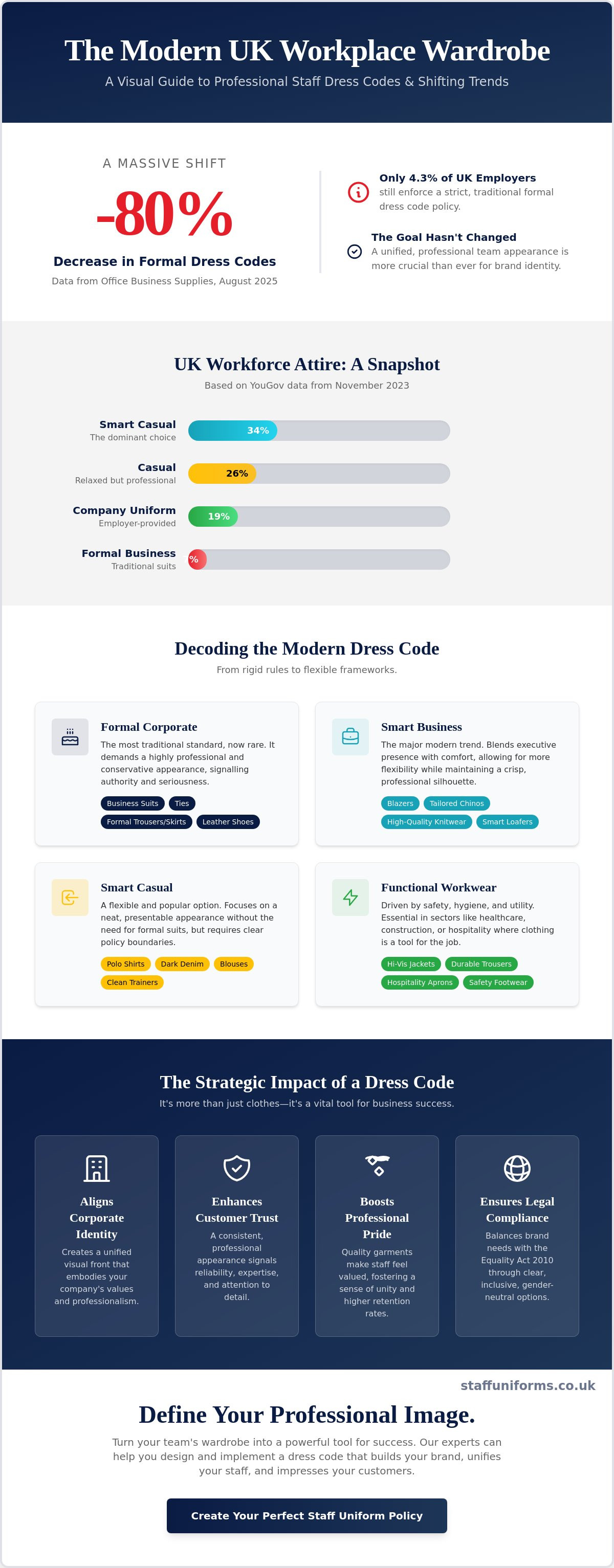
Only 4.3% of UK employers still enforce a formal dress code, representing a massive 80% decrease according to data from Office Business Supplies in August 2025. You probably agree that while traditional suits are fading, the need for a unified and professional team appearance is stronger than ever. It's challenging to define clear standards that respect the Equality Act 2010 while ensuring your staff feels comfortable and represents your brand accurately. Learning how to create a professional staff dress code is no longer about rigid rules; it's about building a strategic identity that fosters professional pride.
This guide provides everything you need to design, implement, and maintain a policy that balances brand image with legal compliance and staff comfort. We'll explore current UK market trends, explain how to select high-quality garments like breathable polo shirts or durable workwear trousers, and provide a clear framework for a written policy your team will actually follow. From understanding "smart casual" to procurement of bespoke corporate wear, you'll discover how to turn your team's wardrobe into a vital tool for business success.
Key Takeaways
- Align your team’s appearance with your corporate identity to boost professional pride and improve customer perception across all touchpoints.
- Master how to create a professional staff dress code using a phased framework that audits brand needs before drafting clear, unambiguous policy language.
- Ensure your policy remains inclusive and legally compliant by navigating the Equality Act 2010 and implementing modern, gender-neutral options.
- Discover why high-performance garment procurement is the foundation of a successful code, focusing on durable fabrics that maintain a sharp, professional image.
- Transition from traditional formalwear to "Smart Business" standards that balance executive presence with the functional requirements of your specific industry.
Why a Professional Dress Code is Essential for UK Businesses
A dress code is far more than a list of prohibited items; it's a visual extension of your corporate identity. When your team wears high-quality corporate suits or branded polo shirts, they embody your company's values and build a unified front. This visual consistency acts as a silent ambassador for your brand. It tells your clients that your business is organised, reliable, and detail-oriented. In an era where 26% of workers report wearing casual attire to work, providing clear guidelines helps your business stand out as a professional leader in your industry.
Understanding how to create a professional staff dress code is the first step toward building a workforce that feels unified and focused. Beyond branding, a well-defined policy reduces "decision fatigue" for your employees. When staff members have clear parameters for their daily outfits, they save time and mental energy every morning. This clarity improves efficiency before the workday even begins. Current data from November 2023 shows that 19% of UK workers wear a work uniform provided by their employer, highlighting how many professionals value the simplicity and structure of a company-issued wardrobe.
Psychologically, the clothing we wear influences our mindset and performance, a concept often called enclothed cognition. When a team member puts on a sharp blazer or a clean hospitality apron, their mental state shifts toward a professional focus. This transition helps staff separate their personal lives from their professional responsibilities, leading to improved concentration and a stronger sense of purpose on the job.
The Link Between Attire and Professional Pride
Quality clothing makes staff feel valued and respected. This is the "human element" of workwear. When you provide durable, bespoke garments, you signal that you care about your team's daily comfort and presentation. A well-designed code fosters a sense of unity and belonging, turning a group of individuals into a cohesive team. Investing in high-quality, comfortable garments directly correlates with higher staff retention rates as employees feel more valued and respected by their employer. This sense of professional pride is especially vital in high-pressure environments like healthcare or construction, where functional, high-performance gear is a tool for success.
Enhancing Customer Perception and Brand Trust
First impressions form within seconds of meeting a staff member. In sectors like healthcare or technical services, attire signals expertise and authority immediately. A nurse in a professional dress or a technician in a hi-vis jacket commands instant trust from the public. Consistency is equally vital for multi-site operations. A customer should receive the same visual brand experience in London as they do in Manchester. For those interested in the historical evolution of these standards, Wikipedia's overview of dress codes offers a detailed look at how societal norms have shaped workplace attire. By maintaining a clear standard, you reassure your customers that your corporate identity is in safe hands, regardless of which location they visit.
Categorising Standards: From Formal Corporate to Functional Workwear
UK workplace standards are evolving rapidly. YouGov data from November 2023 reveals that only 7% of workers still wear traditional business attire like suits to the office. Meanwhile, 34% of the workforce has adopted "smart casual" as their primary style. When you're researching how to create a professional staff dress code, you must first distinguish between a general dress policy and a prescribed uniform. A dress code sets the standard for personal clothing, while a uniform provides the specific garments. Both require clear, unambiguous boundaries to prevent the confusion that often arises from vague terms like "business casual."
The rise of "Smart Business" standards represents a major shift in 2026. This category blends executive presence with modern comfort. It allows for flexible items like high-quality knitwear or tailored chinos, provided they maintain a crisp, professional silhouette. Even "Casual" policies, which 26% of UK workers now follow, need strict limits. Prohibiting items like ripped denim or offensive slogans ensures that even a relaxed atmosphere remains professional and respectful. Understanding these tiers helps you decide how to create a professional staff dress code that fits your industry while keeping your workforce unified.
Formal Corporate and Executive Standards
In high-end client environments, mandating corporate suits and blazers remains the gold standard for establishing authority. Standardising shirts and blouses ensures a polished look that reflects executive presence and reliability. This tier also sets expectations for grooming and accessories to create a "total look" that signals expertise. As you look to implement an office dress code, remember that formal standards succeed when they are applied equitably across your entire leadership team.
Functional Workwear and Industry-Specific Attire
Industries like hospitality, healthcare, and construction require a more practical approach. In these sectors, the code must prioritise movement, durability, and temperature regulation. Functional workwear doesn't mean sacrificing brand identity. You can easily integrate branded polo shirts, hospitality aprons, or cargo pants into a professional framework that supports daily tasks. For instance, medical scrubs or beauty tunics must withstand industrial laundering while maintaining their shape and colour. If your team works in demanding environments, selecting durable workwear garments is essential for long-term value and staff comfort.
Navigating Legal Compliance and Workplace Inclusivity
Legal compliance is the foundation of any modern workplace policy. In the UK, the Equality Act 2010 remains the primary legislation governing how you manage your team's appearance. It dictates that your dress code must not discriminate against the nine protected characteristics, including religion, sex, disability, and age. When you are determining how to create a professional staff dress code, you must ensure that standards for different genders are equivalent, even if they aren't identical. For example, requiring female staff to wear high heels or makeup while men have no such requirements is likely unlawful under May 2018 government guidance. Instead, focus on a "professional silhouette" that allows for gender-neutral options like tailored trousers or high-quality knitwear.
Inclusivity also means accommodating religious and cultural dress with sensitivity. Unless there's a genuine health and safety risk, prohibiting religious symbols or headwear can lead to legal repercussions. A flexible approach doesn't weaken your brand; it demonstrates a modern, inclusive culture. While you focus on legalities, don't forget that a compliant and well-presented team is a powerful branding tool. Understanding how employee dress can market your business helps you see that an inclusive policy actually broadens your brand's appeal and builds trust with a diverse client base. The goal is to set professional standards that avoid discriminatory restrictions while maintaining a unified corporate identity.
Health, Safety, and PPE Integration
Integrating safety requirements into a professional aesthetic is a critical step that many businesses overlook. Your dress code must align with Health and Safety Executive (HSE) standards without sacrificing your visual identity. For staff moving between front-of-house and back-of-house environments, the transition must be seamless. For instance, a hospitality manager might wear a branded softshell jacket that provides warmth and professional branding while meeting site safety needs. Professional standards should never compromise PPE. Your procurement strategy should focus on high-quality safety gear, like hi-vis vests or waterproof jackets, that features consistent embroidery or screen printing to keep the team looking unified and professional.
Fairness and Reasonable Adjustments
Employers have a legal duty to make reasonable adjustments for disabled employees. This might include allowing specific footwear for those with mobility issues or sensory-friendly fabrics for staff with skin sensitivities. Modern UK workplaces are also becoming more accepting of tattoos and piercings, provided they aren't offensive. Drafting a "Reasonable Adjustments" clause helps future-proof your policy. It allows you to maintain high standards while remaining adaptable to individual needs. By focusing on the "human element" of workwear, you ensure that every staff member feels comfortable and valued. This is a vital part of how to create a professional staff dress code that actually works for your entire workforce.
How to Implement Your Dress Code Policy: A Step-by-Step Framework
Implementation is the most critical stage of how to create a professional staff dress code. A policy only succeeds when it's practical and understood by everyone. Start with Phase 1: Audit. Analyse your current brand image and employee needs. If 34% of your workforce already leans toward smart casual, your policy should reflect that reality. Phase 2 involves drafting the policy in plain English. Avoid jargon. Phase 3 is the consultation period. Staff feedback is essential because it identifies potential issues with garment fit or functionality before you commit to a large order. Phase 4 is the launch. Provide a transition period of at least 30 days to allow staff to update their wardrobes or for new uniforms to arrive. Finally, Phase 5 requires regular reviews. Revisit the code annually to ensure it remains relevant to changing UK workplace trends and legal standards.
Drafting Clear and Unambiguous Guidelines
Vague language is the enemy of a successful dress code. Terms like "appropriate" or "excessive" lead to inconsistent enforcement and employee frustration. Instead, be specific. State that "collared polo shirts are required" rather than "smart tops." Many successful UK firms now use visual look-books. These guides illustrate acceptable standards using photos of the actual garments staff will wear, such as medical scrubs, beauty tunics, or hospitality aprons. This visual approach removes any "grey areas" regarding fit or style. You should also clearly define the consequences of non-compliance within the staff handbook. This transparency ensures everyone knows the expectations from day one, reducing the need for awkward disciplinary conversations later.
Communication and Staff Buy-In
Present the new code as a benefit. Frame it as an investment in your team's professional pride and a way to simplify their mornings. When staff see high-quality, bespoke garments like softshell jackets, tailored blouses, or durable cargo pants, they recognise the value you're providing. Training management is equally important. Supervisors must enforce the code fairly and consistently to avoid claims of favouritism or discrimination. Consistency across all departments builds a stronger sense of unity. Create an open channel for questions during the roll-out, perhaps through a dedicated HR email or a staff briefing. This approach turns the policy into a shared tool for success rather than a top-down mandate. Ready to equip your team with the right gear? Explore our range of professional uniforms to find the perfect fit for your new policy.
The Role of Procurement: Selecting Garments That Support Your Code
A written policy is merely a document until your team puts on the physical garments. The quality of these clothes dictates the success of your entire initiative. If a blouse is translucent or a pair of workwear trousers is restrictive, your staff won't follow the standards you've set. Procurement is the bridge between a theoretical rule and a professional reality. High-performance garments ensure your team looks sharp while feeling comfortable enough to perform their duties. When you understand how to create a professional staff dress code, you realise that providing the right tools, in this case, high-quality clothing, is the most effective way to guarantee compliance.
Investing in durability is a strategic financial decision. Fabrics that withstand industrial laundering maintain their shape, colour, and professional finish far longer than high-street alternatives. Utilising services for custom staff uniforms UK simplifies policy enforcement. When the company provides the gear, there's no room for ambiguity. Every team member wears the same approved items, ensuring a unified brand image across your entire operation. This approach removes the burden of interpretation from your employees and places your corporate identity in safe hands.
Prioritising Fabric Technology and Comfort
Active roles in healthcare, construction, or hospitality demand advanced fabric technology. Selecting moisture-wicking and breathable materials helps staff stay cool and focused during long shifts. "Easy-care" materials are equally important for staff convenience, as they require minimal ironing to look professional. High-quality, durable fabrics significantly reduce the long-term cost of uniform replacement by maintaining their professional appearance through 50 or more industrial wash cycles. This focus on the "human element" of workwear improves morale and ensures your dress code is seen as a benefit rather than a burden.
Bespoke Branding and Customisation Techniques
Bespoke branding turns a standard garment into a vital tool for business success. Choosing between embroidery and screen printing depends on the garment type and the intended use. Embroidery offers a high-end, durable finish for corporate suits and polo shirts, while screen printing is often better for large logos on hi-vis safety jackets. Accuracy is vital. You must ensure your brand colours are matched precisely across different garment types, from beauty tunics to waterproof jackets. This consistency builds trust with your customers and reinforces your corporate identity. To start building a wardrobe that reflects your brand's excellence, Email Sales@staffuniforms.co.uk · Tel 0333 090 8552 to start your professional procurement journey.
Transform Your Team’s Visual Impact
Developing a robust dress code is more than a compliance exercise; it's a strategic investment in your brand’s reputation. By aligning your policy with UK regulations and prioritising employee comfort, you create a workforce that carries itself with professional pride. You’ve seen that successful implementation relies on clear, visual guidelines and a phased consultation process. Mastering how to create a professional staff dress code ensures your corporate identity remains consistent across every industry sector, from medical facilities to construction sites.
The final step is choosing a partner who can bring your vision to life. The Staff Uniform Company has served as a specialist UK supplier since 2017, providing national delivery for all professional sectors. Our expert embroidery and customisation services ensure your logo is applied with precision on every garment, from corporate blazers to durable workwear trousers. We handle the entire process from design to delivery so your brand stays in safe hands. Explore our range of professional corporate and workwear essentials and start building a unified, professional team today.
Frequently Asked Questions
Can I legally force my employees to wear a specific uniform in the UK?
Yes, UK employers can legally require staff to wear a specific uniform, provided the requirement is clearly stated in the employment contract. You must ensure the policy is non-discriminatory under the Equality Act 2010. If the uniform includes Personal Protective Equipment (PPE) like hi-vis jackets, the Health and Safety at Work etc Act 1974 makes its use mandatory for safety reasons.
What is the difference between business casual and smart casual in 2026?
Business casual in 2026 typically requires a structured silhouette, such as a blazer paired with tailored trousers or a blouse, but without the need for a tie or full suit. Smart casual is more relaxed and frequently includes high-quality polo shirts or knitwear with clean chinos. While 34% of UK workers now adopt smart casual, business casual remains the preferred standard for client-facing roles where a more formal executive presence is necessary.
How do I handle religious headwear or jewellery in a professional dress code?
You should permit religious headwear and jewellery unless there is a justifiable health and safety risk that prevents it. For instance, loose items might be restricted around heavy machinery or in specific clinical settings. When you are determining how to create a professional staff dress code, you must balance brand consistency with religious expression to avoid indirect discrimination claims under the Equality Act 2010.
Can a dress code policy forbid visible tattoos and piercings?
Employers can legally restrict visible tattoos and piercings if they can justify the rule as a proportionate means of achieving a legitimate business aim, such as maintaining a traditional brand image. However, modern UK standards are shifting. Many businesses now allow non-offensive tattoos to reflect a more inclusive culture, especially since only 7% of workers still wear traditional business attire as of November 2023.
Who should pay for the staff uniform if it is mandatory?
Employers can ask staff to pay for their uniforms, but the cost must not reduce the employee's take-home pay below the National Minimum Wage. Most professional UK businesses choose to provide the initial set of garments to ensure quality and consistency. Providing the uniform directly is often the most efficient way to manage how to create a professional staff dress code while maintaining positive staff morale.
How often should a company review its dress code policy?
You should review your policy every 12 months to ensure it stays relevant to changing workplace trends and legal requirements. An annual review allows you to assess the durability of your current procurement choices, such as your healthcare scrubs or hospitality aprons. It also gives you the opportunity to adapt to shifts in the market, like the 80% decrease in formal dress code enforcement seen in recent years.
What happens if an employee refuses to follow the dress code?
Failure to follow a lawful and reasonable dress code is a disciplinary matter that you should handle according to your company's formal procedures. Start with an informal conversation to check if there are underlying medical or religious reasons for the non-compliance. If the refusal continues without a valid reason, it can be treated as misconduct, provided the expectations were clearly defined in your staff handbook and training sessions.