
A uniform that looks professional but fails to withstand thermal disinfection isn't just a procurement error; it's a clinical liability. You likely understand the pressure of balancing staff comfort with the rigid demands of the 2026 UK healthcare landscape. It's frustrating when garments degrade after just a few high-temperature washes or when the lines between NHS and private sector standards feel blurred. Choosing infection control compliant uniforms shouldn't be a guessing game of fabric weights and vague supplier promises.
This guide provides the clarity you need to master the technical standards and procurement essentials for healthcare attire that meets the latest UK infection prevention and control (IPC) requirements. We'll break down the implications of the BS EN 13795-1:2025 standard and the ongoing national uniform reviews. You'll get a clear checklist for compliant garment features and the assurance that your medical scrubs can withstand the 60°C+ thermal disinfection required for pathogen reduction. From fabric durability to the "bare below the elbows" policy, we'll ensure your team stays protected, compliant, and professional.
Key Takeaways
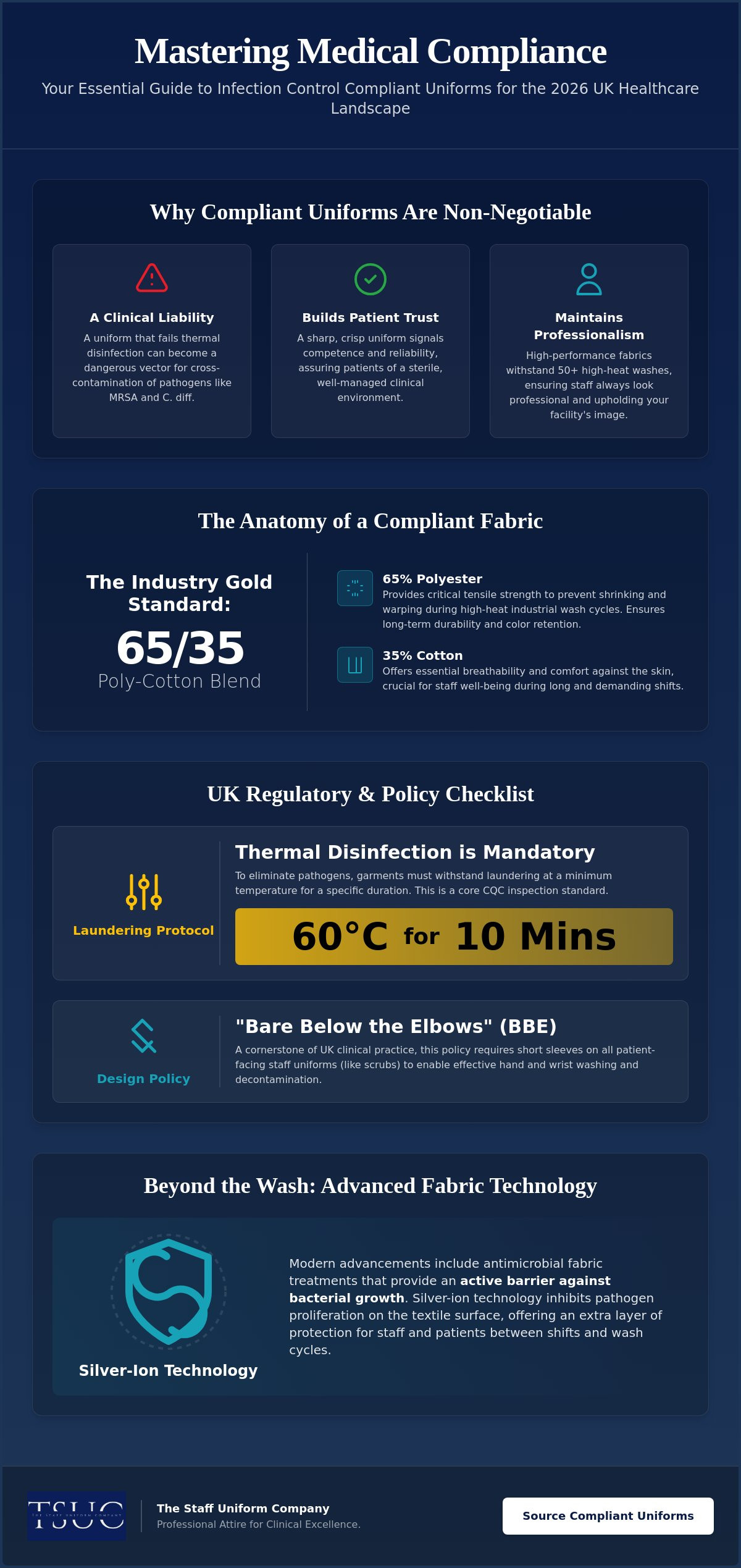
- Understand why specific 65/35 poly-cotton blends are the industry standard for maintaining garment integrity during rigorous high-heat cycles.
- Align your facility with the latest UK regulatory requirements, including the Health and Social Care Act 2008 and CQC inspection standards.
- Master the thermal disinfection protocols necessary to eliminate pathogens, specifically the 60°C for 10 minutes laundering rule.
- Learn how to source infection control compliant uniforms that integrate professional branding through hygiene-safe embroidery without compromising clinical safety.
- Discover the role of advanced fabric treatments, such as silver-ion technology, in creating an active barrier against bacterial growth between shifts.
What Defines Infection Control Compliant Uniforms in 2026?
Infection control compliant uniforms are precisely engineered garments designed to mitigate the transmission of healthcare-associated infections (HCAIs). They serve as a critical barrier between the wearer and the clinical environment. However, without the right material composition, a uniform can quickly shift from a protective layer to a dangerous vector for cross-contamination. In 2026, compliance isn't just about the fabric choice; it's about a holistic approach to garment design that supports modern hygiene protocols and withstands the rigours of industrial processing.
The "Bare Below the Elbows" (BBE) policy remains a cornerstone of UK clinical standards. This requirement dictates that staff in patient-facing roles must wear short sleeves to facilitate effective hand and wrist decontamination. This shift has led to the widespread adoption of Scrubs (clothing) as the primary choice for diverse medical settings. These garments are specifically designed for high-temperature durability, ensuring they don't lose their shape or protective qualities after the repeated 60°C thermal disinfection cycles required by current NHS and private sector guidelines. High-performance textiles ensure that the garment remains a tool for safety rather than a liability.
Beyond the technical specifications, there's a significant psychological element to procurement. A sharp, clean uniform signals competence and reliability. It builds immediate trust with patients who equate a professional appearance with a sterile, well-managed environment. When your team wears uniforms that remain crisp after 50 washes, it sends a clear message about your facility's commitment to excellence and safety.
The Science of Cross-Contamination
Microbiological studies confirm that pathogens like MRSA and C. diff can persist on untreated textile fibres for several days. Bacteria can migrate from contaminated fabric to skin or clinical surfaces within seconds of physical contact. To break this chain of infection, staff must change their uniforms daily. This practice prevents pathogens collected in the ward from being transported into the community or back into the clinic the following morning. Using infection control compliant uniforms made from non-porous, tightly woven fibres helps limit the initial "grip" these pathogens have on the fabric.
Public Perception vs. Microbiological Reality
UKHSA findings suggest that while microbial contamination mostly originates from the wearer, patient confidence is heavily influenced by visual cues. A stained or crumpled garment suggests a lack of attention to detail that patients may project onto the quality of clinical care. Maintaining a crisp, professional look is a core component of "perceived" hygiene. While many modern facilities prefer Medical Scrubs & Healthcare Uniforms, some traditional settings still utilise Nurse dresses. The challenge for procurement managers is ensuring these traditional styles are manufactured with the same high-performance fabrics that allow for rigorous laundering without aesthetic degradation.
Technical Specifications: Fabric Science and Design Features
Selecting infection control compliant uniforms requires a focus on the microscopic details of textile performance. The structural integrity of a garment determines how long it remains a viable clinical tool. In 2026, the industry standard remains a 65/35 polyester-cotton blend. This specific ratio provides the necessary tensile strength to prevent shrinkage during high-heat processing while maintaining the breathability required for long shifts. Polyester ensures the fabric survives hundreds of industrial wash cycles without warping, while cotton provides comfort against the skin.
The ability to withstand thermal disinfection is the most critical technical requirement. According to the NHS guidance on uniforms and workwear, effective pathogen reduction is achieved only when garments are laundered at temperatures of at least 60°C. Inferior fabrics often suffer from fibre breakdown or significant shrinkage at these temperatures, which eventually compromises the professional image of your staff. High-quality poly-cotton blends maintain their shape and colour, ensuring that your investment in a corporate identity remains protected over the long term.
Advancements in Antimicrobial Textiles
Modern procurement now prioritises textiles that offer active protection. Built-in antimicrobial technology provides a continuous layer of defence that works alongside standard laundering protocols. Unlike topical coatings that can leach out after a few washes, integrated silver-ion technology is fused into the fibre during the manufacturing process. Silver-ion technology in medical scrubs provides a self-sanitising barrier that actively inhibits the growth of bacteria and fungi between laundering cycles. This technology is particularly valuable in high-pressure environments where the risk of cross-contamination is elevated. If you need to upgrade your current stock, our range of Medical Scrubs & Healthcare Uniforms incorporates these advanced fabric technologies as standard.
Design for Clinical Efficiency
Design features must support hygiene, not hinder it. The "Bare Below the Elbows" policy is a non-negotiable standard for hand hygiene compliance. This dictates that clinical garments must feature short sleeves or sleeves that can be easily and securely rolled up. Minimalist design is equally vital. We focus on removing unnecessary pleats, ruffles, or deep pockets that can trap moisture and contaminants. Instead, we utilise functional design elements like action backs and side vents. These features balance the physical demands of patient handling with a streamlined silhouette. Every fastening, from buttons to zips, should be non-porous and durable enough to withstand the mechanical stress of industrial dryers without breaking or melting.
UK Regulatory Frameworks and Compliance Standards
Compliance in the UK healthcare sector is governed by a rigorous set of legal requirements and clinical guidelines. The Health and Social Care Act 2008 remains the foundational document for any procurement decision. Its Code of Practice on the prevention and control of infections mandates that all providers ensure staff attire supports hygiene protocols. For procurement managers, this means sourcing infection control compliant uniforms that facilitate high-temperature laundering and meet specific design standards. The Care Quality Commission (CQC) actively reviews these policies during inspections of private clinics and care homes. They look for evidence that uniforms are fit for purpose and managed through a clear, risk-assessed policy, and you can learn more about You Can Do It Training Ltd to see how accredited health and safety training can further strengthen your compliance profile.
The landscape shifted significantly in early 2026 with the rollout of the National Healthcare Uniform. This initiative by NHS Supply Chain aims to standardise colours and styles across England to improve patient recognition and reduce costs. While the initial rollout faced reviews regarding fabric quality, the core objective remains clear: a unified clinical identity that prioritises safety. Employers carry the legal responsibility for providing and maintaining compliant workwear. You must ensure that the garments provided don't just look the part but actually perform under clinical pressure. This duty of care extends to ensuring staff have enough sets of uniforms to allow for a fresh change every shift.
NHS vs. Private Sector: Aligning Standards
Private healthcare providers frequently look to NHS England uniform and workwear guidance as the gold standard for their own procurement. Adopting role-based colour coding and high-performance scrubs uk helps private clinics demonstrate a commitment to patient safety that matches the public sector. This alignment prevents patient confusion and ensures that even non-clinical staff, such as receptionists or facility managers, wear attire that doesn't compromise the sterile environment. Consistency across these roles builds a cohesive brand image while maintaining strict hygiene boundaries.
Health and Safety at Work (HSAW) Requirements
It's vital to differentiate between a standard uniform and Personal Protective Equipment (PPE). While infection control compliant uniforms are designed for hygiene, they don't replace the need for aprons or gloves during high-risk procedures. Risk assessment protocols should dictate garment selection based on the specific tasks performed. In multi-service facilities where healthcare and service roles overlap, procurement becomes more complex. For guidance on managing diverse workplace requirements, see our Hospitality Workwear Suppliers guide. Every garment must be assessed for its ability to withstand the necessary cleaning protocols without losing its protective or professional qualities.
Laundering Protocols: Maintaining Compliance for Longevity
Maintaining the integrity of your clinical attire requires more than just a standard wash cycle. Thermal disinfection is the non-negotiable standard for killing the majority of healthcare-associated pathogens. To achieve this, garments must be laundered at 60°C for at least 10 minutes. This specific temperature and duration ensure that bacteria like MRSA are effectively neutralised. While many facilities rely on industrial laundering services, the reality of modern healthcare often involves staff taking their uniforms home. This creates a risk profile that procurement managers must manage through clear, documented protocols. If you are currently evaluating your stock levels to ensure compliance, you can view our full range of medical scrubs and healthcare uniforms designed for high-temperature durability.
Logistics play a vital role in preventing cross-contamination. You must maintain a strict separation between clean and soiled linen during transport. Pathogens can easily migrate from a used tunic to a fresh one if they share the same container or storage area. We recommend using colour-coded bags or dedicated plastic bins that can be disinfected between uses. Detergent selection is another critical factor. You need to balance high microbial kill-rates with fabric preservation. Avoid excessive use of chlorine bleach, as it aggressively breaks down the polyester-cotton fibres we discussed earlier. Instead, opt for high-quality professional detergents that work effectively at 60°C without stripping the fabric's protective properties.
Best Practices for Home Laundering
When staff launder their own infection control compliant uniforms, clear guidance is essential. Uniforms should always be washed separately from household items like towels or bedding. This prevents the transfer of domestic pathogens into the clinical environment. We advise staff to use a hot iron or a high-heat tumble dry setting after washing. This secondary heat application provides an additional layer of microbial reduction. For transporting contaminated garments, water-soluble alginate bags are the safest option. These bags go directly into the washing machine and dissolve, meaning the wearer never has to touch the soiled fabric once it's removed.
When to Replace Your Uniforms
Even the highest quality infection control compliant uniforms have a finite lifespan. You must identify signs of fabric fatigue, such as fraying at the cuffs or thinning in high-friction areas. These physical defects create micro-pockets where bacteria can hide from the laundering process. While integrated antimicrobial treatments are durable, they typically begin to lose efficacy after 50 to 75 industrial wash cycles. Perform a comprehensive audit of garment quality during your annual IPC review to identify thinning or frayed areas that may harbour pathogens. Replacing worn stock isn't just about aesthetics; it's a vital part of your infection prevention strategy.
Procuring Infection Control Compliant Uniforms with The Staff Uniform Company
The Staff Uniform Company acts as a strategic partner rather than just a vendor. We understand that procurement isn't merely a logistical task; it's a vital component of clinical risk management. Our commitment to UK healthcare is reflected in our supply of hospital-grade medical scrubs and nurse dresses. We offer expert consultancy to help you align your custom staff uniforms uk with the latest regulatory frameworks. This ensures your workforce remains compliant while projecting a quiet confidence that reassures patients. We bridge the gap between technical requirements and the practical needs of a busy medical facility.
Customisation shouldn't mean compromising on safety. We provide hygiene-safe logo embroidery and branding options that don't create areas for bacterial growth or compromise the fabric barrier. Our solutions are fully scalable. We serve independent dental practices and large-scale care home groups with the same level of detail-oriented efficiency. By sourcing infection control compliant uniforms through us, you're investing in garments that withstand the 60°C+ wash cycles required for modern IPC standards. We take the guesswork out of compliance, allowing you to focus on patient care.
Our Healthcare Range
Our clinical range highlights high-performance scrubs and tunics designed for maximum durability. Every item is tested for the rigours of 2026 UK healthcare environments, ensuring they maintain their shape and colour after dozens of industrial washes. We focus on size and fit inclusivity. This ensures your team stays comfortable and mobile during demanding shifts. Proper fit is essential for safety, as oversized or restrictive clothing can hinder clinical tasks or lead to contamination risks. Our nurse dresses and medical scrubs combine a professional aesthetic with the functional requirements of a technical workplace.
Seamless Procurement for National Providers
National providers require a seamless procurement process to maintain a consistent brand identity across a diverse estate. We manage bulk orders across multiple sites, ensuring that every location receives compliant stock on schedule. Our service model handles the entire lifecycle from concept to final delivery. This eliminates the stress of managing long-term uniform contracts or dealing with unreliable lead times. We ensure a continuity of supply that keeps your workforce protected and professional at all times. High-quality infection control compliant uniforms improve internal morale and enhance external perceptions of your business.
View our full range of Medical Scrubs & Healthcare Uniforms
Future-Proofing Your Clinical Procurement
Compliance in 2026 demands a rigorous approach to every stitch and fibre. You've seen how the right fabric composition and design features, such as "Bare Below the Elbows" sleeves, are essential for maintaining clinical standards. By prioritising garments that withstand 60°C thermal disinfection, you ensure your team remains protected and your facility stays within UK regulatory guidelines. It's about more than just meeting a checklist; it's about fostering professional pride through equipment that performs under pressure.
The Staff Uniform Company has been a specialist UK supplier since 2017. We provide high-performance fabrics specifically tested for 60°C+ washing, ensuring your investment lasts through hundreds of cycles. Trusted by national healthcare and care providers, we're ready to help you secure infection control compliant uniforms that balance clinical safety with a professional aesthetic. Our team understands the functional requirements of your sector and provides the reliable, no-nonsense expertise you need to succeed.
Browse our range of infection control compliant healthcare uniforms
Your commitment to excellence starts with the tools your team wears every day. We're here to ensure those tools never let you down.
Frequently Asked Questions
What is the required washing temperature for infection control compliant uniforms?
The required washing temperature for effective thermal disinfection is at least 60°C for a duration of 10 minutes. This standard is necessary to achieve a significant reduction in pathogens like MRSA. While lower temperatures might remove visible dirt, they don't provide the microbiological kill-rate required for clinical safety. It's essential that your garments are manufactured from high-performance fabrics that won't shrink or degrade under these intense heat conditions.
Does the UK government mandate specific colours for healthcare uniforms in 2026?
NHS England introduced a national healthcare uniform rollout in January 2026 to standardise colours and roles across trusts. This initiative helps patients easily identify staff members and reduces procurement costs. While private sector providers aren't legally bound to these specific colours, many align their corporate identity with these standards. This helps maintain a professional and recognisable clinical appearance that patients already trust.
Can I add my logo to a compliant medical uniform without affecting hygiene?
You can add your logo to a compliant medical uniform by using specific hygiene-safe embroidery techniques or non-porous heat transfers. These methods ensure the branding doesn't create trap points for moisture or bacteria. We recommend placing logos in areas that don't come into direct contact with patients, such as the upper chest. This maintains the highest levels of infection control while promoting your professional brand.
How often should healthcare staff change their uniforms?
Healthcare staff must change their uniforms daily to prevent the transmission of pathogens between the clinical environment and the community. Wearing a fresh set of infection control compliant uniforms for every shift is a foundational IPC requirement. This practice ensures that any contaminants picked up during a shift are neutralised through laundering before the garment is worn again, protecting both staff and patients.
What is the difference between antimicrobial and antibacterial fabrics?
Antibacterial fabrics specifically target and inhibit the growth of bacteria, whereas antimicrobial treatments offer a broader spectrum of protection against bacteria, fungi, and some viruses. In a healthcare setting, antimicrobial fabrics are generally preferred as they provide a more comprehensive barrier. These treatments are often integrated into the fibre during manufacturing. This ensures the protection remains effective even after multiple industrial wash cycles and high-temperature processing.
Are short sleeves mandatory for infection control compliance in the UK?
Short sleeves are mandatory for staff in clinical or patient-facing roles to comply with the "Bare Below the Elbows" policy. This standard allows for effective hand and wrist decontamination, which is impossible with long sleeves. If long-sleeved garments are worn for religious or cultural reasons, they must be designed with removable or securely rollable sleeves. These modifications ensure hygiene isn't compromised during clinical procedures.
How do I know if my current uniforms meet CQC inspection standards?
To ensure your uniforms meet CQC inspection standards, you should verify they are thermally stable at 60°C and support the "Bare Below the Elbows" policy. Inspectors look for a clear, documented uniform policy that includes risk assessments for different roles. Using infection control compliant uniforms from a specialist supplier provides the necessary evidence that your attire is fit for purpose and supports a safe clinical environment.
What are the benefits of using 65/35 poly-cotton blends in medical workwear?
The primary benefits of a 65/35 poly-cotton blend are its exceptional thermal stability and durability. The polyester component prevents the garment from shrinking or losing its shape during 60°C wash cycles, while the cotton ensures breathability and comfort for the wearer. This specific ratio has become the industry standard because it balances the technical requirements of industrial laundering with the physical needs of busy healthcare professionals.