
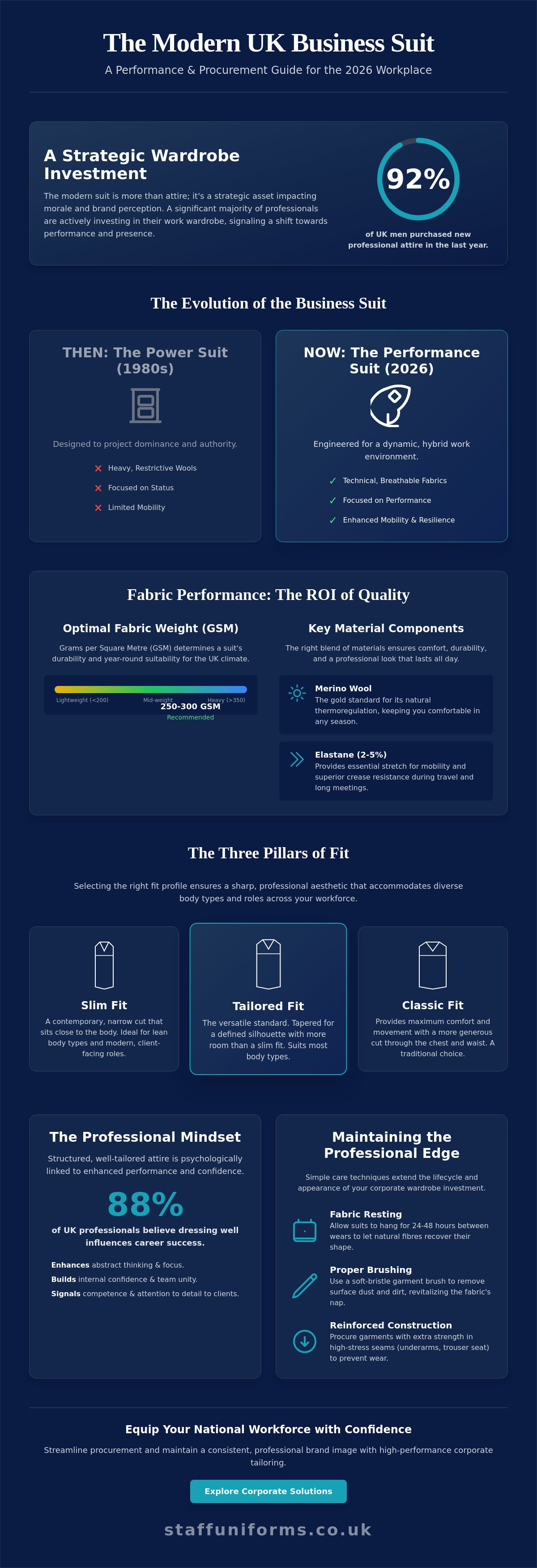
Did you know that 92% of UK men purchased new professional attire in the last year? This statistic highlights a significant shift toward viewing a wardrobe as a strategic asset rather than a simple requirement. When you invest in men's business suits uk workplaces demand, you aren't just buying fabric. You're equipping your team with a tool that impacts internal morale and external brand perception. It's a balance of performance and presence.
The 2026 UK workplace demands more from a wardrobe than ever before. A professional business suit is no longer just a uniform; it's a high-performance tool designed for a dynamic environment. While the 1980s focused on the "power suit" to project dominance, today's focus has shifted toward the "performance suit." This evolution means prioritising mobility, breathability, and resilience. For professionals in high-stakes, client-facing roles, a dedicated suit remains the gold standard. It signals respect, competence, and a commitment to quality—a standard exemplified by Bespoke Men's Suits—that casual attire cannot replicate.
There's a deep psychological link between professional attire and workplace performance. When an individual puts on a well-tailored jacket, it triggers a shift in mindset. This isn't just about external perception; it's about internal confidence. Research into professional dress suggests that structured clothing can enhance abstract thinking and improve focus. When your team wears the high-quality men's business suits uk professionals rely on, they feel equipped to handle complex negotiations and technical challenges with quiet confidence. For those seeking a truly personalized touch, Herts Tailors provides premium custom-made suits and bespoke shirts that further elevate this professional presence. Selecting the right men's business suits uk businesses need involves balancing this psychological impact with real-world utility.
We know the struggle of seeing high-end garments wear out too quickly in high-friction areas or feeling restricted during a long commute. You need a solution that offers industrial-grade durability without sacrificing a premium feel. It's possible to achieve a consistent, professional image that keeps your workforce comfortable through hybrid schedules and long office days. We're here to help you manage these choices with confidence.
This guide provides a comprehensive look at mastering procurement for the 2026 environment. We'll cover everything from the impact of the EU Digital Product Passport to selecting fabrics that meet new sustainability disclosure requirements. You'll learn how to identify high-performance materials and implement styling strategies that ensure your team looks sharp and stays productive.
Key Takeaways
- Understand how the 2026 corporate landscape has evolved the traditional power suit into a high-performance tool for the modern professional.
- Learn how to evaluate fabric weight and construction to ensure your investment in men's business suits uk delivers maximum durability and crease resistance.
- Identify the three essential fit profiles to provide your workforce with a sharp aesthetic that accommodates diverse body types and roles.
- Master the logistics of national procurement to maintain a consistent brand image while streamlining sizing for a distributed team.
- Implement simple garment care techniques, such as fabric resting and proper brushing, to extend the lifecycle and professional edge of your corporate wardrobe.
The Role of Men's Business Suits in the 2026 UK Workplace
The 2026 UK workplace demands more from a wardrobe than ever before. A professional business suit is no longer just a uniform; it's a high-performance tool designed for a dynamic environment. While the 1980s focused on the "power suit" to project dominance, today's focus has shifted toward the "performance suit." This evolution means prioritising mobility, breathability, and resilience. For professionals in high-stakes, client-facing roles, a dedicated suit remains the gold standard. It signals respect, competence, and a commitment to quality that casual attire cannot replicate.
There's a deep psychological link between professional attire and workplace performance. When an individual puts on a well-tailored jacket, it triggers a shift in mindset. This isn't just about external perception; it's about internal confidence. Research into professional dress suggests that structured clothing can enhance abstract thinking and improve focus. When your team wears the high-quality men's business suits uk professionals rely on, they feel equipped to handle complex negotiations and technical challenges with quiet confidence. Selecting the right men's business suits uk businesses need involves balancing this psychological impact with real-world utility.
From Traditional Formal to Modern Professional
The days of heavy, restrictive wools are gone. Modern tailoring focuses on technical fabrics that move with the body rather than fighting against it. The fundamentals of a business suit remain consistent, but the execution has evolved to suit hybrid work models. Suits are now often reserved for "high-impact" days, requiring garments that can withstand commutes and long hours without losing their shape. Even as the "smart-casual" trend persists, a sharp blazer or suit jacket remains the essential anchor that maintains professional standards in any setting.
Suits as a Pillar of Corporate Identity
Consistency across a workforce creates a powerful visual message. When every team member adheres to a high standard of tailoring, it builds immediate trust with UK clients. It demonstrates that the business pays attention to detail and values its public image. Beyond the client's perspective, professional dress fosters a sense of unity and pride within the team. It aligns every employee with a shared mission and a common standard of excellence. Corporate identity is the visual embodiment of business values. By investing in quality tailoring, you ensure those values are visible in every professional interaction.
Fabric Performance & Construction: The ROI of Quality Tailoring
Procuring men's business suits uk teams can rely on requires a deep dive into technical specifications. A suit's return on investment isn't found in the brand name but in the fabric's performance under daily pressure. One of the most critical metrics for procurement managers is GSM (grams per square metre). For the UK's temperate but unpredictable climate, a mid-weight fabric between 250 and 300 GSM offers the best year-round utility. It provides enough substance for winter insulation while remaining breathable during a crowded summer commute. Lightweight fabrics under 200 GSM might feel luxury but often lack the structural integrity needed for daily office wear.
Crease resistance is another pillar of professional longevity. A suit that looks impeccable at 9:00 AM must maintain that sharp silhouette through a full day of meetings and travel. This isn't just about aesthetics; the impact of professional attire on career prospects is well-documented, with 88% of UK professionals agreeing that dressing well influences success. High-quality tailoring uses natural wool resilience and strategic synthetic blends to ensure the fabric "bounces back" after hours of sitting. We focus on reinforced construction, ensuring our corporate suits and blazers feature extra strength in high-stress seams to prevent premature wear in the underarms and trouser seat.
Choosing the Right Material for Daily Wear
Merino wool is the gold standard for UK business suits because of its natural thermoregulation. It keeps the wearer cool when it's warm and warm when it's cool. However, for a modern professional who's constantly on the move, a touch of elastane (usually 2% to 5%) is essential. This small addition provides the necessary stretch for mobility without the fabric bagging at the knees or elbows. While pure wool is prestigious, polyester-rich blends offer significant advantages for high-frequency wear, providing superior stain resistance and the ability to withstand more rigorous cleaning cycles.
Internal Architecture: Linings and Canvas
The longevity of a jacket is often determined by what you can't see. Fused jackets, where the interfacing is glued to the fabric, are common in budget retail but tend to delaminate over time, causing unsightly bubbling. A half-canvas construction is a far better investment for corporate environments. It allows the jacket to drape naturally and mold to the wearer's body over time. Breathable linings are equally vital. We prioritise viscose or cupro linings over cheap polyester because they allow air to circulate, preventing the discomfort and overheating often associated with long commutes or high-pressure presentations.
The Three Pillars of Fit: Slim, Tailored, and Classic Styles
Achieving a uniform standard across a diverse workforce requires a clear understanding of fit profiles. When procuring men's business suits uk teams will wear daily, you must balance individual comfort with a cohesive brand image. Fit is the foundation of professional presence. A poorly fitted suit undermines even the highest quality fabric, while a perfect fit enhances the wearer's confidence and authority. Understanding the history of the modern business suit reveals that British tailoring has always prioritised the silhouette to project professionalism.
The perfect fit starts at the shoulders. The seam should sit exactly where the arm meets the shoulder; if it overshoots, the jacket looks oversized and sloppy. The chest should allow the jacket to fasten easily without pulling, while the sleeves must end just above the large bone in the wrist. This allows a small portion of the shirt cuff to show, which is a hallmark of a well-dressed professional. We provide three distinct fit profiles to ensure every member of your team looks their best.
Fit Comparison for the Professional Workforce
Selecting the right fit often depends on the specific job role and the level of physical activity required throughout the day. Desk-based professionals might prefer a sharper, slimmer silhouette, while those in more active or field-based roles often require the ease of movement provided by a classic or tailored cut.
| Fit Type | Chest Profile | Waist Cut | Leg Opening |
|---|---|---|---|
| Slim Fit | Narrow and contoured | Highly tapered | Slim and narrow |
| Tailored Fit | Standard and shaped | Slightly tapered | Tapered |
| Classic Fit | Relaxed and full | Straight cut | Straight and roomy |
Trouser length is equally vital for a polished look. We offer short, regular, and long options to accommodate all heights across your UK workforce. A "slight break," where the trouser hem just rests on the top of the shoe, is the most versatile choice for modern business environments.
Common Fitting Mistakes to Avoid
The most frequent error in corporate procurement is selecting jackets that are too small. You can identify this by the "X" crease that appears across the midsection when the jacket is buttoned. This indicates the garment is too tight, which restricts movement and causes the fabric to wear out prematurely. Always test for a full range of motion. Your staff should be able to reach forward and sit down comfortably without feeling excessive tension in the back or thighs. Proper sleeve length is another non-negotiable; a jacket sleeve that covers the hand looks unprofessional and hinders productivity.
Corporate Procurement: Equipping a National Workforce
Equipping a national workforce with men's business suits uk teams can wear with pride requires a shift from individual fashion choices to strategic asset management. When you buy for a team, consistency is your most valuable metric. Every employee, whether in a regional branch or a city headquarters, must reflect the same brand standards. This visual unity builds immediate trust with clients and reinforces your corporate identity at every touchpoint. Achieving this across diverse body types is a logistical challenge that requires a structured approach to sizing and stock management.
Sustainability is now a core requirement for UK procurement. Choosing garments designed for long-term industrial use rather than following fast-fashion cycles reduces waste and improves the total cost of ownership. High-quality tailoring allows for subtle branding, such as tonal embroidery on a cuff or custom linings, which integrates your company's values directly into the garment. By focusing on longevity, you ensure that the professional image of your staff remains untarnished by the rapid wear and tear associated with lower-quality alternatives.
Managing Large-Scale Uniform Rolls-Outs
Large-scale roll-outs succeed or fail based on the availability of stock. We recommend choosing "stock-backed" ranges. This ensures that when you hire new starters or need a quick replacement for a damaged item, the exact fabric and fit are readily available. To avoid the common pitfall of inconsistent sizing across a team, utilise sizing sets. Providing a full range of physical samples for staff to try on before bulk ordering eliminates guesswork and reduces the administrative burden of returns. You can explore more detailed corporate suits procurement strategies to refine your rollout process and ensure a seamless transition for your workforce.
The Value of a Strategic Uniform Partner
Transitioning from transactional buying to a managed service model allows you to focus on your core business while we handle the complexities of your wardrobe. A strategic partner understands that professional attire isn't just a cost; it's an investment in staff retention and recruitment. When employees feel they're provided with high-quality, comfortable equipment, internal morale improves. Quality uniforms reduce long-term procurement costs by lasting longer and requiring fewer replacements. By choosing a partner that manages the entire lifecycle from initial concept to final delivery, you ensure your professional image remains sharp and consistent.
If you are ready to upgrade your team's professional presence, explore our range of corporate suits and blazers to find the perfect fit for your business requirements.
Maintaining the Professional Edge: Care and Longevity
A strategic investment in men's business suits uk professionals wear daily requires a commitment to post-purchase care. To maximise the lifecycle of your corporate wardrobe, you must allow garments to recover between wears. Resting a suit for at least 24 hours allows the natural wool fibres to shed moisture and return to their original shape. This simple habit prevents the fabric from becoming brittle and helps maintain the sharp silhouette established during the fitting process. Without this recovery period, high-friction areas will degrade significantly faster, leading to premature replacement costs.
Mechanical cleaning is always superior to chemical intervention for preserving fabric integrity. Use a natural horsehair brush at the end of each day to remove dust and skin cells before they settle into the weave. While dry cleaning is occasionally necessary for deep stains, doing it too often strips the natural oils from the wool, leading to a dull appearance and weakened structure. Steaming is a much safer alternative for removing wrinkles. It refreshes the fabric without the harsh thermal or chemical stress associated with traditional industrial pressing.
Proper storage is the final pillar of garment longevity. Always utilise wide-shoulder hangers that mimic the human frame to support the jacket's internal architecture. Breathable garment bags are essential for long-term storage, as they protect against dust and pests without trapping moisture, which can lead to mildew. Avoid plastic covers, which can cause gases to build up and discolour the fabric over time.
Daily Maintenance Routine
Prompt action saves garments from permanent damage. If an office spill occurs, spot clean immediately with a damp, lint-free cloth by dabbing the area. Never rub the liquid, as this pushes the stain deeper into the fibres. Hanging the suit correctly at the end of the day is non-negotiable. Ensure the trousers are hung straight on a felt-lined bar to prevent creasing. You should never use wire hangers for professional tailoring; they lack the necessary surface area and will permanently distort the shoulder padding and sleeve head.
Extending the Lifecycle of Corporate Attire
Knowing when to repair versus when to replace is key to managing a national workforce's image efficiently. High-friction areas like the crotch and elbows are the first to show thinning. Small tears or loose threads in these areas can often be reinforced by a professional tailor if caught early. A practical tip for procurement managers is to purchase a second pair of trousers for every suit jacket. Since trousers undergo more physical stress and require more frequent cleaning, this strategy effectively doubles the lifespan of the entire men's business suits uk set.
Ready to elevate your team's professional standards with durable, high-performance tailoring? Explore our Men's Business Suits range to find solutions that combine a luxury feel with industrial-grade longevity.
Elevating Your Corporate Identity for 2026
Mastering the procurement of men's business suits uk teams require involves balancing visual impact with technical durability. We've explored how high-performance fabrics and precise fit profiles create a foundation for workplace confidence. Moving from transactional purchases to a managed service model ensures your brand remains consistent across every regional office. It's about providing your staff with tools that reflect their professional pride and commitment to excellence.
Since 2017, we've specialised in corporate tailoring designed for the rigours of daily professional use. Our expert UK-wide national supply chain simplifies the logistics of large-scale roll-outs and ongoing replacements. By prioritising quality construction and proper garment care, you reduce long-term costs while enhancing the external perception of your business. Your workforce deserves equipment that works as hard as they do every single day.
Your team's appearance is a vital driver of business success. View our full range of Corporate Suits and Blazers to discover solutions that combine a luxury feel with industrial-grade longevity. We're ready to help you secure a sharp, consistent future for your brand.
Frequently Asked Questions
What is the best fabric for a daily men's business suit in the UK?
A mid-weight wool-rich blend with a GSM of 250 to 300 is the most practical choice for the UK's temperate climate. Merino wool provides natural thermoregulation to keep you comfortable through changing seasons. Blending this with polyester or elastane increases the garment's industrial durability. This combination ensures the suit withstands the rigours of a daily 9-to-5 grind while maintaining a premium appearance.
How many suits should a professional man own for a standard working week?
A professional should ideally own at least three suits to establish a healthy rotation. This schedule ensures each garment has 48 hours to rest between wears. Resting is vital because it allows the natural fibres to shed moisture and return to their original shape. By rotating your wardrobe, you significantly reduce the rate of fabric fatigue and extend the overall lifecycle of your collection.
What is the difference between a tailored fit and a slim fit suit?
A tailored fit provides a shaped silhouette with a slight taper at the waist, whereas a slim fit is cut much closer to the body across the chest and legs. Tailored fits are the most versatile option for a diverse workforce as they suit most body types. Slim fits offer a sharper, contemporary aesthetic that's often preferred in modern corporate or creative environments where a closer silhouette is desired.
How often should a business suit be dry cleaned to ensure longevity?
You should only dry clean a business suit once or twice a year unless it becomes visibly soiled. Frequent exposure to harsh chemicals strips the natural oils from wool fibres, which leads to a dull finish and weakened fabric. For daily maintenance, use a natural horsehair brush to remove surface debris and a steamer to lift wrinkles. These methods keep the garment fresh without causing structural damage.
Can I machine wash a corporate business suit?
Most high-quality men's business suits uk professionals wear are not suitable for machine washing. The internal architecture, including the canvas and shoulder pads, can warp or delaminate when exposed to the agitation of a wash cycle. Always check the care label before attempting any home laundry. Typically, only specific polyester-heavy ranges designed for high-frequency cleaning are engineered to survive a washing machine without losing their professional shape.
What are the most professional suit colours for the UK finance and legal sectors?
Navy blue and charcoal grey are the definitive professional colours for the UK's finance and legal sectors. These shades project an air of authority, reliability, and conservative expertise. While black is often reserved for formal evening events, navy and charcoal are far more versatile for daily office wear. They pair effortlessly with a wide range of formal shirts and accessories to maintain a consistent brand image.
How do I ensure sizing consistency when ordering suits for a large team?
Utilising physical sizing sets is the most effective way to ensure consistency across a national workforce. Relying on self-measurements often leads to inaccuracies and an administrative burden of returns. By providing a full range of sample sizes for staff to try on, you ensure every team member receives a fit that aligns with your corporate standards. This proactive approach streamlines the procurement process and guarantees a unified appearance.
What is a 'wool-rich' blend and why is it recommended for workwear?
A wool-rich blend contains at least 50% wool combined with synthetic fibres like polyester. Procuring the men's business suits uk workforces need often leads to this material because it pairs natural breathability with industrial strength. These blends offer superior crease resistance and are less prone to pilling than pure wool. They provide the perfect balance between a luxury professional feel and the durability required for active, daily business use.