
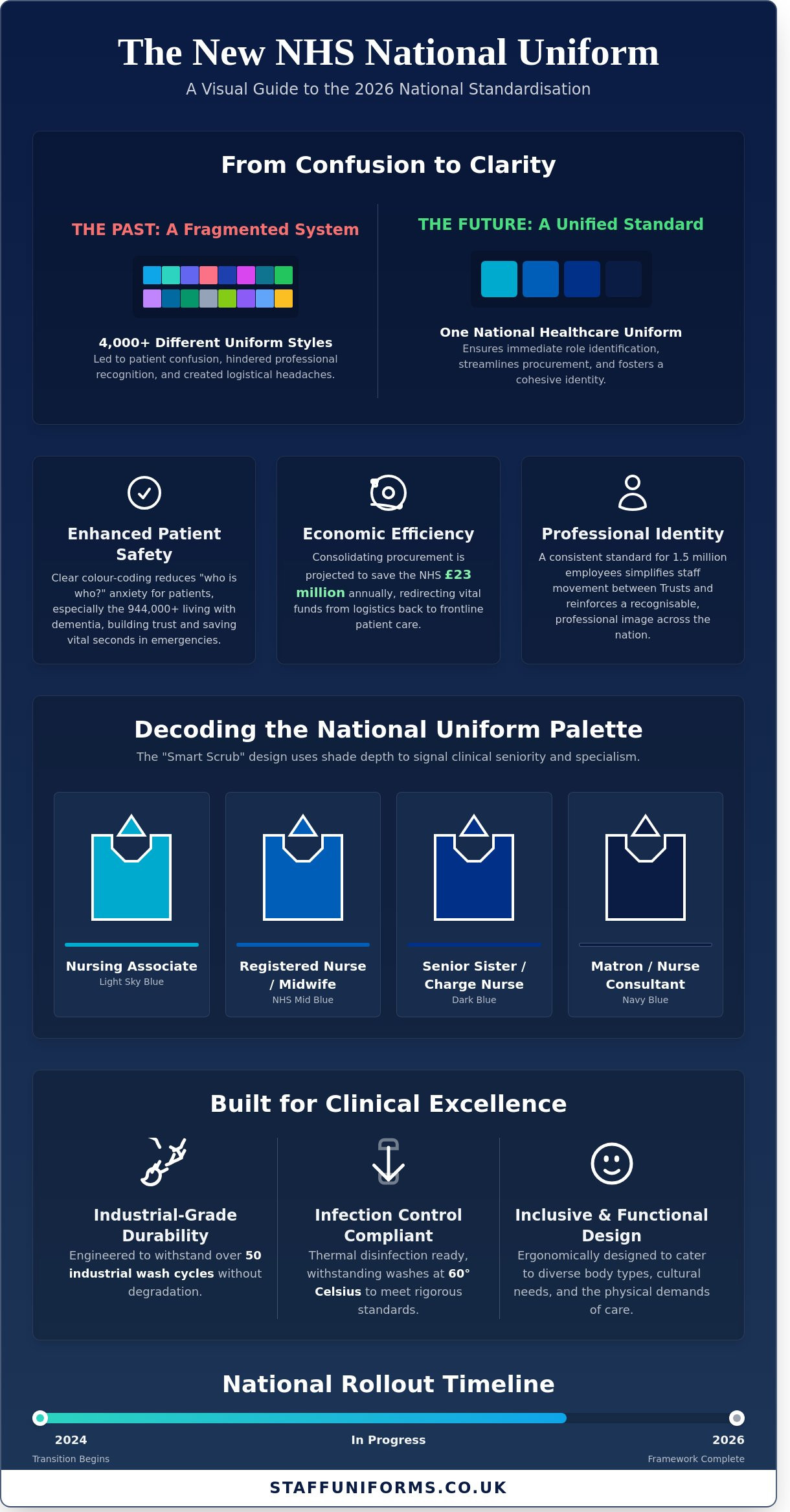
For decades, the visual identity of the NHS has been a fragmented patchwork of over 4,000 different uniform styles and colour combinations across various Trusts. This lack of consistency doesn't just look untidy; it creates genuine barriers to effective communication and patient trust. You've likely felt the frustration of stepping into a busy ward and being unable to distinguish a Senior Sister from a Phlebotomist because the shades of blue don't align with your previous experience. It's a logistical headache that many of the 1.5 million NHS employees face daily.
We understand that clarity in the workplace is a vital tool for success, not just an aesthetic choice. This guide provides a definitive reference for the standardised nhs uniform colours as we move toward the 2026 national rollout. You'll learn exactly how to identify roles through the new colour palette, understand the technical garment standards required for compliance, and see the specific milestones for the transition period. We're here to ensure your team's professional identity is both recognisable and reliable during this major industry shift.
Key Takeaways
- Understand why the NHS is transitioning to a unified National Healthcare Uniform to improve patient safety and streamline procurement across England.
- Master the new nhs uniform colours and the "Smart Scrub" design logic to ensure your staff roles are immediately recognisable and professional.
- Navigate the regional variations between NHS England, Scotland, and Wales to maintain compliance during national recruitment and cross-border operations.
- Review essential technical fabric standards for infection control, including the durability required to withstand 50+ industrial washes at 60 degrees.
- Learn how to manage a seamless transition to the 2026 framework while maintaining your Trust’s identity through professional customisation and branding.
The Evolution of NHS Uniform Colours and National Standardisation
Historically, NHS England operated with a patchwork of styles and shades. Each of the 212 Trusts often chose its own palette, creating a confusing landscape where a navy blue top might signify a Matron in one hospital and a Student Nurse in another. The Evolution of NHS Uniform Colours has progressed significantly from the starched caps of 1948 to a modern focus on clinical functionality. This shift addresses a long-standing issue where fragmented colour schemes led to patient confusion and hindered professional recognition.
The National Healthcare Uniform (NHU) project, launched following a 2021 consultation involving 50,000 healthcare professionals, aims to resolve this inconsistency. Between 2024 and 2026, the NHS is rolling out a unified garment range across England. This isn't just a branding exercise; it's a strategic move to ensure every staff member is recognised for their professional expertise through a consistent set of nhs uniform colours. The programme prioritises inclusivity, offering garments that cater to cultural requirements and diverse body types, ensuring the workforce feels both comfortable and respected.
Why the NHS is Moving to a National Healthcare Uniform
Economic efficiency sits at the heart of this transition. The NHS currently spends approximately £23 million every year on fragmented uniform procurement. By consolidating thousands of different garment types into one national catalogue, the NHS Supply Chain leverages massive buying power to reduce unit costs. This approach ensures a steady supply of high-quality, innovative fabrics that meet rigorous infection control standards. Standardisation also simplifies the supply chain, making it easier for staff to access the right kit when they change roles or move between Trusts. It's a practical solution that redirects funds back into frontline patient care.
The Impact of Colour Coding on Patient Safety
Visual consistency acts as a vital clinical tool rather than a simple dress code. For patients, especially the 944,000 people currently living with dementia in the UK, a clear colour hierarchy reduces "Who is who?" anxiety. When a patient can immediately identify a Senior Sister or a Physiotherapist by their specific shade, it builds trust and improves the care experience. In high-pressure emergency settings, instant role recognition saves precious seconds by allowing staff to identify team leaders and specialists at a glance.
Colour-coded uniforms function as a silent, non-verbal communication system that establishes professional boundaries and enhances patient safety through immediate visual verification.
By adopting a unified approach to nhs uniform colours, the health service ensures that professional pride and patient safety go hand in hand. These garments are essential tools for business success within the healthcare sector, providing the durability and clarity required for a modern, efficient workforce.
Decoding the National Healthcare Uniform Colour Palette
The new national framework, launched following a consultation that began in 2020, simplifies the visual landscape of UK hospitals. The "Smart Scrub" design replaces approximately 30,000 different uniform variations with a streamlined, cohesive palette. This design balances the professional authority of a traditional tunic with the ergonomic flexibility of modern scrubs. It's a practical solution for a fast-paced clinical environment, ensuring that garments are durable enough for industrial laundering while remaining comfortable for long shifts.
The nhs uniform colours system uses shade depth to signal seniority and role clarity. Darker tones, such as Navy or Royal Blue, typically represent senior clinical leadership or specialist roles, while lighter shades indicate support or trainee positions. Contrasting piping on the collar and sleeves provides a secondary layer of identification. This ensures patients and colleagues can identify a staff member's grade from a distance. Adhering to the Technical Requirements and Fabric Standards is essential for maintaining infection control and professional consistency across these high-contact roles.
Primary Role Colours: Nursing and Midwifery
Nursing staff now follow a consistent blue-based hierarchy to ensure clinical recognition. Registered Nurses wear a mid-blue, while Nursing Associates are identified by a lighter sky-blue shade. Student Nurses often wear a distinct grey or light blue, frequently featuring white piping to denote their learner status. Midwifery maintains a strong professional identity within the framework. They typically utilise a deep blue or navy, ensuring they remain easily recognisable during maternity care. This shift helps the 1.5 million NHS employees present a unified, professional image to the public.
Specialist and Allied Health Professional (AHP) Colourways
Allied Health Professionals, including physiotherapists and occupational therapists, move to a Ruby and White palette. This bold choice ensures these 14 distinct professions aren't lost in a sea of blue. Healthcare Science staff adopt a Teal colourway, while Pharmacy staff transition to a specific Green uniform. For many Trusts, this marks the first time pharmacists have worn a clinical uniform, moving away from traditional office wear to improve clinical visibility and team integration. You can find high-quality versions of these professional healthcare garments in our latest collection, designed to meet the rigorous demands of the modern healthcare sector.
Comparing Healthcare Uniform Standards Across the UK
Navigating the landscape of nhs uniform colours requires understanding that the UK does not operate under a single dress code. While NHS Scotland and NHS Wales established national standards over a decade ago, NHS England is currently undergoing its most significant shift toward standardisation since its inception. The NHS National Healthcare Uniform project aims to fix the current fragmentation where over 50 different shades of blue are in use across English Trusts. This inconsistency often complicates national recruitment. When a clinician moves from one Trust to another, they frequently find their existing kit is obsolete because the colour-coding doesn't match.
To bridge this gap, the Pathfinder Trust model involves early adopters testing the 2026 standards. These 15 initial Trusts are providing data on garment durability and professional identity before the full national rollout. For staff moving between different health boards, it's vital to check the local "Uniform and Workwear Policy" before purchasing new gear. While a Band 5 nurse might wear cornflower blue in one area, another board might reserve that shade for senior clinical leads.
NHS England vs. Scotland and Wales
NHS Scotland led the way in 2010 by introducing a single national uniform to improve patient safety and identification. Their system uses a specific palette where corporate blue denotes senior charge nurses and sky blue identifies staff nurses. NHS Wales followed in 2011, centralising procurement to save approximately £1.8 million in its first two years. When selecting medical scrubs from The Staff Uniform Company, staff in devolved nations benefit from clear, centralised guidelines that don't vary by hospital site. This contrasts with England, where local Trust policies still dictate the specific hue of a tunic or trouser until the 2026 transition is complete.
Aligning Private Clinics with NHS Standards
Private healthcare providers frequently choose nurse uniforms from The Staff Uniform Company that mirror the nhs uniform colours used by nearby NHS facilities. This isn't just about aesthetics; it's a strategic move to build immediate patient trust. Patients often associate specific shades of navy or royal blue with clinical authority and high standards of care. By adopting these conventions, private clinics ensure their team looks professional and recognisable. Many businesses maintain a unique brand identity by adding bespoke embroidery or contrasting piping. This balance respects clinical traditions while ensuring the private facility stands out in a competitive market.
Technical Requirements and Fabric Standards for Healthcare Attire
Selecting the right garments involves much more than just matching the correct nhs uniform colours. While visual identification is vital for patient safety, the technical construction of the garment determines its longevity and safety in a clinical setting. Modern healthcare fabrics are engineered to act as a barrier against cross-contamination while remaining breathable for the wearer. These aren't just clothes; they're functional tools designed for high-intensity environments.
Infection Control and Thermal Stability
Fabric composition is a critical factor in preventing the spread of pathogens. Most NHS Trusts utilise a 65% polyester and 35% cotton blend, which offers the perfect balance of durability and comfort. These garments must be thermally stable to withstand industrial laundering processes. Specifically, they're tested to survive 50+ cycles at 60 degrees Celsius; the temperature required for thermal disinfection according to UK health and safety guidelines. Advanced moisture-wicking technology is essential for maintaining staff comfort and focus during demanding 12-hour shifts in high-pressure clinical environments. This technical approach ensures that while there is consistency in nhs uniform colours across various Trusts, the fabric also supports rigorous hygiene protocols.
This focus on advanced textiles for personal comfort isn't limited to uniforms. For staff managing long shifts, innovations in personal apparel, such as absorbent underwear from specialists like Underwunder, also utilize smart fabric technology to provide confidence and support throughout the day.
The same principles apply to performance wear, where brands like 2XU have pioneered compression technology in athletic apparel to enhance circulation and reduce muscle fatigue—benefits that are increasingly sought after by healthcare professionals for under-scrub base layers.
- Durability: Fabrics must resist pilling and thinning after repeated high-temperature washes to maintain a professional look.
- Colour Fastness: Dyes are formulated to prevent fading, ensuring the corporate identity remains intact for the life of the garment.
- Sustainability: With the NHS aiming for a Net Zero supply chain by 2045, there is a growing shift toward using recycled polyester and ethically sourced cotton.
Inclusivity and Cultural Sensitivity in Design
The 2021 National Uniform Strategy prioritises a diverse workforce by offering a wider range of garment styles. This includes modest wear options like longer-length tunics and coordinated headscarves that align with the established colour palette. Providing these options isn't just about compliance; it's about professional pride. When staff have access to well-fitted, culturally appropriate uniforms, morale improves significantly. It sends a clear message that the organisation values its people as much as its patients. High-quality tailoring ensures that movement isn't restricted during physical tasks, which reduces the risk of workplace strain or injury over a long career.
Procuring Professional Healthcare Uniforms for Your Team
Moving your team to the new NHS National Healthcare Uniform standards requires a logical, phased strategy. Most Trusts find that a hard cut-over date causes unnecessary waste and budget strain. Instead, plan your procurement around the natural 18-month wear cycle of a standard tunic or set of scrubs. This allows you to introduce the standardised nhs uniform colours gradually. It's a practical way to manage costs while ensuring your team always looks sharp and professional. Data from recent procurement audits suggests that a staggered rollout can reduce initial capital expenditure by up to 30% compared to a total workforce replacement.
Durability is the foundation of value in healthcare settings. You need garments that withstand frequent 60-degree industrial laundering without losing shape or pigment. High-quality polyester-cotton blends are the industry standard for a reason; they offer the breathability of cotton with the hard-wearing nature of synthetic fibres. By sourcing garments that meet these technical specifications, you extend the replacement cycle and reduce the environmental impact of your uniform contract.
Branding and Customisation Options
Professional embroidery does more than just display a name. It builds trust. When a patient sees a crisp logo alongside the correct nhs uniform colours, they feel a sense of security and professional pride. We use precision machinery to ensure logos don't pucker or fade over time. This is crucial for role recognition. You can maintain departmental branding, such as a specific clinic name, without overshadowing the primary role identifiers required by the national standards.
Organising these orders for large, multi-disciplinary teams is easy with our structured bulk-ordering system. We break down the requirements by size, role, and quantity to eliminate guesswork. This ensures that every staff member, from senior consultants to domestic assistants, receives a uniform that fits perfectly and represents your organisation accurately. A well-fitted uniform improves staff morale and enhances the end-customer's perception of the service.
Choosing a Trusted UK Workwear Partner
Choosing the right UK partner means looking beyond the price tag. You need a supplier with deep technical knowledge of garment technology. Reliability is non-negotiable when you're managing the needs of hundreds of staff members. We provide a comprehensive service that manages the entire journey from the first design mock-up to final delivery. This "all-in-one" approach removes the stress of dealing with multiple vendors and ensures consistency across every batch.
A UK-based partner ensures shorter lead times and strict adherence to ethical sourcing standards, including the Modern Slavery Act 2015. Our focus is on longevity and value. We ensure your uniforms stand up to the rigours of a busy clinical environment while maintaining a professional appearance. Explore our range of professional healthcare uniforms today and secure high-quality workwear that your staff will be proud to wear.
Future-Proofing Your Team for the 2026 National Healthcare Uniform Standard
The transition to a unified palette for nhs uniform colours by 2026 marks a vital change for 1.3 million healthcare professionals across England. This national standardisation programme ensures patients can identify staff roles instantly, reducing confusion and improving safety on the ward. It's no longer just about aesthetics; your attire must now meet rigorous technical specifications, including the ability to withstand 60-degree industrial laundering without losing shape or colour density.
The Staff Uniform Company is a specialist UK supplier dedicated to helping Trusts and private clinics navigate these new requirements. We provide high-durability medical scrubs and nurse dresses designed for longevity in high-pressure environments. Our team offers expert logo embroidery and bespoke customisation services to ensure your staff look professional while remaining fully compliant with the latest NHS England guidelines. Choosing the right partner means your procurement process stays simple, transparent, and efficient.
View our full range of NHS-compliant healthcare uniforms and scrubs
Equipping your team with high-quality, standardised workwear is a direct investment in their professional pride and the quality of care they deliver every day.
Frequently Asked Questions
What is the new NHS National Healthcare Uniform?
The NHS National Healthcare Uniform is a standardised range of garments launched in 2024 to unify the professional appearance of 1.1 million staff members across England. It replaces the vast array of styles previously used by individual Trusts with a consistent, evidence-based design. This initiative focuses on clinical safety, comfort, and sustainability. It ensures patients can easily identify healthcare professionals regardless of which hospital they visit.
What colour do nurses wear in the NHS?
Most staff nurses wear light blue or royal blue, though specific shades vary based on seniority and local Trust policy. Under the new national standards, registered nurses typically wear a Mid Blue uniform to ensure clear identification. Senior sisters and charge nurses often transition to a darker navy blue. These distinct nhs uniform colours help patients and families distinguish between different levels of clinical expertise on a busy ward.
Why are NHS uniforms being standardised across England?
Standardisation aims to save the NHS approximately £10 million annually through bulk procurement and improved supply chain efficiency. Beyond the financial benefits, a uniform look improves patient safety by making it easier to identify staff roles quickly. Research conducted during the 2021 consultation showed that 88% of patients preferred a standardised national uniform. This clarity reduces confusion and enhances professional trust in a clinical setting.
Do different NHS Trusts still have their own uniform colours?
Many NHS Trusts currently maintain their own unique colour schemes while the national roll-out progresses through its multi-year transition. While the 2024 National Healthcare Uniform project aims for total consistency, individual Trusts have historically chosen bespoke colours to represent their local brand. You should always check your specific Trust's uniform policy before ordering. We provide durable garments that align with both legacy Trust requirements and the new national specifications.
What colour scrubs do Allied Health Professionals wear?
Allied Health Professionals (AHPs) typically wear specific colours like bottle green for occupational therapists or maroon for physiotherapists. Under the national framework, these roles are assigned distinct shades to maintain professional identity within multidisciplinary teams. For example, radiographers often wear white or light grey tunics. These specific nhs uniform colours ensure that each specialist's role is immediately recognisable to both colleagues and patients.
Can private healthcare providers use NHS uniform colours?
Private healthcare providers can technically use similar colours, but they can't use the protected NHS logo or branding without a formal licence. Most private clinics choose distinct corporate colours to differentiate their brand from the public sector. We help private clients design bespoke uniforms that project a professional image while avoiding confusion with NHS staff. Maintaining a unique identity is vital for business success and brand representation in the private market.
How often should NHS uniforms be replaced for infection control?
You should replace your NHS uniform every 12 to 18 months to ensure the fabric maintains its integrity and professional appearance. Daily washing at 60 degrees Celsius is required for effective infection control, which can eventually degrade garment fibres. If you notice thinning fabric, frayed edges, or permanent staining, it's time for a replacement. High-quality, durable garments last longer under these rigorous thermal disinfection cycles.
What is the difference between Type 1 and Type 2 nurse dresses?
Type 1 nurse dresses feature a traditional concealed zip-front design with a classic collar and action back for movement. Type 2 dresses offer a more contemporary, ergonomic fit often featuring a round neck and simplified lines for improved comfort during long shifts. Both styles must meet strict clinical requirements for durability and breathability. Choosing between them usually depends on your Trust's specific dress code and your personal preference for fit and functionality.