
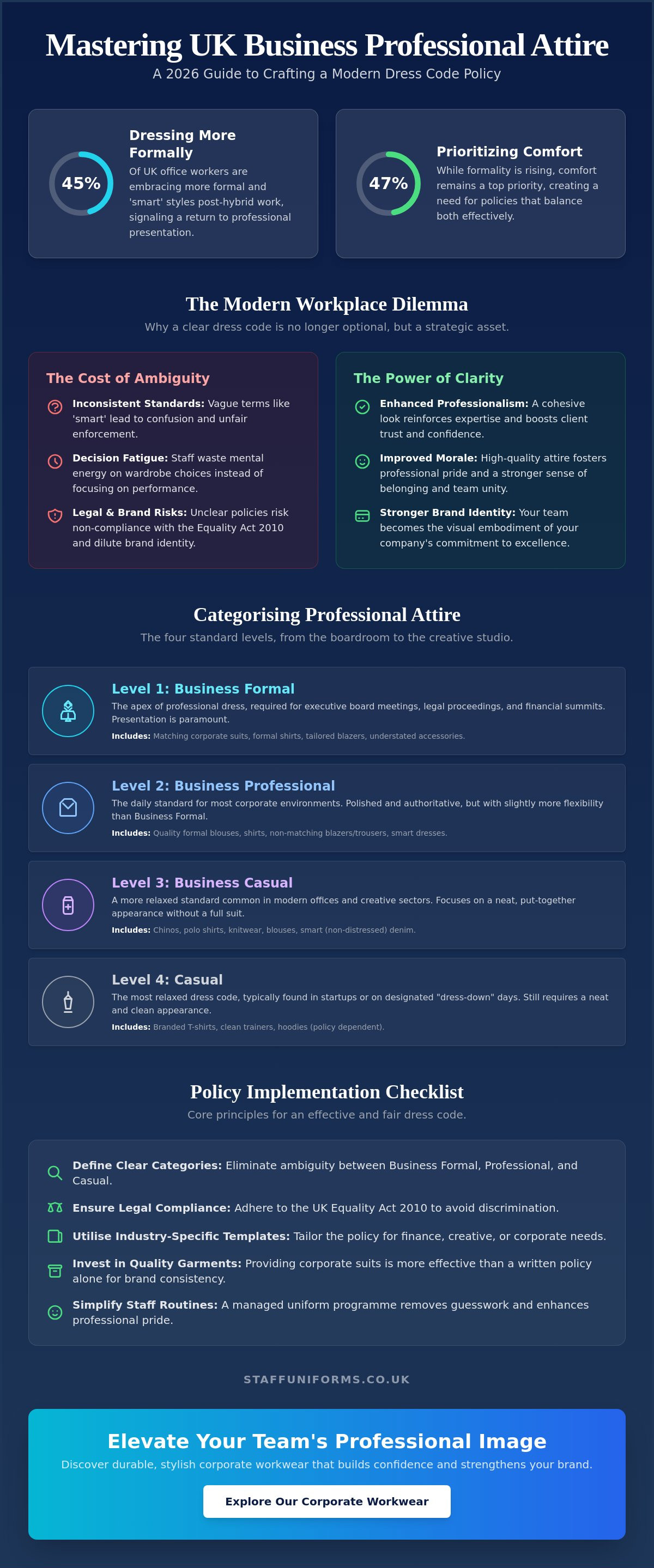
45% of UK office workers are now dressing more formally than in previous years, yet many businesses still struggle to define exactly what constitutes business professional attire uk in 2026. While comfort remains a top priority for 47% of staff, the return to the office has brought a renewed focus on professional presentation and brand consistency. You likely understand the challenge of enforcing standards fairly while navigating the nuances of the Equality Act 2010. It's difficult to maintain a sharp corporate identity when definitions of 'smart' remain ambiguous and staff are left guessing.
This guide helps you master workplace standards with a clear roadmap for drafting and implementing a modern dress code. You'll learn how to create a policy that simplifies morning routines for your team and ensures your staff represents your brand with quiet confidence. We'll explore practical policy examples, legal requirements for reasonable adjustments, and how investing in durable corporate suits and blouses can improve internal morale and external perceptions of your business.
Key Takeaways
- Define clear distinctions between Business Formal and Business Professional categories to eliminate ambiguity for hybrid workforces.
- Understand exactly what constitutes business professional attire uk to ensure your policy adheres to the Equality Act 2010 and avoids gender discrimination.
- Utilise industry-specific templates to tailor your dress code, whether you require the authority of traditional finance wear or the flexibility of creative sectors.
- Learn why providing quality corporate suits and formal shirts is more effective for maintaining brand consistency than a standalone written policy.
- Discover how a managed uniform programme simplifies staff routines and enhances the psychological impact of professional pride in the workplace.
The Role of a Professional Office Wear Policy in 2026
A professional office wear policy is a structured set of guidelines that establishes clear expectations for employee appearance and grooming. It isn't just about enforcement; it's a strategic asset for the modern UK business. As we move through 2026, the shift toward hybrid and flexible working models has created a unique challenge. Employees often move between home environments and high-stakes client meetings, making it difficult to understand what constitutes business professional attire uk without a formal framework. A cohesive policy acts as a vital tool for success, fostering a sense of belonging and ensuring safety while representing the brand with excellence.
Clarity is the foundation of a successful workplace. A well-defined policy reduces decision fatigue for staff every morning, allowing them to focus on performance rather than wardrobe anxiety. There is a proven psychological link between what we wear and how we work. When employees dress in high-quality attire, it fosters professional pride and a sense of belonging within the team. The primary goals are simple: protect the brand's reputation, ensure workplace safety, and create a unified culture that mirrors the high standards of your service.
Why Ambiguity is the Enemy of Professionalism
Vague terms like 'appropriate' or 'professional' are subjective and often lead to inconsistent enforcement. When a manager's definition of smart differs from an employee's, frustration follows. To avoid this, businesses must be specific about Categorising Professional Attire: The Four Standard Levels. This removes guesswork and sets a level playing field for everyone. Without these definitions, it becomes impossible to fairly answer the question of what constitutes business professional attire uk in a way that respects the Equality Act 2010. Clarity protects both the employer and the employee, ensuring standards are applied equitably across the entire workforce.
Branding Beyond the Logo: The Visual Identity
Your team is the face of your business. Clothing is a vital tool for success, not just a daily requirement. Consistent use of corporate suits and formal blouses creates a visual identity that speaks of expertise before a word is even spoken. High standards in presentation directly impact client trust and authority. When your workforce looks cohesive, it reinforces your brand's commitment to excellence and durability. This visual consistency ensures that every interaction, whether in a major corporate meeting or a regional office, carries the same weight of professional reliability and quiet confidence.
Categorising Professional Attire: The Four Standard Levels
The UK workwear market is currently experiencing a notable shift toward structured dressing. Data from late 2025 indicates that 45% of office workers are dressing more formally than in previous years, with 27% adopting 'smart' styles and 25% opting for 'smart casual'. To manage these expectations effectively, businesses must define specific tiers of dress. Understanding what constitutes business professional attire uk requires a granular look at four distinct levels of formality, moving from high-stakes boardrooms to modern hybrid offices.
Level 1 & 2: Formal and Professional Standards
Business Formal represents the highest level of professional representation. It is reserved for high-stakes environments such as legal proceedings, financial summits, or executive board meetings. The core components include matching corporate suits, formal shirts, and tailored blazers. In these roles, grooming and accessories must remain understated and precise. Fabric longevity is a critical factor here. Daily-wear garments must withstand frequent use while maintaining a sharp, crisp silhouette.
Business Professional serves as the daily standard for most corporate and financial sectors. While slightly less rigid than formal wear, it still demands a high level of polish. Integrating UK Legal Compliance and Policy Frameworks into your definitions ensures these standards are applied fairly across your workforce. Choosing high-quality formal blouses and shirts ensures your team remains comfortable without sacrificing authority. If you are looking to upgrade your team's daily standard, you can view our range of professional workwear designed for durability and style.
Level 3 & 4: Casual and Smart Casual Nuances
Business Casual balances comfort with an approachable professional aesthetic. It moves away from the full suit but retains a structured look. Smart Casual, the standard for many creative and tech-focused offices in 2026, focuses on versatility. Defining the 'smart' in smart casual is essential to prevent standards from slipping into purely relaxed wear. This level typically incorporates chinos, high-quality polo shirts, and clean knitwear.
Clarity is vital when defining what constitutes business professional attire uk in casual settings. Prohibited items must be clearly identified to avoid confusion. Sportswear, ripped denim, and overly graphic t-shirts generally remain unprofessional, even in flexible environments. You can maintain brand authority without a full three-piece suit by focusing on fit and fabric quality. A well-fitted pair of workwear trousers paired with a crisp polo shirt ensures staff look capable and ready for client interaction, even in a more relaxed office culture.
UK Legal Compliance and Policy Frameworks
Drafting a dress code isn't just a matter of aesthetics; it's a legal necessity to ensure fairness and safety. In the UK, the Equality Act 2010 serves as the primary legislation governing workplace standards. This Act protects nine specific characteristics, including age, disability, race, and religion. When defining what constitutes business professional attire uk, your policy must be applied equitably. While requirements for men and women don't need to be identical, they must be of an equivalent standard. For example, requiring women to wear high heels or makeup while having no equivalent for men is likely to be considered discriminatory. Employers should focus on the overall level of formality rather than gender-specific restrictions.
Health and safety considerations often take precedence over corporate style. Under the Health and Safety at Work etc. Act 1974, certain roles may require specific protective gear. If your team works near machinery or in high-traffic areas, loose clothing or certain footwear might be prohibited. In these cases, functional safety is the priority. However, for most office-based roles, the focus remains on brand representation. Balancing these requirements requires a strategic approach that respects both the law and your corporate identity.
Navigating Protected Characteristics
A truly professional policy is inclusive by design. This means considering how grooming standards might impact different ethnicities or hair types. Restrictive rules regarding hairstyles can inadvertently target specific groups, leading to claims of indirect discrimination. Similarly, you must make reasonable adjustments for employees with disabilities. This might involve allowing alternative fabrics for those with sensory processing issues or modifying footwear requirements for staff with mobility aids. By addressing these needs during the drafting stage, you create a workplace where everyone feels respected and capable of performing their best.
Enforcement and Disciplinary Procedures
Consistency is the key to fair enforcement. Managers need specific training to ensure they apply the dress code uniformly across the entire team. If a breach occurs, it's vital to handle the situation with discretion. Private, respectful conversations are far more effective than public reprimands. Establishing a clear, multi-step process for addressing issues helps maintain morale and prevents legal complications. Research from Acas on Implementing Your Policy: From Document to Delivery highlights that employee perception of fairness is directly linked to how consistently rules are applied. When staff understand what constitutes business professional attire uk and see it enforced fairly, they are more likely to take pride in their professional appearance.
Professional Office Wear Policy Examples by Industry
A one-size-fits-all policy often fails because it ignores the specific functional needs of different sectors. A financial analyst in London and a creative director in Bristol have different requirements for their daily roles. To define what constitutes business professional attire uk for your specific business, you must align your standards with your industry's expectations and client interactions. This ensures your team projects the right level of authority while remaining comfortable enough to perform their duties efficiently.
Example 1: Corporate Finance and Law Firm
In high-stakes environments like law and finance, tradition and authority are paramount. These sectors typically adhere to 'Business Formal' standards. Requirement: Full corporate suits and blazers in dark, neutral tones like navy, charcoal, or black. Standard: Ironed formal shirts and blouses with minimal, professional patterns. Guidance: Client-facing roles must maintain this standard at all times to project expertise and reliability. This consistency builds trust with high-value clients and reinforces the firm's reputation for precision.
Example 2: Healthcare or Spa Administration
Healthcare and spa management roles require a balance between clinical professionalism and a welcoming, service-oriented warmth. Requirement: Professional beauty spa uniforms or tunics that allow for movement. Standard: Closed-toe, comfortable footwear suitable for active shifts and frequent walking. Guidance: The policy should emphasise hygiene while maintaining administrative authority. High-quality tunics ensure staff look polished while meeting the practical demands of a medical or wellness environment.
Creative, Tech, and Hospitality Variations
Creative and tech industries often adopt a 'Smart Casual' framework. The focus here is on individual expression within a professional frame. Even in these relaxed settings, understanding what constitutes business professional attire uk is necessary to prevent standards from becoming too casual. You might allow dark denim or clean trainers, but only when paired with structured blazers or crisp polo shirts. In hospitality management, the priority shifts to durability and brand colours. Hospitality uniforms must withstand long shifts and high-intensity environments. Using hospitality aprons and workwear trousers in your corporate colours helps maintain brand consistency across the front-of-house team.
Choosing the right garments is the first step toward a successful policy. You can browse our full collection of industry-specific workwear to find durable, high-quality pieces that fit your brand's unique requirements. Whether you need the sharp lines of a corporate suit or the functional comfort of a healthcare tunic, we provide the tools your team needs to succeed.
Implementing Your Policy: From Document to Delivery
A policy is only as effective as its execution. Many businesses fall into the trap of writing detailed handbooks without providing the tools to follow them. When you leave the interpretation of a dress code to individual staff members, you invite inconsistency and frustration. Providing the uniform is a far more efficient strategy than simply setting a dress code. When you provide high-quality garments, you remove the ambiguity of what constitutes business professional attire uk for every member of your team. This proactive approach ensures that your brand identity remains sharp and unified across all departments.
A managed uniform programme offers significant logistical benefits for large UK workforces. It centralises procurement and ensures that every employee, from the boardroom to the front desk, meets the same high standard. Choosing the right fabrics is essential for success. You need materials that withstand the rigours of daily office wear and frequent washing without losing their shape or colour. Utilising custom staff uniforms uk allows you to reinforce your brand identity through subtle customisation, such as bespoke embroidery or specific colour palettes that match your corporate logo.
Procurement Strategies for 2026
Modern procurement requires a focus on longevity and excellence in manufacturing. It's no longer enough to buy off-the-shelf items that wear out within months. Evaluate your suppliers based on their material performance and the durability of their tailoring. Bulk ordering is a sensible strategy for maintaining stock for new starters, ensuring they feel part of the team from day one. Many businesses are transitioning from a reimbursement model to a provided uniform model. This shift gives you total control over the visual standards of your workforce and eliminates the administrative burden of processing individual receipts.
Next Steps for Your Business
Now is the time to review your current appearance guidelines against 2026 standards and the Equality Act 2010. Ambiguity leads to poor brand representation and potential legal risks. By defining what constitutes business professional attire uk through physical garment provision, you support your staff and protect your corporate image. Consult with a specialist supplier to select a range that balances authority with comfort for your specific sector. To bring your updated policy to life, explore our professional corporate range and discover how high-quality workwear can transform your business culture.
Building a Unified Professional Presence
Establishing a clear dress code is a strategic investment in your brand's authority. By removing ambiguity around what constitutes business professional attire uk, you create a legally compliant environment where staff feel confident and prepared. Shifting from a written policy to providing high-quality garments ensures consistency across your entire workforce. This approach eliminates individual interpretation and reinforces your corporate identity through every client interaction.
We are a specialist UK supplier with deep expertise in the corporate, healthcare, and hospitality sectors. Our service includes high-quality logo embroidery and customisation to help you maintain a sharp, professional edge. Design your professional workforce identity with The Staff Uniform Company. Investing in durable, well-fitted attire is a vital tool for your business's long-term success. Your team deserves to wear their professional pride with confidence.
Frequently Asked Questions
Can a UK employer legally force staff to wear a suit?
Yes, UK employers can mandate specific attire like suits as long as the policy doesn't discriminate against protected characteristics under the Equality Act 2010. The requirement must be a proportionate way to achieve a legitimate business goal, such as maintaining a professional image for client meetings. It's essential that these standards are equivalent for all staff members to avoid claims of sex discrimination.
How do I handle dress code violations fairly in a hybrid work environment?
Fairness starts with clear communication about expectations for office days versus remote work. If a violation occurs during a client-facing moment, address it through a private, respectful conversation immediately. A multi-step disciplinary process ensures consistency and transparency. Focus on how the attire affects brand representation rather than personal style to maintain a professional and helpful tone during the discussion.
Are there specific grooming standards for religious reasons I must follow?
Employers must accommodate religious dress and symbols unless they pose a significant health and safety risk. This includes items like hijabs, turbans, or crosses. Flexibility is the legal expectation in the UK. Any restriction must be justified by a genuine occupational requirement, such as preventing loose clothing from getting caught in machinery or meeting strict clinical hygiene standards.
What is the difference between business casual and smart casual in 2026?
Business casual typically involves tailored separates like chinos and formal shirts without a tie. Smart casual is more relaxed, often pairing dark denim with a structured blazer or a high-quality polo shirt. Understanding what constitutes business professional attire uk helps distinguish these from the highest formal tier. In 2026, the trend is moving back toward structure, making the 'smart' element of these categories more important than ever.
Should I provide a clothing allowance or supply the uniforms directly?
Directly supplying uniforms is the most effective way to ensure brand consistency and fabric longevity. While an allowance gives employees choice, it often leads to a fragmented visual identity as staff interpret the policy differently. Providing items like corporate suits or branded blouses ensures everyone meets the same technical standard of excellence while simplifying the morning routine for your workforce.
How can I make my office wear policy more inclusive for gender-neutral staff?
Focus on the level of formality rather than gendered categories. Instead of listing "men's shirts" and "women's blouses," use neutral terms like "professional tops" or "tailored trousers." This approach ensures your policy is inclusive by design. It allows all employees to follow the dress code in a way that aligns with their gender identity while maintaining the high standards required for your corporate image.
What are the common mistakes when drafting a new dress code policy?
The most frequent error is using vague language like "appropriate" or "professional" without specific examples. This ambiguity makes it difficult for staff to know what constitutes business professional attire uk in your specific office. Other mistakes include failing to account for reasonable adjustments for disabled employees or ignoring the psychological impact that high-quality, comfortable clothing has on internal morale and professional pride.