
The lower monthly fee of a rental contract might actually be the most expensive way to clothe your team over a three year cycle. When evaluating renting vs buying staff uniforms uk, many procurement officers find that "predictable" rental costs often include hidden replacement fees and rigid terms that don't account for staff turnover. While renting offers initial flexibility, direct ownership typically delivers a superior ROI for businesses prioritizing brand consistency and garment fit. You likely already feel the pressure of balancing high upfront costs against the need for a professional, durable workforce appearance that meets UK safety standards.
This guide provides a definitive 2026 TCO comparison to help you navigate these complex procurement decisions with confidence. We'll show you how to weigh the benefits of bespoke garment technology against the convenience of outsourced laundry logistics. You'll learn which model best supports your brand image while ensuring full compliance with current UK hygiene and safety regulations. We've broken down the entire process from initial design to final delivery so you can make an informed choice that boosts both staff morale and your bottom line.
Key Takeaways
- Compare the long-term ROI of direct ownership against the convenience of managed rental services to optimize your 2026 procurement budget.
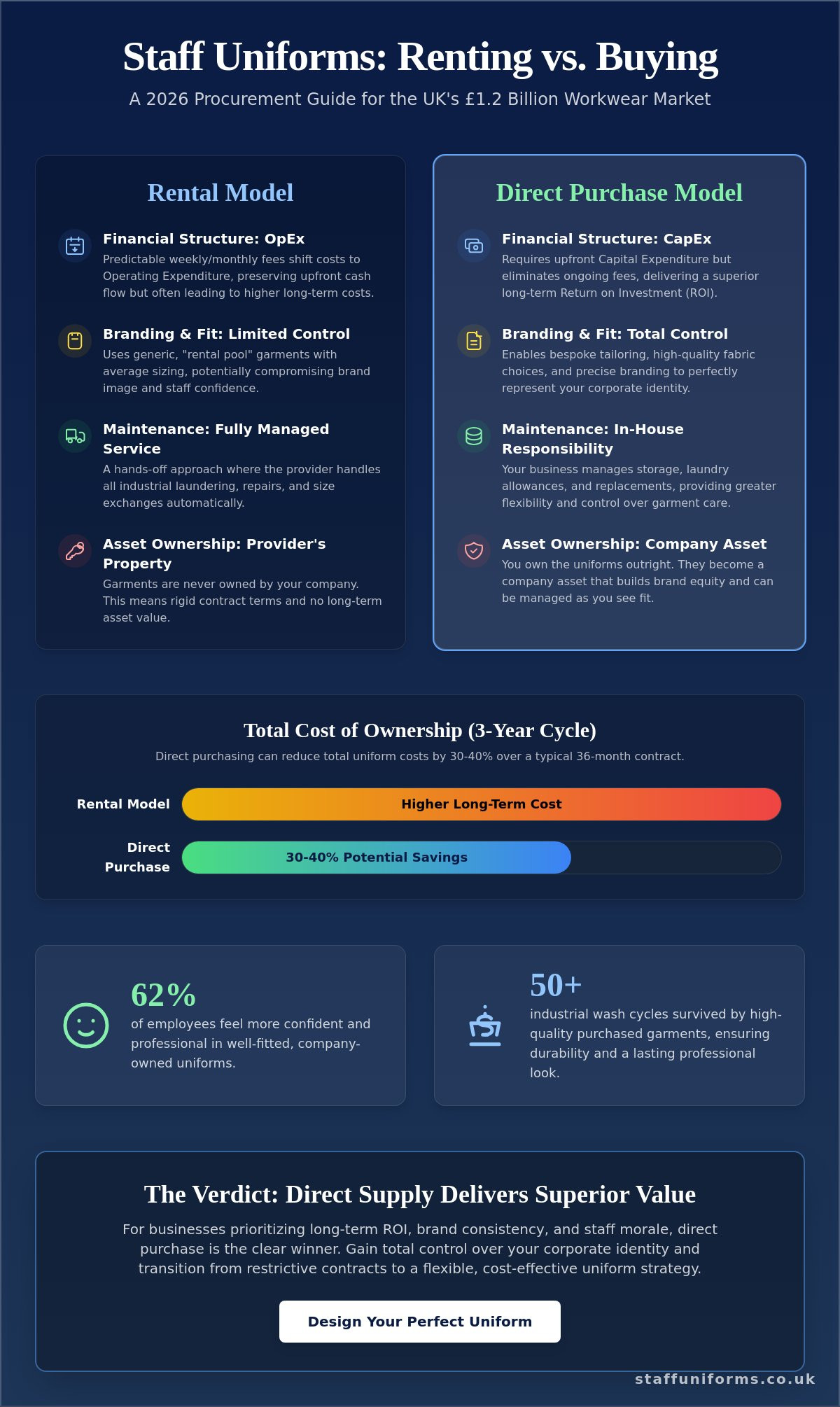
- Discover why the financial case for renting vs buying staff uniforms uk often tips in favour of purchase, potentially reducing total costs by 30-40% over three years.
- Gain total control over your corporate identity with bespoke tailoring and high-quality fabric choices that standard rental models often lack.
- Identify the ideal procurement strategy for your specific sector, ensuring your uniform choice aligns with both operational needs and staff morale.
- Access a practical roadmap for transitioning from restrictive rental contracts to a more flexible and cost-effective direct-supply model.
The Staff Uniform Dilemma: Renting vs Buying in the UK Market
Selecting the right apparel strategy is a critical decision for UK businesses in 2026. The choice between renting vs buying staff uniforms uk affects your cash flow, your team's morale, and your environmental footprint. Currently, the UK workwear market is valued at over £1.2 billion. There's a sharp focus on garment longevity and smart branding as companies move away from low-cost, high-turnover clothing. Precision matters. Your uniform is a tool for success, not just an expense.
The Rental Model operates as a fully managed service. A provider supplies the garments and handles all industrial laundering, technical repairs, and size exchanges. It's a hands-off approach for facility managers. Conversely, the Direct Purchase Model involves buying your inventory outright. You own the assets. Your business must manage internal storage, staff laundry allowances, and replacement cycles. While the history of workwear shows a traditional preference for ownership, modern service-led models are gaining ground due to their operational simplicity.
The Core Differences at a Glance
- Financial Structure: Buying requires significant Capital Expenditure (CapEx) upfront. Renting shifts this to predictable Operating Expenditure (OpEx), often billed per wearer, per week.
- Asset Ownership: Purchased uniforms are company assets. Rented garments remain the property of the service provider.
- Maintenance: Buying places the burden of repair and hygiene on the employee or an internal department. Renting automates these tasks through professional facilities.
This decision impacts your bottom line directly. A poor choice leads to uniform churn. This happens when low-quality garments fail within six months, forcing unexpected spending. Your brand perception also hangs in the balance. A crisp, professionally maintained uniform communicates reliability to your customers. A faded, ill-fitting shirt suggests a lack of attention to detail. Professionalism starts with the first impression.
Why 2026 is a Turning Point for UK Procurement
UK businesses are navigating a sophisticated market. Industry data from 2025 shows that 68% of firms now demand sustainable, high-quality fabrics over disposable alternatives to meet Net Zero targets. The rise of hybrid work has also forced a shift. Corporate attire is now more functional. It blends moisture-wicking technology with professional aesthetics. Economic pressures in the UK mean procurement teams must justify every pound spent. They need durable solutions that survive 50 or more industrial wash cycles without losing shape or colour. Efficiency isn't just a goal; it's a survival tactic. Choosing between renting vs buying staff uniforms uk is how your business adapts to this quality-conscious economy.
Evaluating the Rental Model: Convenience vs Long-Term Commitment
The "all-in-one" promise of a rental model is seductive for procurement teams across the UK. It offers a managed solution where laundry, repairs, and automatic replacements are bundled into a single weekly fee. When weighing up renting vs buying staff uniforms uk, the primary draw is operational simplicity. A facility manager in a high-turnover environment, such as a 200-bed hotel or a busy distribution centre, can offload the logistics of garment maintenance entirely. This model ensures that every staff member has a clean, functional kit at the start of every shift without the company needing to manage an internal laundry room.
Predictable monthly budgeting is another significant advantage. Instead of a large capital expenditure (CAPEX) every two years, businesses pay a set rate per wearer. This preserves cash flow for other areas of the business. However, this convenience comes with a trade-off in staff professional pride. Rental garments are frequently designed for the "average" body type to ensure they can be recycled through a "rental pool." These generic sizes often lack the sharp, tailored fit of purchased items. When clothing doesn't fit well, staff morale can suffer; a 2024 industry survey suggested that 62% of employees feel more confident in well-fitted, branded workwear compared to generic rental alternatives.
Over a standard 36-month contract, the total cost of ownership often tells a different story. While the weekly fee seems small, the cumulative cost frequently exceeds the purchase price of high-quality garments by 150% or more. It's also vital to consider that employees may be eligible for tax relief on uniforms if they are responsible for cleaning their own kit, a benefit that disappears under a fully managed rental laundry service.
The Hidden Costs of Rental Contracts
Rental agreements in the UK often contain clauses that can inflate the total cost. Most contracts include "lost garment" charges, which can be as high as £40 for a single pair of trousers that goes missing. Furthermore, price escalation clauses allow providers to increase rates by 3% to 5% annually, regardless of your initial budget. At the end of a 3-year term, you may also face residual value payments to "buy out" the aged stock if you decide to switch providers or move to a purchase model.
Hygiene and Compliance Standards
In certain sectors, professional industrial laundering is a legal requirement rather than a luxury. For heavy industry or food manufacturing, rental services ensure compliance with strict hygiene standards that domestic washing cannot reach. These providers manage EN ISO 20471 safety standards for hi-vis gear, ensuring that the reflective properties aren't degraded by incorrect washing temperatures. However, for specialized healthcare scrubs, the "pool" system can be a limitation; surgeons and specialists often prefer the consistency and specific fabric tech of their own dedicated garments. If you are looking for more control over your brand image, you might consider our bespoke uniform options as a durable alternative to generic rental stock.
The Case for Direct Purchase: Control, Branding, and ROI
Directly purchasing your workwear offers a level of autonomy that rental contracts simply cannot match. When you own your inventory, you maintain total control over garment quality, fabric choices, and bespoke tailoring. This ensures every employee represents your business exactly as intended. Procurement managers often find that while the initial outlay is higher, the long-term ROI is substantial. Industry data shows that comparing the pros and cons of renting vs buying reveals ownership is often 30-40% cheaper over a three-year period. You avoid the recurring service fees and hidden replacement charges common in rental agreements.
Staff morale also sees a significant boost when teams wear high-quality, well-fitted attire. Off-the-shelf rental garments frequently suffer from a "one size fits many" approach, leading to poor fit and reduced professional pride. Ownership allows for precise sizing tailored to your specific workforce. It also provides the flexibility to update your brand identity instantly. You aren't locked into a multi-year contract that makes changing a logo or colour scheme a legal headache. When weighing up renting vs buying staff uniforms uk, the ability to pivot your brand image without renegotiating a contract is a major strategic benefit.
Unrivalled Branding Opportunities
High-impact branding starts with precision. Custom logo embroidery builds immediate customer trust and sets a high standard for your service delivery. Rental pools often limit you to standard colours and generic styles. By buying direct, you can specify exact Pantone brand colours that rental providers don't stock. This ensures perfect consistency across different garment types. Your front-of-house blazers will perfectly match your warehouse polos, creating a unified corporate image that reinforces your brand's reliability.
Quality and Longevity
Ownership lets you dictate the technical specifications of your workwear. You can select premium fabrics designed for 50+ industrial washes, ensuring garments look professional for longer. There's a stark difference between rental-grade polyester blends and premium wool or cotton-rich fabrics. High-quality materials resist pilling and fading, which reduces the frequency of replacements. Effective inventory management becomes easier when you own the stock. You can track wear and tear accurately and maintain a small buffer of spares without paying monthly storage fees to a third party. This approach reduces textile waste and ensures your team always has access to fresh, durable gear. For many UK businesses, renting vs buying staff uniforms uk comes down to this balance of superior quality versus service convenience.
Sector-Specific Analysis: Which Model Fits Your Industry?
Every workplace carries unique operational demands. A warehouse environment requires different safety protocols than a law firm, and your procurement strategy must reflect these realities. In 2026, UK businesses are moving away from generic solutions to find the specific balance between safety compliance and corporate identity. Deciding on renting vs buying staff uniforms uk depends heavily on your staff turnover rates and hygiene risks. High-turnover sectors often lean toward rental to mitigate the cost of lost garments, while stable teams in professional settings benefit from the quality of ownership.
Corporate and Office Environments
Purchasing is the standard for office settings where the visual impact is paramount. High-quality corporate suits require precise tailoring to look professional, and rental services rarely provide the bespoke fit necessary for client-facing roles. For UK SMEs with 10 to 50 employees, buying allows for better brand consistency and individual pride. It's about the human element of workwear. Staff feel more valued in a suit that's theirs, rather than a generic garment from a shared pool. Ownership ensures that every blazer and trouser set maintains a sharp, professional silhouette that reflects your brand's standards.
Healthcare and Beauty Sectors
Hygiene is non-negotiable in clinical and aesthetic environments. While some large hospitals utilize industrial laundry, many modern private clinics prefer staff-owned scrubs UK providers. High-performance fabrics now allow for effective home-laundering at 60°C, which meets strict UK infection control standards. In the beauty industry, beauty spa uniforms need a personal touch that rental models cannot provide. Therapists require specific styles that allow for a full range of motion. Ownership ensures every therapist has a fresh, perfectly fitted tunic that doesn't suffer from the "greyed" look often seen in mass-laundered rental stock.
Hospitality and Kitchens
The intensity of a commercial kitchen is a major factor in your decision. When evaluating renting vs buying staff uniforms uk, you must consider the speed of wear and tear. Leading hospitality workwear suppliers suggest that bulk purchasing chef jackets is approximately 15% to 20% more cost-effective over a two-year cycle than ongoing rental contracts. For front-of-house staff, items like aprons and waistcoats are easily managed in-house. If you're planning a wider refresh, our uniforms for front of house staff cover everything from blouses and shirts to smart accessories. This gives managers total control over the brand's visual identity during peak seasons without being tied to restrictive laundry collection schedules.
Ready to equip your team with high-quality, durable workwear? View our full range of industry-specific uniforms today.
Implementing Your Uniform Strategy: Why Direct Supply Wins
Transitioning from a restrictive rental contract to a direct purchase model is a strategic move for any UK business. When weighing up renting vs buying staff uniforms uk, the primary advantage of ownership is the total control you regain over your brand image and budget. Most businesses find they can reduce their annual uniform spend by up to 30% simply by eliminating weekly rental fees and hidden loss charges. Moving to ownership requires a clear plan, but the long-term ROI is undeniable. When analyzing renting vs buying staff uniforms uk for your 2026 budget, the data shows that ownership provides better garment quality for a lower total cost of ownership.
The Procurement Process Simplified
A successful transition starts with precision. Don't rely on generic size charts. We recommend a physical sizing exercise for every team member. A well-fitted uniform lasts longer; garments that are too small suffer from premature seam failure, while oversized clothing looks unprofessional. Once you've selected your core range, order samples. Test them for durability and colour fastness. A standard 60-degree wash test will reveal how the fabric holds up to repeated laundering. Finally, set up a top-up system. Keeping a 10% stock buffer ensures new starters are ready for their first shift without delay. If you're outfitting a larger team, buying wholesale uniforms lets you secure consistent sizing and pricing across every department in one order.
Why Partnering with The Staff Uniform Company Makes Sense
We provide a comprehensive all-in-one service that takes the stress out of procurement. From initial design consultation to UK-wide delivery, we manage every detail. You'll get access to premium brands and the latest garment technology, including moisture-wicking fabrics and high-tenacity embroidery. As an independent UK expert, we don't hide behind complex contracts. We offer straightforward, expert advice to help you build a uniform range that your staff are proud to wear. View our full range of professional workwear and get a quote today.
Managing your own laundry is often the biggest concern for businesses leaving rental agreements. You have two practical options. Many modern firms implement a home-wash policy, which is highly effective for standard workwear. For specialized or heavy-duty requirements, partner with a local, no-contract commercial cleaner. This gives you the flexibility to pay only for what you wash, rather than being tied to a fixed weekly volume or a rigid long-term contract.
Final Checklist for Your 2026 Uniform Procurement
- Contract Audit: Confirm the notice period on your current rental agreement to avoid overlap costs.
- Brand Standards: Decide between embroidery for longevity or screen printing for high-visibility logos.
- Stock Buffer: Calculate a 10% to 15% surplus for replacements and new hires based on your 2025 staff turnover rates.
- Supplier Reliability: Choose a UK partner with a proven track record and transparent lead times.
Future-Proof Your Workforce Strategy
Deciding on the best path for renting vs buying staff uniforms uk requires a clear focus on long-term value and brand autonomy. While rental models offer initial ease, they often result in restrictive contracts and higher cumulative costs over a standard three-year procurement cycle. Direct purchase allows your business to maintain strict control over garment quality and branding precision. By selecting high-durability fabrics designed for professional environments, you're ensuring your team looks impeccable while significantly reducing the frequency of replacements.
We provide expert UK-based support to guide you through every step of the 2026 procurement process. As specialists in corporate, healthcare, and hospitality attire, we focus on technical garment features like moisture-wicking and reinforced stitching that standard rentals often overlook. This approach doesn't just save money; it boosts staff morale by providing high-quality workwear they're proud to wear. It's time to move away from generic, outsourced solutions and embrace a strategy that truly reflects your corporate identity.
Explore our 2026 collection and take control of your brand identity
Your business deserves a professional image that's built to last.
Frequently Asked Questions
Is it cheaper to rent or buy staff uniforms in the UK?
Buying is generally more cost-effective for businesses with stable headcounts, while renting offers predictable monthly cash flow. When evaluating renting vs buying staff uniforms uk, consider that purchasing involves a one-off capital expenditure. Renting includes ongoing service fees for laundering and maintenance, which can exceed the purchase price over a three-year contract period. Businesses with high staff turnover often find buying more economical to avoid contract termination fees.
What happens to rented uniforms when a staff member leaves?
Rented uniforms are returned to the service provider for professional cleaning and redistribution or recycling. Most UK rental agreements require you to notify the supplier within 7 days of an employee's departure to stop the service charges for those specific items. The provider inspects the garments for wear and tear before placing them back into your stock pool. This system keeps your storage areas clear and ensures your brand identity remains protected.
Can I get my company logo on rented uniforms?
Yes, you can apply your corporate branding to rented garments through high-quality embroidery or heat-seal transfers. These bespoke options ensure your team looks professional and stays aligned with your corporate identity. It's important to remember that branded items often carry a residual value charge. If you cancel the contract early, you'll likely pay for the remaining life of those specific branded garments because they can't be reissued to other clients.
How long do purchased staff uniforms typically last?
Purchased uniforms generally last between 12 and 18 months in a standard retail or office environment. For 2026 procurement planning, expect high-quality polyester-cotton blends to withstand approximately 50 to 60 industrial wash cycles before showing signs of degradation. Heavy-duty workwear used in construction or engineering may require replacement sooner. Regular fabric inspections help maintain a sharp professional image and ensure all safety standards are met consistently.
Do I need to provide laundry for my staff if I buy uniforms?
You aren't legally required to provide laundry services for standard purchased uniforms unless they're classified as specialist PPE. Most UK employers allow staff to wash their own kits at home, provided they maintain a clean and professional appearance. However, providing a managed laundry solution for purchased items can improve garment longevity. This is a practical solution for industries like food production where thermal disinfection is a strict hygiene requirement.
What are the tax implications of providing staff uniforms in the UK?
HMRC rules specify that uniforms are a non-taxable benefit if they're clearly branded and essential for the job role. To qualify, the clothing must be a recognisable uniform that an employee wouldn't wear in their private life. In the 2024/25 tax year, many employees could claim a flat-rate tax deduction of £60 per year for cleaning their own uniforms. This tax efficiency makes branded workwear a popular choice for boosting staff morale and professional pride.
Which industries benefit most from a managed rental service?
Healthcare, food processing, and heavy engineering sectors benefit most from managed rentals due to stringent hygiene and safety regulations. These industries require technical fabrics like moisture-wicking materials and industrial-grade laundering that kills bacteria at high temperatures. A managed service removes the logistical burden of tracking thousands of garments. It guarantees that every worker has a clean, compliant kit ready for every shift without fail.
Can I switch from renting to buying mid-contract?
Switching from a rental model to a purchase model mid-contract is possible but usually incurs a buy-out fee. You'll typically need to pay the residual value of the garments currently in circulation plus a contract notice fee. Review your service agreement for specific termination clauses before making this procurement shift. It's a strategic move if your business scaling plans change and you prefer to own your assets and manage branding in-house.