
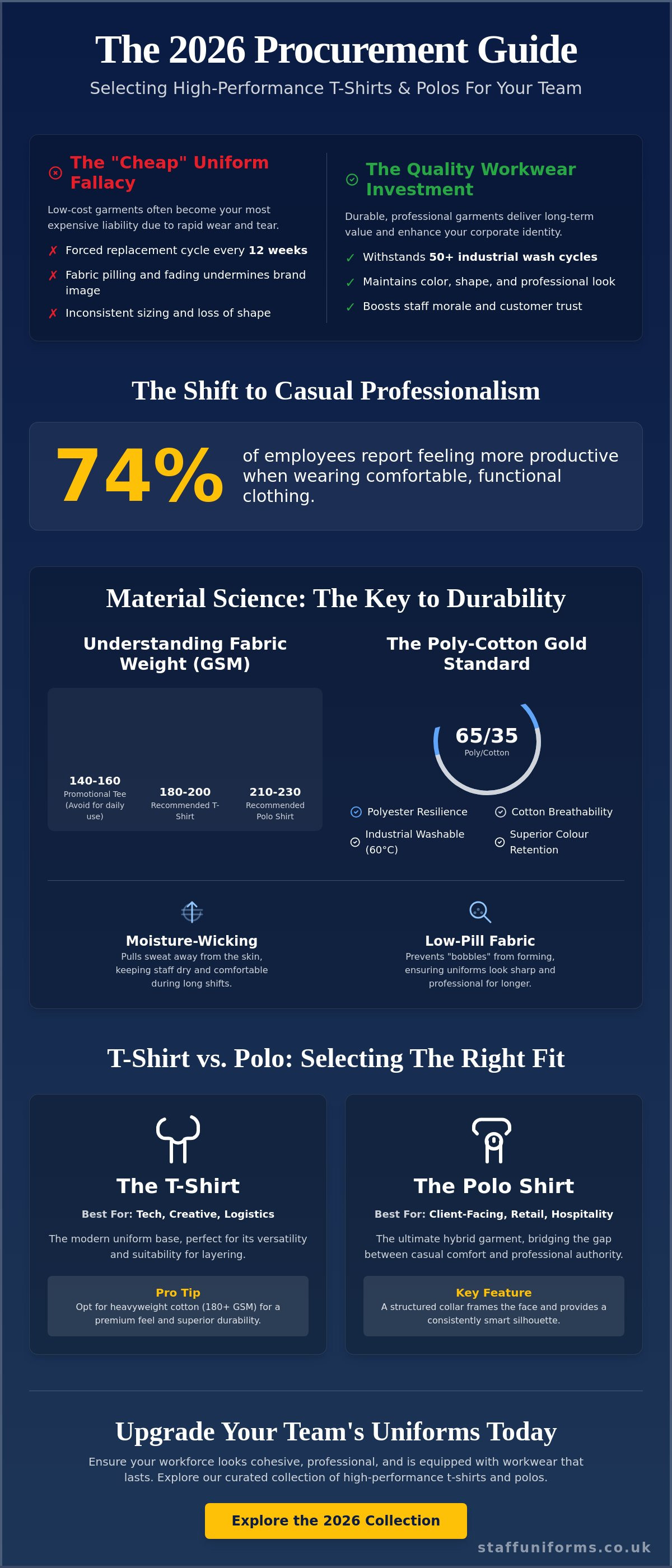
A "cheap" uniform often becomes your most expensive investment when fabric pilling and fading force a full replacement cycle every 12 weeks. You understand that your team's appearance is a direct reflection of your business standards, yet finding high-quality t-shirts & polos that survive the industrial wash while remaining comfortable is a common procurement headache. It's frustrating to see a professional brand identity undermined by inconsistent sizing or fabrics that lose their shape after a single season of use.
We agree that your staff deserve workwear that works as hard as they do. This 2026 guide provides the technical insights you need to select durable, brand-aligned garments that balance employee morale with professional aesthetics. You'll learn how to evaluate fabric weights, moisture-wicking properties, and bespoke branding options to ensure your workforce looks cohesive and stays productive. We'll explore the specific garment technologies that reduce replacement costs and keep your corporate identity sharp from the first shift to the last.
Key Takeaways
- Master the shift to casual professionalism and understand how comfortable uniforms directly improve staff productivity and brand perception.
- Gain technical insights into GSM and fabric durability to choose high-quality materials that offer the best return on investment for your business.
- Learn how to select the perfect t-shirts & polos by matching garment weight and breathability to your team's specific physical roles.
- Optimise your branding with professional logo placement strategies designed to enhance visibility and foster immediate customer trust.
- Explore our 2026 recommendations for high-performance workwear, including durable poly-cotton blends and premium heavyweight fabrics for high-end retail.
The Shift to Casual Professionalism: Why T-Shirts & Polos Rule the Modern Workplace
The UK workplace has undergone a massive transformation heading into 2026. Traditional suits are becoming rare in most sectors. Businesses now prioritise agility and staff comfort. Casual workwear isn't just about looking relaxed; it's a strategic choice for brand identity. In 2024, industry reports indicated that 74% of employees felt more productive when wearing comfortable, functional clothing. This trend has solidified. Choosing high-quality t-shirts & polos allows a company to project a modern, accessible image while maintaining a unified front.
For high-turnover sectors like retail or logistics, the return on investment is clear. Outfitting a team in durable, branded knitwear costs significantly less than formal tailoring. It also simplifies the procurement process. You can maintain a sharp appearance without the high overheads of delicate fabrics. Balancing this relaxed look with professional authority requires a strategic approach to custom staff uniforms uk businesses trust. Quality branding ensures that even a casual garment carries the weight of your company's reputation. It signals to the customer that your team is prepared, professional, and part of a cohesive unit.
The Polo Shirt: The Ultimate Hybrid Garment
The polo shirt remains the bridge between formal and casual. Its structured design provides a professional silhouette that a standard tee sometimes lacks. This stems from the history of the polo shirt as a garment designed for both athletic performance and social standing. The knitted collar is the key feature here. It frames the face and allows staff to transition from a warehouse floor to a client meeting without looking underdressed. You should choose a polo over a button-down when your team needs to move freely but still needs to command respect in face-to-face service roles. It's a reliable choice for 2026 branding.
T-Shirts as Modern Uniforms
By 2026, the humble t-shirt has been elevated. Tech, creative, and logistics firms often opt for these as their primary uniform. The shift is toward "heavyweight" cotton, typically 200gsm or higher. These garments offer a premium feel and better durability than budget alternatives. They don't lose their shape after three washes. For outdoor or temperature-sensitive environments, layering is the best strategy. A branded t-shirt works perfectly under a softshell jacket or a fleece. This provides a versatile, year-round solution for t-shirts & polos that keeps your team comfortable regardless of the British weather. High-quality screen printing or embroidery on a heavyweight tee ensures the logo remains vibrant and professional through rigorous daily use.
Material Science: Choosing Fabrics That Withstand the Daily Grind
Selecting the right fabric for your team's t-shirts & polos isn't just about the initial feel. It's a technical decision that impacts your long-term budget. Professional workwear must survive 50 or more industrial wash cycles while maintaining its structural integrity. This starts with GSM (Grams per Square Metre). For a standard promotional t-shirt, 140-160 GSM is common, but for daily UK workwear, you need more substance. We recommend 180-200 GSM for t-shirts and 210-230 GSM for polos to ensure the fabric doesn't lose its shape or develop holes under heavy use.
Innovation in fabric engineering, often studied at institutions like the Wilson College of Textiles, has led to the development of high-performance moisture-wicking fabrics. These are vital for hospitality and trade roles where physical activity is high. These materials use capillary action to pull sweat away from the skin, keeping staff dry during 10-hour shifts. To ensure your investment lasts, look for "low-pill" fabrics. These use longer fibre lengths and tighter spins to prevent the small bobbles that make a uniform look aged and unprofessional after just a few weeks.
The Poly-Cotton Advantage
The 65/35 poly-cotton blend remains the UK industry gold standard for a reason. It combines the natural breathability of cotton with the extreme resilience of polyester. This specific ratio allows for industrial laundering at 60 degrees, which is a requirement for hygiene in healthcare and food service sectors. Synthetics hold dye significantly better than natural fibres; a black 65/35 polo will retain its depth of colour for 25% longer than a 100% cotton version. It's a "wash and wear" solution that resists creasing, ensuring staff look sharp even at the end of a busy shift.
Sustainable Fabric Choices for 2026
Sustainability is a core procurement requirement for 85% of UK businesses in 2026. Recycled polyester (rPET) made from post-consumer plastic is now a standard option that matches virgin polyester for durability. Bamboo blends are also popular due to their natural antibacterial properties and soft handle. Longevity is the ultimate form of sustainability. By choosing garments with reinforced shoulder seams and twin-needle stitching, you reduce the frequency of replacement. You can explore our range of durable t-shirts & polos to find the right balance of performance and environmental responsibility.
T-Shirts vs. Polos: Selecting the Right Fit for Your Industry
Choosing between t-shirts & polos isn't just about aesthetics; it's a strategic decision based on daily activity levels and brand positioning. You must analyse the physical demands of your team's role before placing an order. If your staff performs high-intensity manual tasks, a lightweight t-shirt offers the necessary range of motion. For client-facing roles where a sharper silhouette is required, the structured collar of a polo provides an instant professional lift that commands respect.
Climate considerations are equally vital in the UK's unpredictable weather. During the summer months, breathability is the priority. Lightweight fabrics around 140-160gsm allow for better airflow. When winter arrives, heavier 220gsm polos serve as excellent insulating layers. They can be worn comfortably under knitwear or integrated with corporate suits to maintain a unified brand image across different departments.
A "one size fits all" approach often undermines staff confidence. Providing fitted ladies’ cuts alongside gender-neutral options ensures every team member looks professional. Data from 2024 workplace satisfaction reports indicates that 84% of employees feel more motivated when their uniform fits correctly. A well-fitted garment doesn't just look better; it lasts longer because the fabric isn't under unnecessary strain at the seams.
The Choice for Hospitality and Service
Most hospitality workwear suppliers recommend polos for front-of-house staff because they bridge the gap between casual and formal. Stain-resistant finishes are a critical feature in these environments. These coatings prevent liquid spills from soaking into the fibres, which is essential for maintaining a clean appearance throughout a long shift. For kitchen staff, 100% cotton t-shirts are the standard choice. They provide the heat resistance and softness required when working in high-temperature environments near industrial hobs.
Trade and Industrial Requirements
Durability is the non-negotiable factor for construction and logistics. Standard retail t-shirts & polos won't survive the rigours of a warehouse or building site. You should look for garments featuring reinforced seams and twin-needle stitching at the hem and sleeves. This construction prevents fraying and ensures the garment holds its shape after industrial laundering. Many modern designs now integrate hi-vis reflective elements directly into the fabric. This allows your team to remain visible and safe without needing a separate waistcoat in lower-risk zones.
Personalisation and Branding: Making Your Uniform Work for You
A high-quality uniform acts as a mobile billboard. Effective branding transforms standard t-shirts & polos into professional assets that build immediate credibility. Research from the British Promotional Merchandising Association indicates that 96% of recipients believe branded items increase brand awareness. Strategic logo placement is vital. While the left chest remains the industry standard for corporate identity, adding a secondary logo to the right sleeve or the nape of the neck increases visibility during face-to-face interactions. This multi-point branding ensures your team is recognisable from every angle.
Managing size runs for a growing workforce requires a data-driven approach. A standard UK size distribution typically follows a 1-2-2-1 ratio for Small, Medium, Large, and Extra Large. Ordering 15% buffer stock in larger sizes prevents delays when onboarding new staff. We ensure your brand guidelines remain consistent across different fabric types. Polyester-rich polos may reflect light differently than 100% cotton t-shirts; therefore, we use specific Pantone matching to maintain visual unity across your entire range.
Embroidery vs. Screen Printing
Embroidery is the premium choice for polo shirts. It creates a durable, three-dimensional finish that withstands industrial laundering. For lightweight t-shirts, screen printing or Direct to Garment (DTG) technology offers a flatter, softer feel. A high-quality embroidered logo often outlasts the garment itself, maintaining its integrity for over 50 wash cycles. Screen prints provide a cost-effective solution for large-scale promotional events where high-detail graphics are necessary.
The Personalisation Process
Precision starts with your artwork. We require high-resolution vector files to ensure clean edges and accurate needle paths. Every order includes a digital proof, which acts as a final technical check before production begins. This step eliminates errors in scale or positioning. Standard UK turnaround times for custom t-shirts & polos currently average 7 to 10 working days from proof approval. This timeline allows for rigorous quality control and precision finishing.
Ready to elevate your corporate identity? Explore our range of customisable t-shirts & polos to find the perfect fit for your brand.
The Staff Uniform Selection: Top T-Shirts & Polos for 2026
Selecting the right garments for your workforce impacts both brand perception and daily comfort. For 2026, our collection of t-shirts & polos focuses on textile longevity and industry-specific utility. The Essential Poly-Cotton Polo remains our most requested item for general trade and logistics. It's engineered for all-day durability, featuring a 65/35 blend that resists pilling and maintains its shape after 50 or more industrial wash cycles.
High-end retail and tech brands are increasingly moving toward the Premium Heavyweight Tee. These garments utilize a 220gsm combed cotton fabric that provides a structured, retail-ready silhouette. This weight ensures the garment doesn't look transparent under bright office lighting and offers a superior canvas for high-definition embroidery or screen printing.
Healthcare and physical roles require a different technical approach. Our performance-ready active polos utilize moisture-wicking technology to keep staff cool during long shifts. These are particularly effective in clinical environments where hygiene and temperature regulation are critical. Colour trends for 2026 show a shift in the UK market. While Navy remains the dominant choice, accounting for 38% of corporate orders, we've seen a 12% increase in requests for Forest Green and Slate Grey as businesses seek to modernise their visual identity.
Spotlight on Best-Sellers
Our Pro-Pique Polo is a standout for 2026 due to its reinforced neck seams and taped shoulders. These features prevent the "sagging" often seen in cheaper alternatives, ensuring your team looks professional from Monday to Friday. For eco-conscious brands, the Organic Cotton Crew has become a top-tier choice. It meets strict sustainability certifications while maintaining a soft hand-feel that staff appreciate.
- Budget Tier: Value-driven poly-cotton blends for high-turnover seasonal staff.
- Mid-Range Tier: The Pro-Pique series, offering the best balance of cost and long-term wear.
- Premium Tier: Organic cottons and heavyweight tech fabrics for executive and customer-facing roles.
Ready to Upgrade Your Team?
Managing a large-scale uniform rollout shouldn't be a logistical burden. Our online portal allows for seamless re-ordering, letting you track stock levels and past specifications with a few clicks. If you're unsure which fabric weight or branding technique suits your specific environment, consulting with our experts provides the clarity you need. We offer bespoke uniform solutions tailored to the unique demands of your industry, from construction sites to corporate offices.
Future-Proof Your Team’s Professional Image
Selecting the right workwear is a strategic investment in your brand’s reputation. As we move into 2026, the demand for durable, moisture-wicking fabrics and versatile designs continues to grow across the UK. Your choice of t-shirts & polos directly impacts staff morale and customer perception. High-quality garments don't just look better; they withstand the daily grind and maintain their professional finish after repeated washes. Choosing the correct fit for your specific industry ensures your team stays comfortable and productive throughout their shift.
Staff Uniforms has supported the corporate, healthcare, and hospitality sectors since 2017. We maintain over 90 professional styles in stock, ensuring you find the exact match for your business requirements. Our expert UK-based embroidery and printing services provide the precise, high-end branding your logo deserves. We handle the entire process from initial selection to final delivery, removing the complexity from your procurement. It's time to equip your workforce with clothing that reflects the quality of your service and the pride of your team.
Ready to upgrade your company's look? Shop our professional T-Shirts & Polos collection today and build a uniform that works as hard as your staff does.
Frequently Asked Questions
What is the best fabric for a work polo shirt?
A 65% polyester and 35% cotton blend is the most practical choice for most UK work environments. This specific ratio provides the perfect balance between the breathability of natural cotton and the hard-wearing durability of synthetic fibres. It holds its colour through repeated washes and resists the creasing that often plagues 100% cotton garments during a busy shift.
How many t-shirts should I provide per staff member?
You should provide a minimum of 3 to 5 shirts for every full-time employee to ensure they have a fresh garment for every shift. Allocating 5 shirts covers a standard working week and significantly extends the lifespan of the uniform by reducing the frequency of individual garment washes. This approach maintains a consistent professional image and prevents the rapid wear and tear associated with smaller allocations.
Can I get my company logo embroidered on any t-shirt?
Most garments support embroidery, but we recommend a minimum fabric weight of 180 GSM to ensure a professional, pucker-free finish. A standard chest logo typically requires 5,000 to 10,000 stitches, which can be too heavy for lightweight promotional shirts. For thinner fabrics, heat transfer or screen printing provides a much cleaner result that won't distort the garment's shape.
What is the difference between pique and jersey knit polos?
Pique knit features a textured, honeycomb-like weave that's heavier and more breathable, making it the traditional choice for corporate t-shirts & polos. Jersey knit is smooth and flat, similar to a standard t-shirt, offering a softer feel against the skin. Pique is generally more durable and hides perspiration better, while jersey provides a more casual, modern aesthetic for creative or retail roles.
How do I ensure the sizes fit my entire team correctly?
Use a physical size set or a brand-specific size guide because UK sizing can vary by up to 2cm between different manufacturers. Relying on generic labels like Medium or Large often leads to returns and staff dissatisfaction. We provide samples to 100% of our contract clients to ensure every team member feels comfortable and looks professional before we start the branding process.
How long do custom branded polos usually take to deliver in the UK?
Standard delivery for custom branded orders in the UK is typically 7 to 10 working days from the moment you approve your digital artwork. If your order exceeds 500 units, the production timeline may extend to 15 working days to accommodate rigorous quality control checks. We always use tracked couriers like DPD or DHL to ensure your kit arrives safely and on schedule.
What is a good GSM weight for a durable work t-shirt?
A weight between 180 GSM and 200 GSM is the industry benchmark for a durable, professional-grade t-shirt. Garments that fall below the 140 GSM mark are often too sheer for professional use and tend to lose their shape 30% faster than heavier alternatives. Choosing a higher GSM ensures your t-shirts & polos can handle the rigours of daily wear and industrial laundering without thinning.
Do poly-cotton blends shrink in industrial washes?
Poly-cotton blends are specifically engineered to resist shrinking, usually maintaining their dimensions within a 2% margin even in 60-degree industrial washes. The polyester content acts as a stabilising agent that prevents the cotton fibres from contracting. In contrast, 100% cotton garments that haven't been pre-shrunk can lose up to 5% of their original size after the first few wash cycles.