
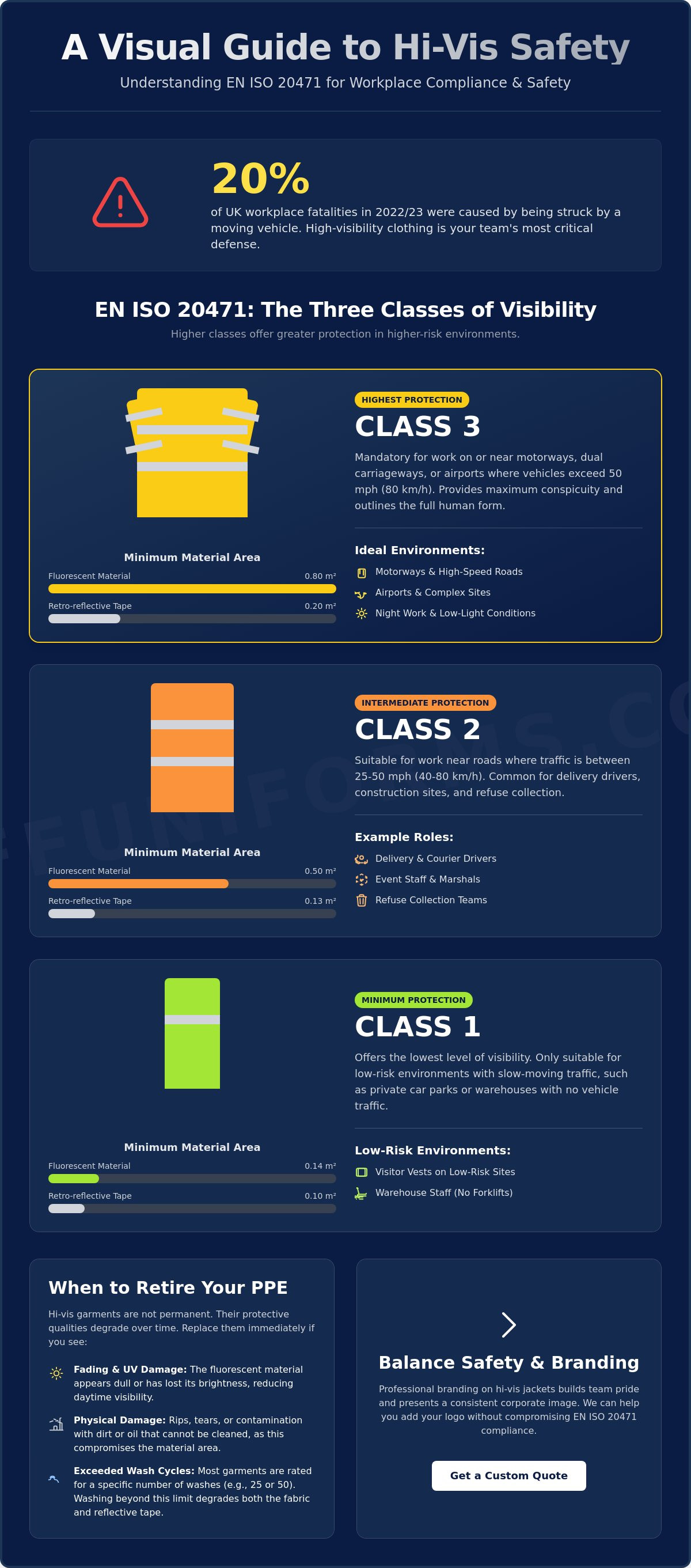
According to the Health and Safety Executive, being struck by a moving vehicle accounted for 20% of all UK workplace fatalities in 2022/23. This figure confirms that your hi vis jackets are not just a line item in the budget; they're the most important tool your team wears. We know that procurement managers often find the technical requirements of EN ISO 20471 confusing, especially when trying to maintain a sharp corporate identity across a large, diverse workforce.
You likely feel that replacing flimsy garments every 90 days is a waste of resources that could be better spent elsewhere. It's a common pain point for businesses that value longevity and professional pride. This guide promises to simplify the selection process by teaching you how to identify high-performance, compliant gear that lasts. We'll cover the three visibility classes in detail, explain how to balance safety with branding, and provide a clear checklist for when to retire worn-out items to ensure your staff stays safe and your business remains fully compliant.
Key Takeaways
- Master the technical requirements of EN ISO 20471 to ensure your team remains fully compliant with UK safety standards for high-risk environments.
- Evaluate the functional benefits of different garment silhouettes, helping you select the ideal hi vis jackets to balance staff mobility with maximum visibility.
- Uncover the critical maintenance factors, such as UV exposure and industrial wash cycles, that determine when your PPE no longer provides adequate protection.
- Streamline your procurement process by learning how to combine bulk ordering with professional branding to maintain a consistent and reliable corporate image.
What are Hi Vis Jackets and Why are They Essential for Workplace Safety?
In the United Kingdom, hi vis jackets serve as a critical line of defense for workers in high-risk environments. These garments are specialized personal protective equipment (PPE) designed to maximize visibility in low-light conditions or where heavy machinery and vehicles operate. Understanding What are Hi Vis Jackets involves looking at their dual-action mechanism. They use fluorescent materials to convert invisible UV light into visible light for daytime clarity. For nighttime or dark interiors, they feature retroreflective tapes that bounce light back to its source, such as vehicle headlights, ensuring the wearer is seen from every angle.
UK employers carry a clear legal obligation under the Health and Safety at Work Act 1974 to provide suitable PPE at no cost to the employee. This isn't just a suggestion; it's a statutory requirement that has governed site safety for over 50 years. Beyond legal compliance, high-quality gear impacts workforce psychology. When a team wears professional, well-fitted hi vis jackets, it builds a culture of professional pride. It demonstrates that the business values its people. This investment leads to better morale and a stronger brand image on-site, as staff feel protected and part of a cohesive unit.
The Core Purpose of High-Visibility Clothing
The primary goal is to make the wearer "conspicuous" against any background environment. This involves two distinct types of safety. Active safety refers to the visibility of a moving worker, helping drivers and plant operators anticipate their path. Passive safety ensures a static worker is seen even when they aren't moving. These garments are essential across more than 15 major UK sectors, including construction, rail, and logistics. In these industries, proximity to heavy plant machinery is a daily reality, making visual detection a life-saving necessity.
Understanding the UK Safety Landscape in 2026
The EN ISO 20471 standard remains the mandatory benchmark for professional use in 2026. It ensures that garments meet specific surface area requirements for both fluorescent and reflective materials. Modern fabric technology has moved beyond heavy, non-breathable materials. Today's jackets utilize advanced moisture-wicking weaves and mechanical stretch fabrics that improve breathability by 30% compared to designs from a decade ago. Treating hi-vis as a tool for business success, rather than a regulatory hurdle, reduces accidents and minimizes costly project downtime. It's a practical solution for maintaining a safe, efficient, and professional workforce.
Navigating UK Hi-Vis Standards: EN ISO 20471 Classes Explained
UK health and safety law places a clear duty on employers to provide suitable personal protective equipment. When Procuring Professional Hi Vis Jackets, you must adhere to EN ISO 20471. This international standard categorizes garments into three distinct classes based on the surface area of fluorescent fabric and retro-reflective tape. Higher classes offer better visibility in complex backgrounds or high-speed traffic environments.
Class 3 represents the highest level of protection. It's mandatory for personnel working on or near dual carriageways and motorways where vehicle speeds exceed 50mph. Class 2 is the intermediate standard. You'll typically find this used by delivery drivers, refuse collectors, or workers in zones where traffic moves between 25mph and 50mph. Class 1 is the minimum requirement. It's only suitable for low-risk environments, such as private car parks or as a secondary layer in a multi-garment system.
Class 3 vs. Class 2: Which Does Your Team Need?
Choosing between classes depends on two factors: vehicle speed and driver distraction. If your team works in environments where traffic exceeds 50mph, Class 3 hi vis jackets are essential. To achieve Class 3 status, a jacket must feature specific tape placement and full-length sleeves with reflective bands to outline the human form clearly. If the work occurs in lower-speed zones with less environmental complexity, Class 2 often suffices.
Secondary Certifications for Environmental Protection
Visibility is only one part of the safety equation. In the UK's unpredictable climate, your hi vis jackets often need to satisfy additional standards. EN 343 measures protection against rain, grading garments on breathability and water penetration. For staff in cold-store facilities or working during winter nights, EN 342 specifies the thermal insulation required to prevent cold stress.
The UK rail industry has its own unique mandate. RIS-3279-TOM is the Railway Group Standard that requires high-visibility clothing to be a specific shade of fluorescent orange. This ensures workers are visible against the green backgrounds of the rail corridor without being confused with trackside signals. Ensuring your gear meets these precise specifications protects your team and your reputation. You can explore our range of fully compliant safety wear to find the right fit for your industry.
Choosing the Right Style: Bomber Jackets vs. Parkas vs. Softshells
Selecting the right silhouette for hi vis jackets isn't just a matter of preference; it's a functional decision based on the daily physical requirements of your team. The wrong cut can impede movement or fail to provide adequate protection against the elements. You must match the jacket style to the specific job role to ensure both efficiency and safety.
- Bomber Jackets: These are the standard for plant operators and delivery drivers. The short, waist-length cut and elasticated hem prevent the fabric from bunching up when seated. This design offers maximum mobility for arms and torso, which is vital for those operating heavy machinery or loading vehicles.
- Parkas and Traffic Jackets: For staff stationed outdoors in the UK, where average annual rainfall can exceed 1,400mm in certain regions, the longer length of a parka is essential. These jackets extend below the hip, providing a superior barrier against wind and driving rain. They're the go-to choice for marshals, site supervisors, and security personnel.
Managers who move between active sites and high-level client meetings often require a more versatile wardrobe. They may choose to layer high-visibility outerwear over Corporate Suits to maintain a professional executive presence while staying fully compliant with site safety protocols.
Performance Fabrics and Breathability
Physical labor generates significant body heat. If your hi vis jackets lack moisture-wicking linings, staff often experience the uncomfortable "boil-in-the-bag" effect where sweat is trapped against the skin. Modern softshell hi-vis options have gained popularity as a lightweight alternative. These garments offer a 25% reduction in weight compared to traditional heavy-duty coats while providing 4-way stretch and water resistance. For year-round versatility in the unpredictable UK climate, "3-in-1" jackets are a smart procurement choice. These feature a removable inner fleece or softshell, allowing the garment to adapt from a heavy winter coat to a light waterproof shell in seconds.
Ergonomics and Staff Morale
A well-fitted jacket is a fundamental safety feature. Excessively baggy clothing increases the risk of snagging on scaffolding, machinery, or vehicle doors. We've seen a 40% increase in demand for female-fit hi-vis jackets, which ensure that reflective tape and pockets are positioned correctly for the female form, improving both comfort and safety. Beyond the technical specs, the "human element" is vital. When a team wears clean, professional, and well-fitted gear, it boosts internal morale and significantly improves how customers perceive your business. High-quality uniforms signal to the world that your company is disciplined, reliable, and detail-oriented.
Durability, Care, and Custom Branding for Hi Vis Jackets
A common misconception in the construction and logistics sectors is that hi vis jackets remain effective until the fabric physically tears. This is a safety risk. High-visibility performance depends on luminosity and retroreflection, two properties that degrade long before the seams fail. Industrial environments expose garments to UV radiation, abrasive dust, and chemical residues that quietly strip away their protective qualities.
UV exposure is particularly aggressive. It breaks down the chemical bonds in fluorescent dyes, causing the "glow" to fade into a dull yellow or orange that doesn't meet EN ISO 20471 standards. To maintain a safe site, you must implement a formal inspection routine. Use this checklist to determine if your gear needs replacing:
- Tape Integrity: Look for horizontal cracking or "crazing" across the silver reflective strips.
- Luminance: Compare the jacket to a new garment; if the fabric looks pale or "matte," it's lost its fluorescent power.
- Contamination: Permanent staining from oil, grease, or bitumen that covers more than 50 square centimetres of the background material.
- Mechanical Damage: Frayed edges or holes that compromise the garment's structure.
Maintaining Reflectivity and Longevity
Proper laundering is the most effective way to extend the life of your safety investment. Most professional hi vis jackets include a "maximum wash cycle" icon on the care label, typically ranging from 25 to 50 cycles. This isn't a suggestion; it's the limit of the garment's certified safety life. Wash jackets inside out at 40°C. Use mild, non-biological detergents. Avoid bleach and fabric softeners, as these chemicals coat the microscopic glass beads in the reflective tape, effectively "turning off" their ability to bounce light back to drivers. In heavy industrial usage, a standard jacket typically reaches the end of its compliant lifespan within 6 months.
Branding Your Hi-Vis: Logo Embroidery vs. Printing
Adding your company identity shouldn't compromise worker safety. You must ensure that logos don't obscure the minimum required area of fluorescent material specified for the jacket's Class rating. For small chest logos, embroidery provides a durable, professional finish that handles repeated washing without peeling. It's the preferred choice for corporate identity and management roles.
Heat-seal printing is better for large back logos. It's lightweight and won't puncture the waterproof membrane of a technical jacket. If your team works in high-risk environments requiring flame-retardant (FR) gear, your branding must comply too. We use specialized FR-rated threads and inks to ensure the logo doesn't become a fuel source in a flash fire. For a comprehensive look at building a brand identity through workwear, consult our Custom Staff Uniforms UK procurement guide.
Ready to upgrade your team's safety and professional image? View our durable hi-vis collection and branding options today.
Procuring Professional Hi Vis Jackets for Your Workforce
Selecting the right protective gear involves a clear progression from risk assessment to technical specification. You've identified the site hazards, determined the necessary EN ISO 20471 class, and chose styles that suit your team's daily movements. Now, the focus shifts to procurement. Efficiently sourcing hi vis jackets requires a balance between safety compliance and brand identity. High-quality workwear isn't just a regulatory hurdle; it's a tool that boosts staff morale and your project's professional image. Taking a proactive approach ensures that safety standards never slip while your corporate identity stays sharp.
Managing Bulk Orders and Customisation
Managing a diverse workforce across multiple UK sites often complicates the supply chain. We streamline this by offering a centralised ordering process designed for scale. A dedicated account manager ensures your branding remains consistent, whether you're ordering ten units or a thousand. This consistency builds trust with your clients and identifies your team instantly on a busy site. We provide a full-service solution, including matching hi-vis trousers and accessories. This ensures your team looks unified and stays fully protected from head to toe without the hassle of coordinating multiple vendors.
The Staff Uniform Company manages the entire lifecycle of your order. We handle design, precision branding like embroidery or heat-transfer printing, and final delivery. This all-in-one approach removes the stress of procurement. When your team wears hi vis jackets that fit well and carry a crisp company logo, they take more pride in their work. We've seen that a well-fitted uniform significantly improves staff retention and performance. Professionalism and safety are two sides of the same coin.
Final Checklist for Safety Procurement
Before you finalise your order, run through this essential checklist to ensure total compliance and value for money:
- Certification: Verify that every garment meets EN ISO 20471 standards for your specific work environment.
- Style Suitability: Ensure the weight and breathability of the fabric match the season and the team's physical activity level.
- Branding Strategy: Confirm logo placement doesn't obscure the minimum required area of fluorescent or reflective material.
- Durability: Check for reinforced seams and high-quality zips that withstand the rigours of industrial use.
Ready to upgrade your team's kit? You can view our professional range of hi vis jackets to find the perfect fit for your requirements. For managers overseeing mixed-use facilities or diverse sectors, our Hospitality Workwear Suppliers guide offers additional insights into managing complex uniform contracts across the UK.
Secure Your Workforce with Compliant High-Visibility Gear
Investing in high-quality workwear isn't just a regulatory requirement; it's a direct commitment to your team's daily safety and your brand's reputation. Selecting the right hi vis jackets ensures your staff remain visible and protected under EN ISO 20471 standards, whether they're facing harsh winter conditions in a Class 3 parka or managing site logistics in a lightweight softshell. Compliance is the foundation of site safety, but durability and comfort are what keep your workforce productive throughout a long shift. Our UK-based experts provide the technical advice you need to navigate specific safety classes and fabric performance ratings efficiently.
Staff Uniforms acts as your partner in professional branding, managing the entire process from garment selection to final delivery. We offer industry-compliant safety gear enhanced by professional logo embroidery and precision printing services. This all-in-one approach ensures your corporate identity remains consistent while meeting the highest safety benchmarks. A well-fitted, high-quality uniform doesn't just protect; it improves staff morale and reinforces a professional image to every customer you meet. Secure your team's safety and elevate your professional presence with gear built for the rigours of the British workplace.
Browse our range of high-performance hi vis jackets and safety workwear
Frequently Asked Questions
How often should hi vis jackets be replaced in a professional environment?
Replace hi vis jackets every 6 to 12 months depending on the intensity of use. Most manufacturers certify reflective strips for 25 to 50 wash cycles before performance degrades. Inspect garments daily for tears, permanent staining, or fading. If the fluorescent material loses its vibrancy or the tape cracks, the jacket no longer meets EN ISO 20471 standards. Regular replacement cycles prevent safety lapses and keep your team fully compliant with workplace regulations.
Can I put my company logo on a hi vis jacket without voiding its safety rating?
You can add a company logo to your hi vis jackets without voiding safety ratings, provided the branding doesn't cover too much fluorescent material. EN ISO 20471 specifies minimum areas for background and retro-reflective materials. For a Class 3 garment, you must maintain at least 0.80 square metres of background fabric. Our experts calculate logo placement to ensure your corporate identity stays visible while meeting all legal safety requirements. This balance protects your brand and your staff simultaneously.
What is the difference between Class 2 and Class 3 hi vis jackets?
The primary difference lies in the total area of reflective tape and fluorescent fabric. Class 3 jackets require 0.80 square metres of background material and 0.20 square metres of reflective tape, making them essential for high-speed environments over 50mph. Class 2 garments require 0.50 square metres of background material. Choosing Class 3 provides the highest level of protection for workers on motorways or in low-light, high-risk conditions. It ensures maximum visibility from all angles.
Are there specific hi vis jackets required for working on UK railways?
Working on UK railways requires orange hi vis jackets that meet the RIS-3279-TOM standard. This specific regulation ensures trackside workers are visible against typical rail backgrounds and don't clash with yellow signals. Yellow garments are strictly prohibited on the lineside for safety reasons. Your jacket must also meet EN ISO 20471 Class 2 or 3 standards to comply with Network Rail safety protocols. This ensures your team remains visible in all lighting conditions near active tracks.
How should I wash my hi vis jacket to ensure it stays reflective?
Wash your hi vis jacket inside out at a maximum temperature of 40°C to protect the glass bead reflective technology. Avoid using bleach or fabric softeners, as these chemicals break down the retro-reflective coating and dull the fluorescent dyes. Always air dry the garment instead of using a tumble dryer. Following these steps preserves the jacket's integrity for the full 25 to 50 washes specified by the manufacturer. Proper maintenance extends the life of your investment and ensures ongoing compliance.
What does the EN ISO 20471 standard actually mean for my business?
EN ISO 20471 is the international safety standard that specifies requirements for high-visibility clothing capable of signalling the user's presence visually. For your business, this means any hi vis jackets purchased must pass rigorous tests for colour fastness, luminance, and reflective performance. It categorises garments into three classes based on risk levels. Using certified gear protects your company from liability and ensures your workforce meets UK Health and Safety Executive (HSE) guidelines. It's a non-negotiable benchmark for professional safety.
Is yellow or orange hi vis better for my specific industry?
Yellow hi vis jackets offer the highest level of luminance and are the standard choice for construction and warehouse environments. Orange is mandatory for the UK rail industry and often preferred in offshore or rural conditions because it provides better contrast against grey or white backgrounds. Your choice should depend on the specific backdrop of your site. Conduct a thorough risk assessment to determine which colour offers the best contrast. This decision directly impacts the safety and recognition of your staff.
Can hi vis jackets be both waterproof and breathable?
High-performance hi vis jackets use advanced membrane technology to be both waterproof and breathable. Look for garments with an EN 343 rating, which measures water penetration and water vapour resistance. A Class 4:4 rating represents the highest level of protection and breathability. These jackets keep rain out while allowing sweat to escape, which maintains staff comfort and prevents overheating during intensive physical shifts. Investing in breathable fabrics improves worker morale and productivity during long hours in difficult UK weather.