
Your workwear isn't just a line item on a procurement sheet; it's the most visible tool your workforce uses every single day. In 2026, understanding what to look for in a workwear supplier requires moving beyond simple price tags to find a strategic partner that protects both your staff and your brand reputation. You've likely dealt with the frustration of poor garment durability or fragmented supply chains that create endless administrative headaches. It's exhausting when uniforms arrive looking unprofessional or feeling so uncomfortable that staff morale takes a hit.
We know that managing a national UK workforce demands efficiency and technical expertise. You need a partner that ensures your team feels confident in everything from corporate suits to hi-vis safety jackets. This guide will show you how to identify a reliable partner that balances durability, compliance with the latest ANSI/ISEA 107-2020 standards, and a cohesive brand identity. We'll examine the shift toward all-season versatile layering and the importance of a single-source model that simplifies your entire fulfillment process from initial concept to final delivery.
Key Takeaways
- Shift your focus from initial unit costs to the total cost of ownership to avoid frequent re-ordering and hidden expenses.
- Discover why the 50+ industrial wash benchmark is essential for maintaining garment integrity and meeting UK safety standards.
- Learn exactly what to look for in a workwear supplier to ensure your partner can manage everything from corporate blazers to hi-vis vests.
- Simplify your procurement by moving to a single-source model that reduces administrative tasks and ensures brand consistency across departments.
- Understand how high-quality uniforms act as a vital tool for business success by boosting staff morale and enhancing your professional image.
What to Look for in a Workwear Supplier: Moving Beyond the Price Tag
Choosing a partner for your staff uniforms isn't just about picking a catalog. It's about finding a strategic ally. A transactional vendor fulfills an order; a strategic partner manages your entire corporate identity. When considering what to look for in a workwear supplier, look for those who understand that uniform procurement is a logistical challenge, not just a shopping list. They should offer solutions that reduce administrative friction for national UK teams, ensuring every site receives consistent quality without local managers wasting hours on phone calls or chasing missing parcels.
A deep understanding of the history of workwear reveals that functional clothing has always been about more than just coverage. It's a vital tool for safety and professional distinction. A reliable supplier acts as a consultant. They help you map specific garments to job functions while maintaining a cohesive look across diverse departments. This expertise ensures your corporate suits look as professional as your technical cargo pants look durable.
The True Cost of Poor Quality
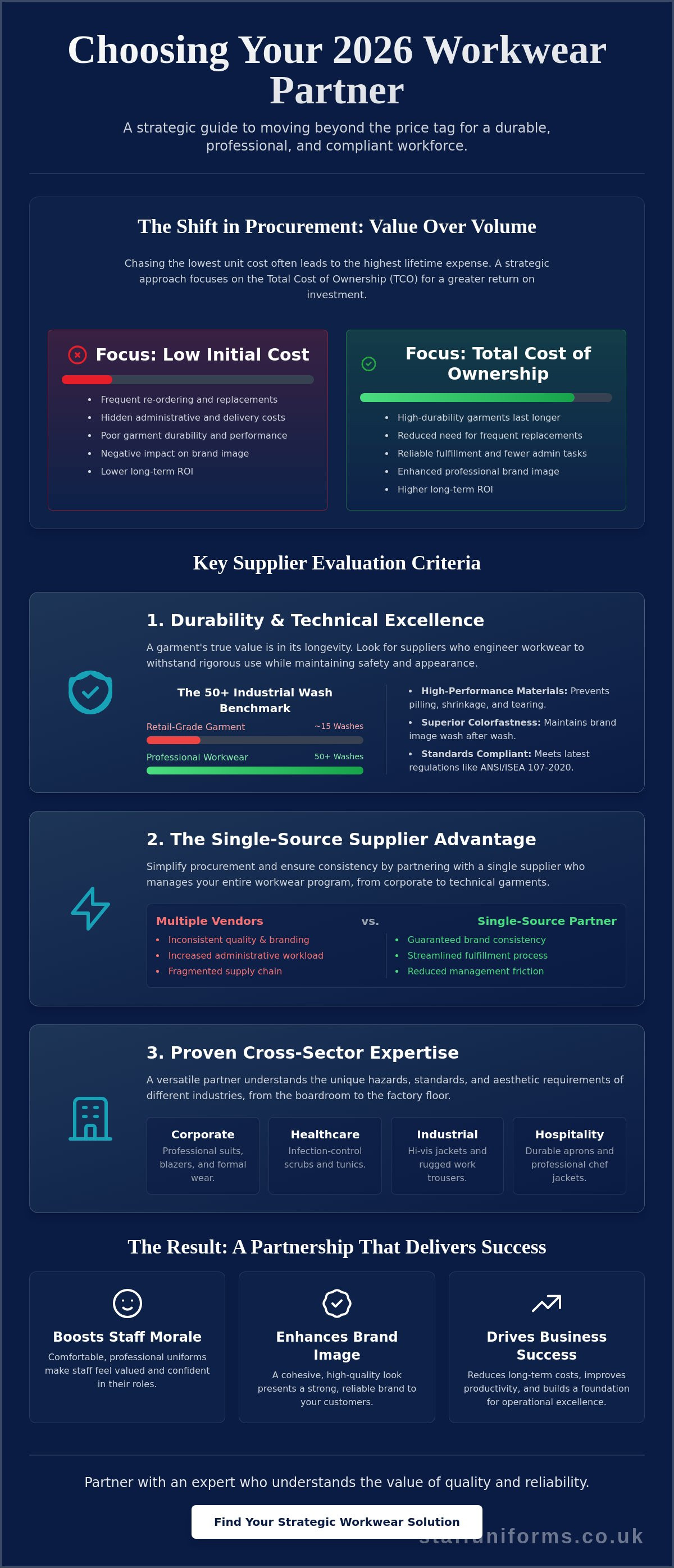
Procurement teams often fall into the trap of chasing the lowest unit cost. This usually leads to the highest lifetime expense. If a polo shirt costs 20% less but lasts half as long, you're doubling your spend over 12 months. Value over volume is the hallmark of professional procurement. Beyond the fabric, consider the operational cost of delivery delays. If a new starter can't begin work because their uniform hasn't arrived, your business loses productivity and revenue. High-durability garments and reliable fulfillment cycles are the real drivers of ROI.
Sector Expertise Matters
Different industries face unique hazards and standards. A supplier that understands medical scrubs needs to appreciate infection control and the necessity of frequent high-temperature laundering. This is a world away from the requirements for industrial hi-vis jackets or hospitality aprons. Specialized knowledge ensures your team stays compliant with industry-specific safety standards without you having to micromanage the technical details. A partner with cross-sector expertise can provide corporate blazers for your front-of-house while simultaneously equipping your maintenance team with rugged workwear trousers, all under one streamlined contract.
Technical Standards and Fabric Longevity: The Foundation of Value
Technical excellence is the bedrock of a successful uniform program. When evaluating what to look for in a workwear supplier, you must scrutinize their fabric testing protocols. It's not enough for a garment to look good on day one. It must maintain its structural integrity and protective properties after months of rigorous use. A partner that understands material science can explain how specific blends prevent pilling, shrinkage, and tearing in demanding environments.
The '50+ Industrial Wash' benchmark is a critical metric for 2026. Most retail-grade clothing begins to degrade after just 15 cycles. Professional-grade workwear is engineered to withstand at least 50 high-temperature industrial washes without losing shape or safety features. This longevity drastically improves your cost-per-wear. Choosing high-performance materials means you spend less time processing returns and more time focusing on core operations. It's a simple calculation: higher initial quality equals lower long-term spend.
Sustainability has moved from a "nice-to-have" to a procurement mandate. Modern suppliers should offer garments made from recycled polyester or organic cotton, backed by ethical sourcing certifications. This isn't just about corporate social responsibility. It's about future-proofing your supply chain against upcoming environmental regulations. A supplier's commitment to these standards reflects their overall attention to detail and reliability.
Durability and Maintenance
Fabric weight and weave are the primary indicators of a garment's lifespan. For heavy-duty workwear trousers, you should look for high-density weaves that resist abrasions and punctures. In hospitality and healthcare, colorfastness is equally vital. If your chef jackets or medical scrubs fade after three months, your brand image suffers. High-quality dyes ensure that your team looks as professional in month twelve as they did in week one. If you want to see how these standards translate to real-world performance, you can view our technically engineered collections.
Safety and Compliance
Compliance is a moving target. As of 2026, ANSI/ISEA 107-2020 remains the benchmark for high-visibility gear, and your supplier must ensure every safety vest or waterproof jacket meets current EN ISO 20471 standards. They should actively monitor updates to OSHA regulations and ANSI standards to keep your workforce protected. Over-specifying PPE can lead to unnecessary costs and worker discomfort, while under-specifying leads to accidents. A knowledgeable partner helps you strike the right balance, providing the exact level of protection required for the specific hazards of your workplace.
Evaluating Service Models: Why a Single-Source Supplier Wins
Managing multiple uniform contracts is a significant drain on corporate resources. When your procurement team has to juggle separate vendors for front-of-house attire, medical scrubs, and safety gear, administrative friction becomes inevitable. Each supplier brings a different invoicing system, varying lead times, and inconsistent quality standards. This fragmentation often leads to a diluted brand identity where the blue of a polo shirt doesn't quite match the blue of a softshell jacket. Identifying what to look for in a workwear supplier involves assessing their ability to centralize these diverse needs into a single, cohesive service model.
A single-source partner ensures brand consistency across every department. It allows for a unified aesthetic that reinforces your professional image to external clients while simplifying internal logistics. Beyond the visual benefits, a dedicated account manager becomes your primary point of contact for solving procurement issues. This expert understands your specific turnover rates and seasonal requirements, moving from a reactive "order taker" to a proactive strategist who anticipates your needs before they become urgent shortages.
Streamlining Your Procurement
Transitioning from a fragmented vendor list to a strategic partnership requires a logical approach. Follow these three steps to regain control over your uniform spend:
- Step 1: Audit your current supply chain. Document every vendor and identify where overlapping product categories or redundant shipping fees are inflating your costs.
- Step 2: Consolidate your requirements. Move your corporate suits, hospitality aprons, and industrial trousers into a single procurement portal to gain a bird's eye view of your inventory.
- Step 3: Establish a replenishment schedule. Use historical data on staff turnover and garment lifespan to automate re-ordering, ensuring new starters always have their kit on day one.
Logistics and UK-Wide Fulfillment
Logistics are the true test of a partner's reliability. For national facility managers, UK-based inventory is critical. It acts as a buffer against global supply chain shocks that can delay overseas shipments for weeks. You need a supplier that treats a small top-up order with the same urgency as a thousand-unit bulk rollout. Efficiency also means having access to support during standard UK office hours, allowing you to resolve queries quickly without navigating international time zones. Reliable fulfillment isn't just about speed; it's about the consistency of stock availability that keeps your national workforce operational and professional.
Brand Representation and Staff Morale: The Psychological Impact of Quality
A uniform is far more than a cost center or a compliance requirement. It's a vital tool for business success that influences how your employees feel and how your customers perceive your brand. When an employee puts on a well-fitted, professionally finished garment, their mindset shifts. They aren't just a worker; they're an ambassador for your company. Identifying what to look for in a workwear supplier means evaluating how their products will influence your staff's daily mindset and your company's external reputation.
High-quality workwear directly correlates with improved internal morale and staff retention. If a team feels that their employer has invested in comfortable, durable, and stylish attire, they feel valued. Conversely, forcing staff into ill-fitting or scratchy polyester can lead to resentment and a lack of professional pride. This human element is often overlooked in procurement, yet it's the foundation of a productive workforce. Your supplier should be a partner that helps you foster a sense of unity and team identity through the physical tools you provide your staff.
The Power of Personalization
Customization is where your brand identity truly comes to life. You must choose the right application method for your specific industry needs. For example, embroidery offers a premium, long-lasting finish that's ideal for corporate blazers or hospitality aprons. It withstands frequent laundering and maintains a crisp, professional look. Heat-applied prints might be more suitable for lightweight t-shirts or specific waterproof jackets where needle punctures could compromise the fabric's integrity. High-quality branded workwear acts as a mobile billboard for your service, reinforcing your market presence with every client interaction. When selecting custom staff uniforms, consider logo placement strategies that maximize visibility without looking cluttered or unprofessional.
Employee Comfort and Pride
The impact of fit and fabric feel on daily productivity cannot be overstated. A technician in restrictive workwear trousers or a nurse in a poorly designed dress will be distracted by discomfort, which can lead to fatigue or errors. Modern UK workforce diversity also demands a focus on inclusive sizing. A supplier that only offers a limited range of "standard" sizes fails to support your entire team. When deciding what to look for in a workwear supplier, ask about their approach to ergonomic design and their ability to provide consistent fits for all body types. A professional look fosters a sense of collective pride, ensuring that every member of the team, from the front desk to the warehouse, feels like a vital part of the organization.
Ready to elevate your team's professional image? Explore our range of customizable corporate and technical wear today.
Partnering with The Staff Uniform Company for National Excellence
Selecting a strategic partner is the final step in securing your workforce's future. You've seen why durability, compliance, and morale matter. Now, you need a partner that delivers on those promises consistently. The Staff Uniform Company manages the entire lifecycle of your uniform program. We don't just supply garments; we manage the journey from initial concept and design through to final national delivery. This comprehensive service model is exactly what to look for in a workwear supplier when you're managing a complex UK workforce across multiple locations.
We understand the logistical demands of sectors ranging from healthcare to heavy industry. Our technical expertise ensures that your hi-vis safety vests meet the 2026 ANSI/ISEA 107-2020 standards while your corporate blazers maintain a sharp, professional silhouette. By taking ownership of the fulfillment process, we allow your facility managers to step back from the administrative burden of uniform management. It's about providing a service that works as hard as your employees do. We act as a trusted advisor, ensuring your corporate identity is handled with expertise and quiet confidence.
A Complete Workwear Solution
Our catalog covers every aspect of your business needs. From medical scrubs and nurse dresses to chef jackets and hospitality aprons, our focus remains on functional, results-oriented clothing. We specialize in hospitality uniforms that withstand the rigors of the service industry while looking impeccable. Our materials, like those found in our softshell jackets and workwear trousers, are engineered for high-wash durability. This reliability lets you focus on your core business goals, knowing your team's professional presentation is secure. Identifying what to look for in a workwear supplier means finding this exact balance of technical performance and brand representation.
Next Steps for Your Workforce
Transitioning to a single-source supply model is a straightforward process when guided by experts. We begin by consulting with your team to map out specific requirements for each job function. We'll help you identify overlaps in your current fragmented supply chain and propose a streamlined inventory of polo shirts, blouses, and formal shirts that meet your technical needs. Our goal is to move you from a transactional relationship to a strategic partnership. Contact us today to schedule a professional procurement review for 2026. We'll analyze your current spend and garment performance to build a reliable, high-value workwear solution that supports your national UK operations and enhances your professional pride.
Securing Your Workforce for 2026 and Beyond
A successful uniform program is built on technical durability and strategic alignment. By prioritizing high-performance fabrics designed for 50+ industrial washes, you ensure that your investment lasts while your team remains protected and professional. Consolidating your procurement into a single-source model removes the administrative friction that often plagues national operations, allowing for consistent brand identity across every department from the front office to the warehouse floor.
Understanding what to look for in a workwear supplier allows you to move from a transactional mindset to a strategic partnership that enhances both staff morale and external brand perception. We are specialists in the corporate, healthcare, and industrial sectors, providing expert UK-wide national fulfillment from initial concept to final delivery. Our commitment to longevity and technical excellence ensures your corporate identity is handled with the expertise it requires. Partner with The Staff Uniform Company for your 2026 workwear requirements and experience the difference that professional, reliable supply makes. Your team is your greatest asset; equip them with the quality they deserve to drive your business forward with confidence.
Frequently Asked Questions
What are the most important factors when choosing a workwear supplier?
Reliability and technical expertise are the most critical factors. You need a partner that understands the specific hazards of your industry, whether that's healthcare compliance or industrial safety. Look for a supplier that manages the entire lifecycle from design to delivery. This ensures your corporate identity remains consistent across all departments. A provider's ability to offer a comprehensive range, from corporate suits to hi-vis vests, simplifies your procurement process significantly.
How can I ensure my workwear supplier is compliant with UK safety standards?
Verify that the supplier actively monitors and implements the latest UK safety regulations. They should confirm that high-visibility garments meet EN ISO 20471 and ANSI/ISEA 107-2020 standards. Ask for technical data sheets and certification proof for specialized PPE. A trustworthy partner will provide transparent documentation regarding material performance and manufacturing techniques. This proactive approach protects your workforce and ensures your business meets its legal obligations without constant oversight.
Is a single-source supplier better than using multiple vendors?
A single-source supplier is generally superior because it eliminates the administrative friction of managing multiple contracts. Centralizing your requirements for medical scrubs, hospitality uniforms, and technical trousers ensures brand consistency across your entire organization. It allows for a unified aesthetic and a streamlined invoicing process. You gain a dedicated account manager who understands your specific replenishment needs. This model reduces shipping costs and minimizes the time spent chasing various vendors for updates.
What is the difference between logo embroidery and printing for workwear?
Embroidery provides a premium, high-durability finish that's ideal for formal shirts, blazers, and aprons. It withstands industrial laundering and maintains a crisp appearance over time. Printing is often better for lightweight t-shirts or waterproof jackets where needle punctures might damage the fabric's protective membrane. Your choice depends on the garment's use case and the required longevity. A professional supplier will advise on the best application method to maximize your brand's visibility.
How do I evaluate the durability of uniforms before placing a bulk order?
Evaluate durability by requesting samples and checking for the 50+ industrial wash benchmark. Examine the fabric weight and density, particularly for high-wear items like workwear trousers and cargo pants. Look for reinforced stitching in stress areas and high-quality dyes that resist fading. Testing a small batch in real-world conditions provides the best insight into how the garments perform. This step is a key part of what to look for in a workwear supplier before committing to a national rollout.
Should I prioritize unit cost or lifetime value in workwear procurement?
Prioritize lifetime value to achieve a better return on investment. Chasing the lowest unit cost often results in poor-quality garments that require frequent replacement. High-durability uniforms that last twice as long effectively halve your long-term spend. Consider the total cost of ownership, including delivery reliability and the impact on staff productivity. Investing in quality reduces administrative headaches and ensures your team remains professional. This focus on value over volume is essential for efficient procurement.
What should I look for in a supplier's delivery and logistics capabilities?
Look for UK-based inventory and a proven track record of national fulfillment. Local stock acts as a vital buffer against global supply chain shocks and ensures faster delivery for new starters. Assess their ability to handle both bulk rollouts and small top-up orders with equal efficiency. Clear communication and standard UK office hours for support are also vital. These logistical capabilities are central to what to look for in a workwear supplier to maintain an operational workforce.