
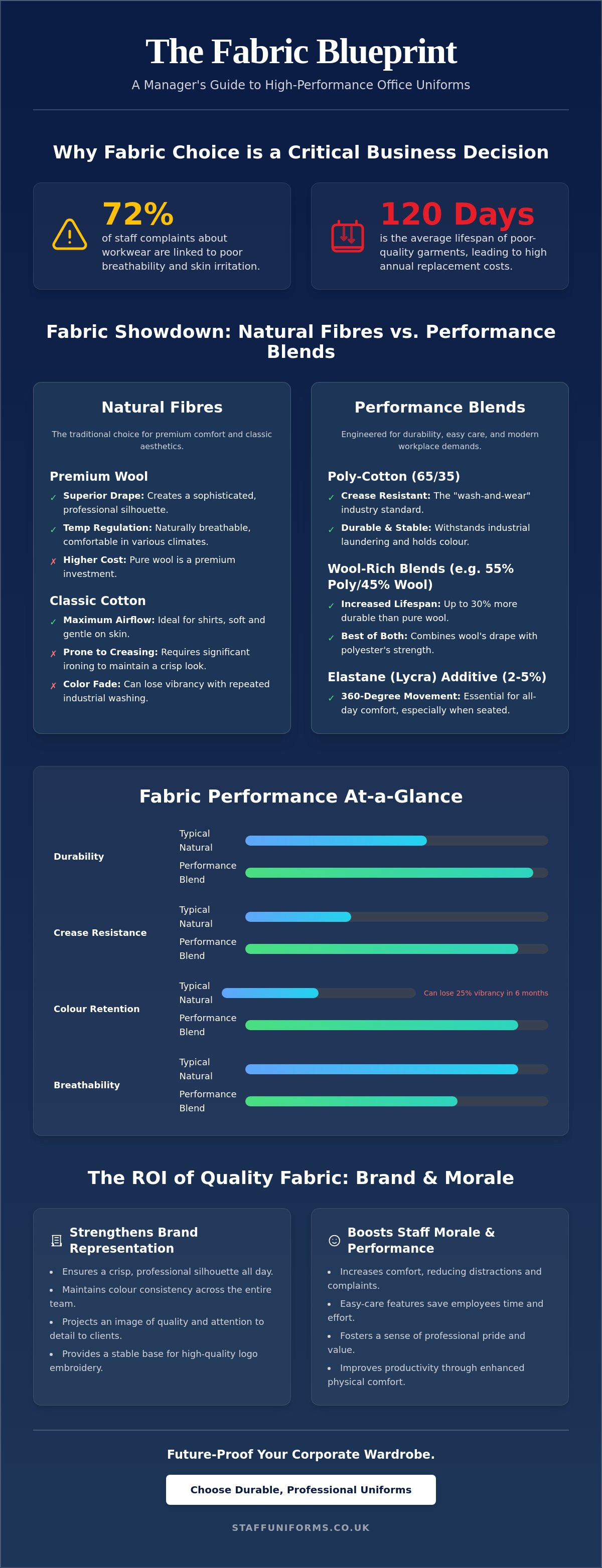
In early 2024, a survey of UK corporate managers revealed that 72% of staff complaints regarding workwear were directly linked to poor breathability and skin irritation. These issues don't just affect comfort; they lead to garments looking worn out after only 120 days of use, which significantly increases your annual replacement costs. Identifying the best fabrics for office uniforms requires a technical understanding of how different fibres perform under the pressure of a 40-hour work week.
You already know that a professional image relies on garments that hold their shape and colour through repeated laundering. This guide reveals the specific technical specifications and performance characteristics of modern textiles to ensure your team looks sharp and stays comfortable. We will explore high-performance wool blends, cotton-rich fabrics, and advanced synthetics to help you make an informed procurement decision that protects your brand identity and your bottom line.
Key Takeaways
- Understand how high-quality fabric choices directly influence employee professional pride and strengthen your brand’s first impression with UK clients.
- Discover the best fabrics for office uniforms by comparing the thermal properties of premium wool-blends with the crisp, breathable finish of cotton poplin.
- Learn to match specific weaves to workplace roles, ensuring front-of-house staff project a premium image while administrative teams benefit from maximum crease resistance.
- Secure long-term ROI by selecting durable materials that withstand industrial laundering and provide a stable base for high-quality logo embroidery.
- Future-proof your 2026 procurement strategy with technical insights into performance blends designed to handle the unique demands of the British corporate climate.
Defining Excellence: Why Fabric Choice Dictates Office Performance
Selecting the best fabrics for office uniforms is a strategic procurement decision that extends far beyond simple aesthetics. Fabric serves as the foundation of your corporate identity. It's the primary interface between your staff and their daily tasks. When a garment feels substantial and fits well, it fosters a psychological sense of professional pride. This isn't a modern trend; the history of workwear demonstrates that clothing has always been a vital tool for establishing authority and functional readiness in the workplace.
In client-facing roles, your team's attire provides the first visual data point for a customer. A limp collar or a pilled sleeve suggests a lack of attention to detail that clients may subconsciously attribute to your service quality. High-quality textiles ensure that the "first impression" remains sharp from 9:00 AM until the final meeting of the day. Cheap fabrics often carry hidden costs that disrupt annual budgets. Low-grade polyester blends frequently suffer from pilling and fading, sometimes losing up to 25% of their colour vibrancy within just six months of regular commercial laundering. Investing in superior textiles reduces the frequency of replacements, offering better long-term value for UK businesses.
The ideal office fabric strikes a precise balance. It must offer an elegant aesthetic while maintaining the utility required for a busy 40-hour work week. This means looking for materials that resist creasing but remain breathable enough for a heated office environment.
The Impact on Brand Representation
Maintaining a crisp silhouette depends entirely on fabric weight and structure. If a fabric is too light, it loses its shape; if it's too heavy, it becomes cumbersome. Consistent corporate identity also relies on colour retention. High-performance fabrics are treated to hold dyes deeper within the fibres, ensuring that a team of fifty looks uniform rather than a mismatched gradient of faded blues and blacks. Corporate Drape is defined as the way fabric hangs on the body, providing a professional outline that avoids clinging or sagging. This structured look ensures your brand is represented with quiet confidence and precision.
Staff Morale and the Comfort Factor
Staff performance is directly linked to physical comfort. Common workplace complaints often centre on skin irritation, overheating, or restricted movement caused by rigid, non-breathable materials. When employees feel comfortable, they're more likely to engage positively with customers and maintain high productivity levels. Modern office wear must also incorporate easy-care features. Busy professionals value garments that require minimal ironing and can withstand standard machine washes without losing their integrity. By prioritising the human element in your fabric selection, you're treating the uniform as a vital tool for business success rather than just a cost centre.
The Science of Comfort: Natural Fibres vs. Synthetic Performance Blends
Selecting the best fabrics for office uniforms requires balancing employee well-being with long-term asset management. Wool remains the premium choice for corporate tailoring. It offers natural temperature regulation and a sophisticated drape that synthetic alternatives struggle to replicate. Most UK firms now opt for wool-rich blends, typically 55% polyester and 45% wool, to increase garment life by up to 30% compared to pure wool. Cotton serves as the foundation for executive shirting. Its 100% natural composition allows for maximum airflow, though it requires significant ironing. Recent textile science research highlights how modern polymer treatments can now enhance these natural fibres to resist stains without sacrificing softness.
Polyester isn't the stiff material of the past. It's the engine room of the modern uniform. It provides the tensile strength needed to survive daily wear and industrial laundering. Adding 2% to 5% Elastane, often branded as Lycra, has transformed corporate trousers. This small addition allows for 360-degree movement. It's a practical solution for staff who spend 7 or 8 hours at a desk. These technical advancements ensure that the best fabrics for office uniforms deliver both a sharp silhouette and all-day comfort.
Polyester-Cotton (Poly-Cotton) Blends
The 65/35 polyester-to-cotton ratio is the recognised industry standard for a reason. This specific blend offers the wash-and-wear convenience busy professionals demand. While 100% cotton shirts often look crumpled by midday, a 65/35 blend maintains a crisp, professional appearance throughout a 12-hour shift. These garments dry 40% faster than pure cotton and resist the shrinkage common in high-temperature washes. It's a reliable choice for high-pressure office environments where presentation cannot be compromised.
Poly-Viscose and Lycra: The Modern Corporate Suit
Poly-viscose has replaced many traditional fabrics in the mid-range corporate market. Viscose is a semi-synthetic fibre that adds a silk-like lustre and soft hand-feel to durable polyester. When combined with 2% Lycra, the result is a suit that moves with the wearer. This blend is particularly effective at maintaining sharp trouser creases and resisting the bagging at the knees often seen in cheaper materials. For teams that require a high-end look with everyday resilience, exploring our tailored range ensures your staff stay comfortable and look sharp. These fabrics ensure your investment lasts through 50 or more wash cycles without losing structural integrity.
Understanding Weaves: Oxford, Poplin, and Twill for the Office
The performance of your corporate clothing depends heavily on the weave construction. Selecting the best fabrics for office uniforms requires a balance between aesthetic appeal and daily durability. While the raw material provides the foundation, the way those fibres are interlaced determines how the garment hangs, breathes, and resists creasing throughout a ten-hour shift.
- Oxford Weave: This utilises a basket-weave structure where multiple warp yarns cross over an equal number of weft yarns. It creates a visible, slightly pebbled texture that is famously durable. It's the standard for smart-casual environments because it looks substantial and resists wrinkles better than finer weaves.
- Poplin (Plain Weave): This is a tightly closed, simple over-under weave. It results in a smooth, crisp surface that feels lightweight and cool against the skin. It's the traditional choice for formal white shirts and executive blouses.
- Twill: Recognisable by its diagonal ribbing, twill is exceptionally dense. This structure makes it the most durable option for workwear trousers and heavy-duty shirts. It hides stains and spills more effectively than flat weaves, which is vital for active staff.
- Herringbone and Fine Stripes: These variations of the twill weave add visual depth. A herringbone pattern provides a broken chevron effect that catches the light, offering a premium feel without the need for loud colours or patterns.
Choosing the Right Weave for Your Role
Oxford shirts have become the workhorse of the modern UK office. They bridge the gap between formal and relaxed, making them ideal for sales teams and project managers. For high-level executive meetings, Poplin remains the gold standard. Its silk-like finish conveys authority and precision. Reception staff often benefit from Twill weaves. Because these roles involve frequent movement and constant public interaction, the extra garment longevity and crease resistance of a fine twill ensure they look sharp from 9:00 to 17:30.
Fabric Weight and GSM Explained
In the UK textile industry, we measure fabric density in Grams per Square Metre (GSM). This figure tells you exactly how much "substance" is in the garment. It's a critical metric for procurement managers to ensure consistency across a large workforce. Most professional shirting falls into two primary categories.
- Lightweight (100-120 GSM): Best for summer months or high-temperature office environments. These fabrics are highly breathable but can be delicate.
- Mid-weight (150-180 GSM): The standard for year-round wear in Britain. These offer a balance of warmth and durability.
The GSM measurement directly dictates the transparency and warmth of a blouse, with lower figures offering higher breathability but requiring careful layering to maintain professional modesty. When selecting the best fabrics for office uniforms, always request the GSM specifications to avoid issues with sheer garments or overheating staff. A 115 GSM poplin is perfect for a layered look, while a 160 GSM Oxford provides the opacity required for a standalone shirt.
Strategic Selection: Matching Fabric to Office Roles and UK Climates
Identifying the best fabrics for office uniforms involves balancing aesthetics with specific duty requirements. A one-size-fits-all approach often leads to staff discomfort or premature garment wear. Front-of-house staff, such as receptionists and concierge teams, benefit significantly from high-viscose blends. Viscose mimics the elegant drape and soft handle of silk while remaining durable enough for daily wear. It provides a premium feel that aligns with high-end brand identities and ensures a positive first impression for clients.
Back-office and admin teams require a different strategy. These roles involve long periods of sitting, which causes standard fabrics to crease at the lap and elbows. High-polyester ratios, typically a 65/35 or 70/30 blend, are the solution here. Polyester provides excellent "memory," allowing the garment to spring back into shape. These fabrics are the workhorses of the corporate world. They handle 40-hour weeks and frequent industrial laundering without losing their professional edge.
For leadership and executive roles, wool-rich blends are the standard choice. Wool offers natural temperature regulation and a sophisticated texture that synthetics cannot replicate. These materials are essential for corporate suits, providing a sharp silhouette that signals authority and confidence. A 60% wool and 40% polyester mix is often the "sweet spot" for durability and prestige in a 2026 office environment.
Climate-Adaptive Office Wear
UK weather is notoriously unpredictable, often shifting 10 degrees in a single afternoon. Cotton-rich shirts, containing at least 60% cotton, are vital for breathability during humid summer months. They allow moisture to wick away from the skin, keeping staff cool during busy shifts. When temperatures drop, fine-gauge knitwear becomes the primary layering tool. A 12-gauge merino or acrylic-wool mix provides warmth without adding bulk under a jacket. For staff who commute or move between sites, softshell jackets offer a wind-resistant outer layer that maintains a professional profile better than a standard fleece.
A Procurement Checklist for Office Managers
- The Recovery Test: Perform a simple "scrunch test" by holding a handful of fabric tightly for five seconds. If it doesn't bounce back instantly, it will look untidy by midday.
- Structural Integrity: Check for reinforced seams, twin-needle stitching, and high-quality internal linings. These details prevent fraying at high-stress points like armpits and pockets.
- Branding Compatibility: Ensure the fabric weight supports custom staff uniforms UK branding. Thin fabrics can pucker under heavy embroidery, while very thick fabrics might limit the detail of a screen print.
Selecting the right material ensures your team stays comfortable and looks professional from their morning commute until the end of the day. Email Sales@staffuniforms.co.uk · Tel 0333 090 8552 to request fabric samples for your next procurement cycle.
Future-Proofing Your Wardrobe: Durability, Care, and Customisation
Selecting the best fabrics for office uniforms involves more than just initial aesthetics. It requires a 2026 perspective on longevity and brand representation. By 2026, industry data suggests that 70% of UK corporate tenders will mandate recycled polyester or organic cotton blends as standard. These materials provide the structural integrity needed for daily wear while meeting strict ESG (Environmental, Social, and Governance) targets. Choosing high-performance blends ensures your team looks sharp from Monday morning through Friday afternoon without the fabric losing its "memory" or shape.
Branding and Decoration Compatibility
Your choice of fabric dictates the quality of your branding. For crisp, professional embroidery, you should select fabrics with a high GSM (Grams per Square Metre). Materials below 180 GSM often suffer from puckering around the logo, which diminishes your corporate image. If you're opting for technical, moisture-wicking fabrics, heat-seal transfers or vinyl printing are superior to traditional stitching. These methods maintain the fabric's integrity and prevent needle holes from compromising the garment's performance. We ensure every customisation process respects the base material's tension and weave to prevent fraying.
The Longevity Mindset
A managed hospitality workwear approach is increasingly popular for mixed-use facilities where office staff and front-of-house teams overlap. This strategy focuses on industrial laundry compatibility and rigorous care standards. To double the life of a corporate blazer or trousers, we recommend a proactive maintenance schedule. Follow these three practical steps to protect your investment:
- Implement a rotation policy: Use a "rule of three" system where staff have one garment in use, one in the wash, and one ready in the wardrobe to prevent fibre fatigue.
- Follow industrial wash codes: Many modern blends require specific temperatures to reactivate stain-resistant coatings; always check the internal care label.
- Avoid high-heat drying: Excessive heat is the primary cause of pilling and elastic breakdown in stretch fabrics.
Investing in the best fabrics for office uniforms is a commitment to your brand's future success. Quality materials reduce the frequency of replacement cycles, which significantly lowers your total cost of ownership over a three-year period. If you're ready to upgrade your team's professional image with durable, high-specification clothing. Email Sales@staffuniforms.co.uk · Tel 0333 090 8552 today.
Secure Your Team’s Professional Edge
Selecting the right materials for your workforce isn't just about aesthetics; it’s a strategic business decision that impacts daily productivity and long-term procurement budgets. By balancing the breathability of natural fibres with the resilience of synthetic blends, you ensure your staff stays comfortable throughout the UK’s unpredictable seasons. Choosing the best fabrics for office uniforms, such as durable twills or crisp poplins, ensures your corporate identity remains sharp from the first morning meeting to the final commute.
Staff Uniforms has operated as a specialist UK supplier since 2017, providing high-performance apparel that stands the test of time. Our garments are engineered to withstand 50+ industrial washes without losing their shape or colour. With our expert in-house embroidery and branding services, we transform standard corporate wear into a powerful tool for brand recognition. It’s time to invest in a wardrobe that works as hard as your employees do.
Explore our full range of professional corporate wear to find the perfect fit for your 2026 business goals.
Frequently Asked Questions
What is the most durable fabric for office trousers?
Polyester-wool blends are the most durable choice for office trousers. This combination withstands 50,000 Martindale abrasion cycles, ensuring longevity through daily use. The polyester provides high tensile strength while the wool maintains shape and breathability. It's a practical investment for procurement managers looking to reduce replacement cycles in 2026. These blends don't wear thin as quickly as pure cotton equivalents.
Is 100% cotton better than a poly-cotton blend for office shirts?
Poly-cotton blends are superior for office shirts because they balance comfort with performance. While 100% cotton offers breathability, it creases within 30 minutes of wear and requires intensive ironing. A 65/35 poly-cotton blend remains crisp throughout a 9-hour shift. This makes it one of the best fabrics for office uniforms where maintaining a sharp, professional appearance is a top priority.
What fabric is best for staff with sensitive skin?
Bamboo viscose or 100% organic cotton are the best options for staff with sensitive skin. These natural fibres have smooth surfaces that reduce friction and irritation. Bamboo specifically possesses hypoallergenic properties and absorbs 40% more moisture than standard cotton. Providing these options ensures 100% of your workforce feels comfortable. It's a simple way to improve staff morale and workplace inclusivity.
How do I prevent my office uniforms from pilling?
Prevent pilling by selecting garments made from long-staple cotton or high-quality synthetic blends with a low-pill finish. Pilling occurs when short fibres break and tangle on the surface. You should wash uniforms inside out at 30 degrees Celsius and avoid mixing soft fabrics with heavy denim. These simple steps can extend the garment's life by up to 12 months.
What does "easy-care" actually mean in garment technology?
Easy-care refers to fabrics treated with a resin finish or mechanical process that resists wrinkling and simplifies maintenance. These garments require minimal ironing and dry faster than standard textiles. For a busy professional, it means a shirt can be pulled from a dryer and worn immediately. This technology reduces domestic energy consumption by approximately 15% compared to high-maintenance fabrics.
Which office fabrics are the most sustainable for 2026?
Recycled polyester (rPET) and Tencel Lyocell are the leading sustainable choices for 2026. rPET uses 59% less energy to produce than virgin polyester and diverts plastic waste from UK landfills. Tencel is derived from wood pulp in a closed-loop process. Both options deliver high performance while meeting corporate social responsibility targets. They're reliable alternatives that don't compromise on the professional look.
Can all office fabrics be embroidered with a company logo?
Most office fabrics support embroidery, but the fabric weight must be at least 140 GSM to prevent puckering. Very lightweight silks or thin synthetics might require heat-seal transfers instead. We use high-speed industrial machines that apply 5,000 stitches per minute to ensure your company logo is sharp. This branding technique creates a premium, long-lasting finish that withstands 50+ industrial laundry cycles.
How does fabric weight (GSM) affect the professional look of a uniform?
Fabric weight, measured in Grams per Square Metre (GSM), dictates the drape and opacity of the uniform. A standard office shirt should range between 115 and 135 GSM for a crisp look. Trousers usually require 250 to 300 GSM to maintain a professional silhouette and resist wear. Selecting the correct weight ensures your team looks uniform and the best fabrics for office uniforms are fit for purpose.