
Did you know that selecting the wrong textile can increase your annual uniform spend by up to 30% due to premature pilling and fabric fatigue? It's a common frustration for UK procurement managers searching for the best fabric for hospitality uniforms only to see their investment fade after just a few months. You've likely dealt with staff complaints about uncomfortable heat in the kitchen or a lack of stretch during a busy service shift. These issues don't just affect your bottom line; they impact your brand's reputation and employee morale.
Choosing the right materials is about more than just aesthetics. It's about finding textiles that stand up to rigorous industrial laundering while keeping your team comfortable. This 2026 procurement guide breaks down the technical specifications of modern fabrics to help you achieve a crisp, well-fitted look that lasts. We'll examine the specific moisture-wicking blends and high-stretch synthetics that reduce replacement frequency and ensure your corporate identity remains in safe hands.
Key Takeaways
- Lower your long-term expenditure by understanding the "Total Cost of Ownership" and how fabric quality directly impacts your brand’s first impression.
- Identify the best fabric for hospitality uniforms by comparing the rugged reliability of the UK’s 65/35 poly-cotton standard against modern, soft-touch synthetics.
- Enhance staff morale and meet CSR goals by integrating performance-driven moisture-wicking technology and sustainable recycled polyester (rPET) into your 2026 kit.
- Apply a professional procurement framework to select role-specific materials, prioritising sharp drapes for front-of-house and heat regulation for kitchen teams.
- Maximise uniform longevity with expert tips on how different textiles react to industrial laundering and professional branding techniques like embroidery.
Why Fabric Choice is the Foundation of Hospitality Success
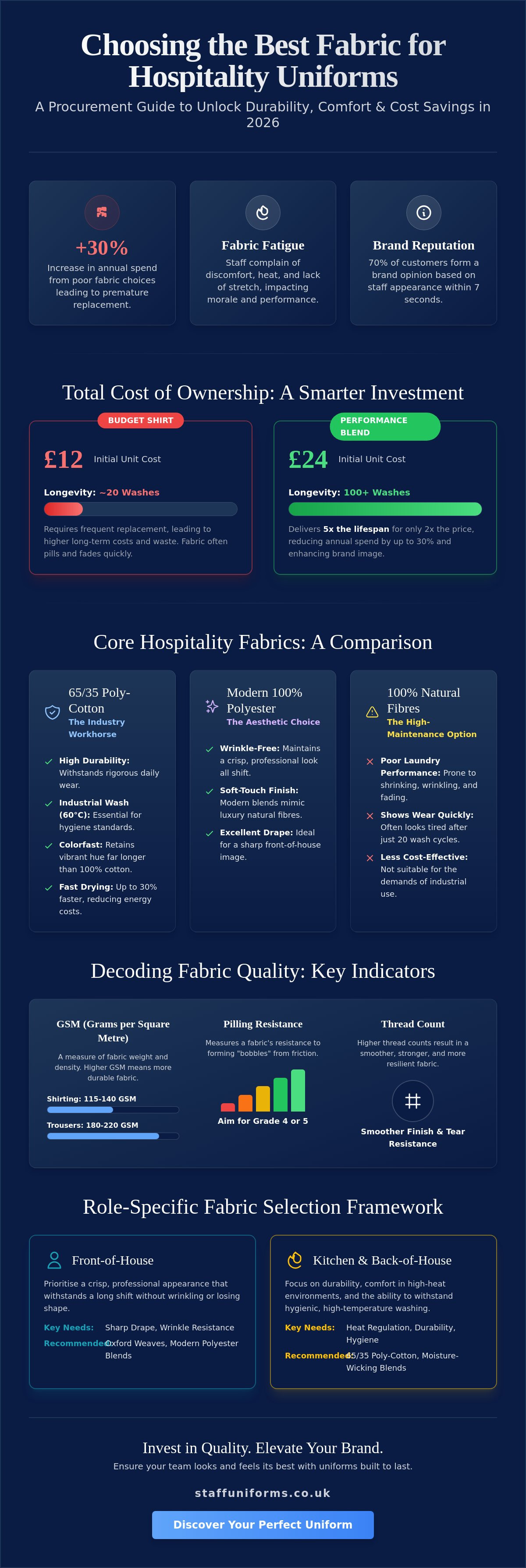
Hospitality success starts with a guest's first glance. Research indicates that 70% of customers form an opinion about a brand based on staff appearance within seven seconds of entering a venue. Choosing the best fabric for hospitality uniforms isn't just a design choice; it's a strategic business decision that impacts your bottom line. In the UK market, procurement managers are shifting focus from initial unit price to the Total Cost of Ownership (TCO). A budget shirt costing £12 might require replacement after 20 industrial washes, whereas a high-performance blend priced at £24 can withstand 100 or more cycles. This longevity reduces annual uniform spend by up to 30%.
The 2026 UK trend reflects a significant move away from "disposable" workwear. Businesses now prioritise high-quality longevity to meet both sustainability goals and financial targets. Staff retention also hinges on these choices. Employees who feel comfortable and confident in their attire are 15% more likely to report higher job satisfaction. If a fabric is itchy, restrictive, or traps heat, performance suffers during peak service hours. Investing in premium textiles is an investment in your team's daily output and your brand's reputation.
The Psychology of a Professional Uniform
Visual cues dictate authority and service quality. An Oxford weave fabric provides a structured, crisp appearance that commands respect in front-of-house roles. It suggests attention to detail and reliability. Beyond looks, breathability is vital. During a busy Friday night shift, staff body temperatures can rise significantly. High-performance fabrics allow heat to escape, which directly supports staff performance. Professional drape is the way fabric falls and holds its shape. Selecting the best fabric for hospitality uniforms ensures staff look as professional at the end of a ten-hour shift as they did at the start.
Durability vs. Aesthetics: Striking the Balance
Pure 100% natural fibres often fail the rigorous industrial laundry tests required in the UK hospitality sector. They shrink, wrinkle, and lose colour when exposed to 60°C wash cycles. Modern hospitality requires a balance of natural and synthetic clothing materials to ensure garments survive daily wear. Smart blends, such as poly-cotton or recycled polyester mixes, mimic the soft touch of luxury textures while offering synthetic strength. To ensure you're buying quality, check these three indicators:
- GSM (Grams per Square Metre): Aim for 180-220 GSM for durable trousers and 115-140 GSM for shirting.
- Thread Count: Higher counts offer a smoother finish and better resistance to tearing under stress.
- Pilling Resistance: Quality fabrics achieve a Grade 4 or 5 on the pilling scale, preventing "bobbles" from forming on friction points.
By focusing on these technical specifications, businesses can secure uniforms that look premium and last for years rather than months.
Core Hospitality Fabrics: Comparing the Industry Workhorses
Selecting the best fabric for hospitality uniforms requires a balance between aesthetic appeal and operational reality. In the UK market, the 65/35 poly-cotton blend remains the gold standard for 2026. This specific ratio provides the durability of synthetic fibres with the breathability of natural cotton. It withstands industrial laundering at 60°C, which is vital for maintaining hygiene standards in food-heavy environments. Modern textile engineering has moved beyond the stiff, scratchy synthetics of the past. Today's 100% polyester options often feature "soft-touch" finishes that mimic silk or fine cotton. These fabrics are particularly useful for front-of-house roles where a crisp, wrinkle-free appearance is mandatory throughout a ten-hour shift. Innovation in this space is rapid. Many procurement managers now look toward sustainable and smart fabrics to meet corporate social responsibility targets while ensuring high performance.
Polyester-Cotton (Poly-cotton) Blends
The 65/35 blend dominates the industry because it solves three main problems: colour fading, drying time, and crease retention. While 100% cotton garments often look tired after 20 washes, poly-cotton retains its vibrant hue for significantly longer. It dries up to 30% faster than pure cotton, reducing energy costs in high-volume operations. For roles like housekeeping and casual dining, this fabric is the most cost-effective choice. For a premium feel, always specify "combed cotton" in the blend. This process removes short, prickly fibres, leaving a smoother surface that feels better against the skin.
The Versatility of Twill and Poplin Weaves
The weave of a garment is just as important as the fibre content. Twill is easily identified by its diagonal rib pattern. It's a heavy-duty construction that hides stains and resists tearing, making it the primary choice for waist aprons and chef jackets. Poplin, by contrast, is a plain weave that produces a smooth, flat surface. It's lightweight and elegant, ideal for formal server shirts and blouses. Oxford weaves sit in the middle; they're more textured than poplin but more breathable than heavy twill, perfect for a "smart-casual" gastropub vibe.
- Twill: Best for high-abrasion roles like baristas and back-of-house staff.
- Poplin: The standard for crisp, professional shirting in fine dining.
- Oxford: A durable, thicker weave that holds its shape well for reception staff.
Choosing the right material ensures your team stays comfortable during peak service hours. If you're unsure which weave suits your brand's aesthetic, you can view our fabric samples to feel the difference in quality firsthand. High-quality fabric isn't just a purchase; it's a tool that supports your staff's daily performance.
Performance and Sustainable Fabrics for 2026
Choosing the best fabric for hospitality uniforms in 2026 requires a focus on both longevity and environmental impact. Modern procurement managers are shifting away from traditional materials in favour of textiles that work harder for the wearer. High-pressure environments demand garments that manage heat and moisture effectively. Moisture-wicking is the capillary action that moves sweat to the outer garment layer, allowing for rapid evaporation and keeping staff comfortable during peak service hours. This technology is now a baseline requirement for kitchen and front-of-house teams alike.
Hygiene standards have also evolved. Antimicrobial finishes are becoming a standard for hygiene-sensitive hospitality areas. these treatments inhibit 99.9% of bacteria growth, which significantly reduces fabric odours and extends the time between deep cleans. When selecting materials, refer to this comprehensive guide to hospitality uniforms for insights on balancing comfort with these functional requirements.
Eco-Friendly Fabric Innovations
Sustainability is no longer a luxury. It's a corporate necessity. Recycled Polyester (rPET) has seen a 45% increase in adoption across the UK hospitality sector since 2023. This material uses significantly less energy to produce than virgin polyester and diverts plastic waste from landfills. Sourcing uniforms made from recycled ocean plastics and organic cotton provides a durable alternative that withstands industrial laundering. These sustainable fabrics often outperform virgin synthetics in pilling resistance and colour fastness.
Businesses investing in custom staff uniforms uk can easily incorporate green branding into their identity. Using recycled materials allows a brand to communicate its values to guests without saying a word. It's a practical way to meet ESG targets while providing high-quality workwear that staff feel proud to wear.
Technical Performance Features
Finding the best fabric for hospitality uniforms involves more than just aesthetics; it's about engineering a garment that works as hard as the person wearing it. Mechanical stretch fabrics are a key innovation for 2026. They provide essential mobility without the use of elastane, which often degrades and loses its "snap" after repeated high-heat washes. Instead, the stretch is built into the weave itself, ensuring the garment maintains its professional silhouette for over 50 wash cycles.
- Easy-iron and non-iron finishes: These treatments reduce maintenance time for busy staff and ensure a crisp appearance from the start of the shift to the end.
- Teflon-coated fabrics: Essential for bar service and floor staff, these coatings provide a barrier for liquid and stain repulsion, allowing spills to bead off the surface.
- Breathable membranes: Advanced layers that allow heat to escape while preventing external moisture from penetrating the fabric.
These technical features don't just improve the look of a team. They directly impact staff morale and retention. A well-fitted, high-performance uniform acts as a vital tool for business success, allowing your team to focus on guest experience rather than wardrobe malfunctions.
Role-Specific Fabric Selection: A Procurement Framework
Choosing the best fabric for hospitality uniforms requires a departmental approach. A material that excels in the lobby will likely fail in the laundry room or the heat of the line. Procurement managers must balance aesthetic consistency with functional performance across four distinct zones to ensure staff comfort and garment longevity.
Front of House and Management
First impressions rely on sharp lines and a crisp silhouette. High-end corporate suits typically feature a wool-blend or high-grade polyester. Wool provides natural temperature regulation; polyester adds essential crease resistance for long shifts. For 2026, we recommend a 280 GSM (grams per square metre) fabric for blazers to provide structure without excessive bulk. Waistcoats can drop to 220 GSM for better layering and breathability. Formal shirts should utilise "stay-white" technology. These fabrics use optical brighteners and soil-release finishes to prevent the yellowing often seen after 30 industrial wash cycles.
The Heat of the Kitchen
In back-of-house environments, safety and heat regulation are the primary drivers. 100% cotton remains the gold standard for chef jackets. It's a natural fibre that doesn't melt against the skin during a flash fire or hot oil spill. Modern kitchen wear now integrates "Coolmax" mesh panels in high-heat areas like the underarms and upper back. This moisture-wicking technology can lower skin temperature by up to 2 degrees Celsius in a 40-degree kitchen environment. When selecting aprons, consider the specific task:
- Heavyweight Canvas: A 300 GSM cotton canvas offers maximum protection against heat and sharp objects.
- PVC-Coated Polyester: Essential for pot-washing stations where waterproof, wipe-clean surfaces are required.
Housekeeping, Maintenance, and Wellness
Housekeeping teams require maximum durability and a wide range of motion. A 65/35 poly-cotton blend is the industry workhorse here. This ratio ensures the garment survives 50 or more industrial wash cycles at 60 degrees without losing its shape. The inclusion of 2% elastane is now a standard requirement to allow for the constant bending and reaching involved in room turnovers.
In spa and wellness settings, the "zen" aesthetic is achieved through soft-touch fabrics that resist chemical degradation. These garments must withstand constant exposure to massage oils and chlorine. Bamboo-polyester blends are currently seeing a 15% increase in procurement volume due to their natural antimicrobial properties and silk-like texture which enhances the guest's perception of luxury.
Maximising Uniform Longevity: Care and Branding
Choosing the best fabric for hospitality uniforms is only half the battle. Your investment's true value depends on how that material handles daily branding stress and rigorous cleaning cycles. A professional garment should maintain its structural integrity for at least 50 industrial wash cycles. If it fails after ten, your procurement strategy is leaking profit. High-performance fabrics aren't just about comfort; they're about protecting your brand's visual standards over hundreds of shifts.
Branding and Fabric Compatibility
Logo application isn't a one-size-fits-all process. High-stitch count embroidery adds significant weight and tension to a garment. If you apply a dense logo to a lightweight 130gsm cotton shirt, the fabric will pucker and pull. This ruins the professional silhouette. For crisp, flat embroidery, stick to stable, heavyweight fabrics like 200gsm pique knits or heavy poly-cotton twills.
Casual events or high-turnover roles often suit screen printing or heat transfers. These work best on smooth surfaces like fine-gauge jersey cotton. To ensure the logo outlasts the garment, match the branding method to the fabric's heat tolerance. Synthetic blends often require lower-temperature transfers to avoid scorching or "ghosting" marks around the design area. Proper matching ensures the logo remains vibrant even as the fabric ages.
Industrial Wash Standards
UK hygiene regulations often necessitate a 60-degree wash to ensure total stain removal and thermal disinfection in food-led environments. The best fabric for hospitality uniforms must withstand these temperatures without excessive shrinkage. A standard 100% cotton garment can shrink by up to 5% in high-heat cycles. This quickly turns a size Medium into a Small, forcing premature replacement.
Polyester-cotton blends, typically in a 65/35 ratio, are the industry standard for a reason. They offer superior dimensional stability and colour fastness. You should avoid overusing fabric softeners on moisture-wicking fabrics. These chemicals coat the fibres and strip away the material's ability to breathe. This effectively turns a high-tech polo into a sweat-trap within a few months of service.
The True Cost of "Cheap" Fabrics
Budget-driven procurement often backfires. A cheap poly-cotton shirt costing £9 might seem attractive on a spreadsheet. However, these garments frequently lose shape or pill after just 15 washes. Replacing that shirt three times over a two-year period, plus the additional branding costs each time, makes it 3x more expensive than a premium £22 alternative that lasts the full 24 months. Longevity is the only real metric for workplace value.
Final Checklist: 5 Questions for Your Suppliers
Before signing off on your 2026 order, put these specific questions to your hospitality workwear suppliers:
- What is the tested shrinkage percentage of this fabric when washed at 60 degrees?
- Is this material specifically rated for high-density embroidery, or will it require heavy backing?
- Does the fabric manufacturer provide a guaranteed colour-fastness rating against industrial detergents?
- Can you provide Martindale abrasion test results to prove the fabric's resistance to pilling?
- What is the expected lifespan of this garment in a full-time, 5-day-a-week hospitality environment?
Future-Proof Your Brand with High-Performance Workwear
Selecting the best fabric for hospitality uniforms is a strategic investment in your brand's daily operational efficiency. By 2026, successful procurement will rely on balancing moisture-wicking performance with sustainable blends that withstand the rigours of 75-degree industrial laundering. We've spent nearly 10 years supplying the UK hospitality sector, providing durable solutions that maintain their professional appearance across thousands of busy shifts. It's about more than just aesthetics; it's about garments that stand up to the heat of the kitchen and the pace of the front desk.
Our team understands that a high-quality garment isn't just clothing; it's a vital tool for business success. Our expert in-house logo embroidery and branding services ensure your corporate identity remains sharp and recognizable throughout the life of the product. We test our fabrics to ensure they don't pill or fade, keeping your team's morale high and your customer's perception positive. It's time to move beyond standard off-the-shelf options and choose textiles designed for the specific demands of a modern hotel or restaurant environment.
Explore our full range of professional hospitality uniforms and build a wardrobe that works as hard as your staff do.
Frequently Asked Questions
What is the most durable fabric for restaurant aprons?
Heavyweight poly-cotton twill with a minimum weight of 240 GSM is the most durable choice for restaurant aprons. This specific blend combines the natural breathability of cotton with the tear resistance of polyester. It's designed to withstand over 50 industrial wash cycles without losing its structural integrity. This robust weave provides an essential barrier against kitchen spills and physical abrasions during busy shifts.
Is 100% cotton better than poly-cotton for hospitality staff?
Poly-cotton blends are generally superior to 100% cotton for the majority of hospitality roles. While pure cotton offers high breathability, it creases instantly and requires intensive pressing to look professional. A 65% polyester and 35% cotton mix is the best fabric for hospitality uniforms because it resists wrinkles and dries 30% faster than pure cotton. This saves your business significant time and energy costs.
What fabric weight (GSM) should I look for in a professional chef jacket?
You should look for a fabric weight between 170 and 220 GSM for a professional chef jacket. This specific range balances vital thermal protection with wearer comfort in kitchens that frequently exceed 30 degrees Celsius. Jackets below 160 GSM often fail to protect staff from hot oil splashes. Heavier options above 240 GSM often lead to staff fatigue and heat stress during a 10 hour service.
Do sustainable fabrics last as long as traditional uniform materials?
Modern sustainable fabrics like recycled polyester (rPET) match the 100% durability of traditional virgin materials. Independent lab tests show that rPET fibres maintain their tensile strength through 40 or more high-temperature washes. We often recommend Tencel blends for front-of-house roles. These fabrics offer 50% better moisture absorption than cotton while maintaining a premium, professional appearance that lasts for several seasons.
How can I prevent my staff uniforms from pilling?
Prevent pilling by selecting garments manufactured from long-staple combed cotton or vortex spun yarns. These technical spinning methods reduce the loose surface fibres that cause bobbling. You should also wash uniforms inside out at 40 degrees Celsius to minimise surface friction. Avoiding mixed loads that include heavy zips or velcro will extend the aesthetic life of your garments by up to 12 months.
Which fabric is best for keeping servers cool in a busy restaurant?
Moisture-wicking polyester blends with a micro-fine "cool-mesh" finish are the most effective for keeping servers cool. These technical fabrics move moisture away from the skin 5 times faster than standard cotton. This is the best fabric for hospitality uniforms in high-pressure environments. It helps your team maintain a professional appearance by preventing visible sweat patches during peak service hours in the UK summer.
Can all hospitality fabrics be industrially laundered?
Not all hospitality fabrics are suitable for industrial laundering. You must check the garment specification for an "Industrial" or "Pro-Wash" certification before ordering. Standard retail clothing often fails at the 60 to 85 degree temperatures used in commercial UK laundries. Industrial-grade uniforms use specific VAT dyes and reinforced stitching to ensure they don't shrink or fade after 100 plus heavy-duty cycles.
What is the best fabric for formal front-of-house blazers?
A wool blend consisting of 55% polyester and 45% wool is the gold standard for formal front-of-house blazers. This specific ratio provides the natural drape of wool with the crease resistance required for an 8 hour shift. It's a practical investment for premium hotels and fine dining establishments. These blazers often feature a Teflon coating to repel liquid stains, keeping your reception team looking immaculate.