
Business casual is not a license for relaxed clothing; it is a strategic uniform choice that prioritises fabric performance and brand consistency over fleeting fashion trends. Many procurement managers find that vague dress codes often lead to inappropriate attire or fast-fashion items that fall apart after just a few washes. Selecting the right business casual workwear uk requires a balance between employee comfort and a professional corporate identity. It's frustrating when your team lacks a cohesive look or when finding consistent styles for diverse body types becomes a logistical headache.
You likely want a workforce that looks polished without the stiffness of traditional formal wear. This guide helps you master that balance by providing a clear framework for selecting durable, stylish business casual uniforms for your UK workforce. We'll explore the shift toward "polished casual" trends, the impact of the 2026 EU Green Claims Directive on sourcing, and how to simplify ordering for new starters. You will learn how to choose high-quality polo shirts, blouses, and workwear trousers that reduce long-term costs while boosting internal morale and professional pride.
Key Takeaways
- Define the 2026 standard of functional professionalism using structured layers and smart trousers to create a cohesive team image.
- Identify high-performance, easy-care fabrics that offer non-iron technology and moisture-wicking properties to ensure long-term garment durability.
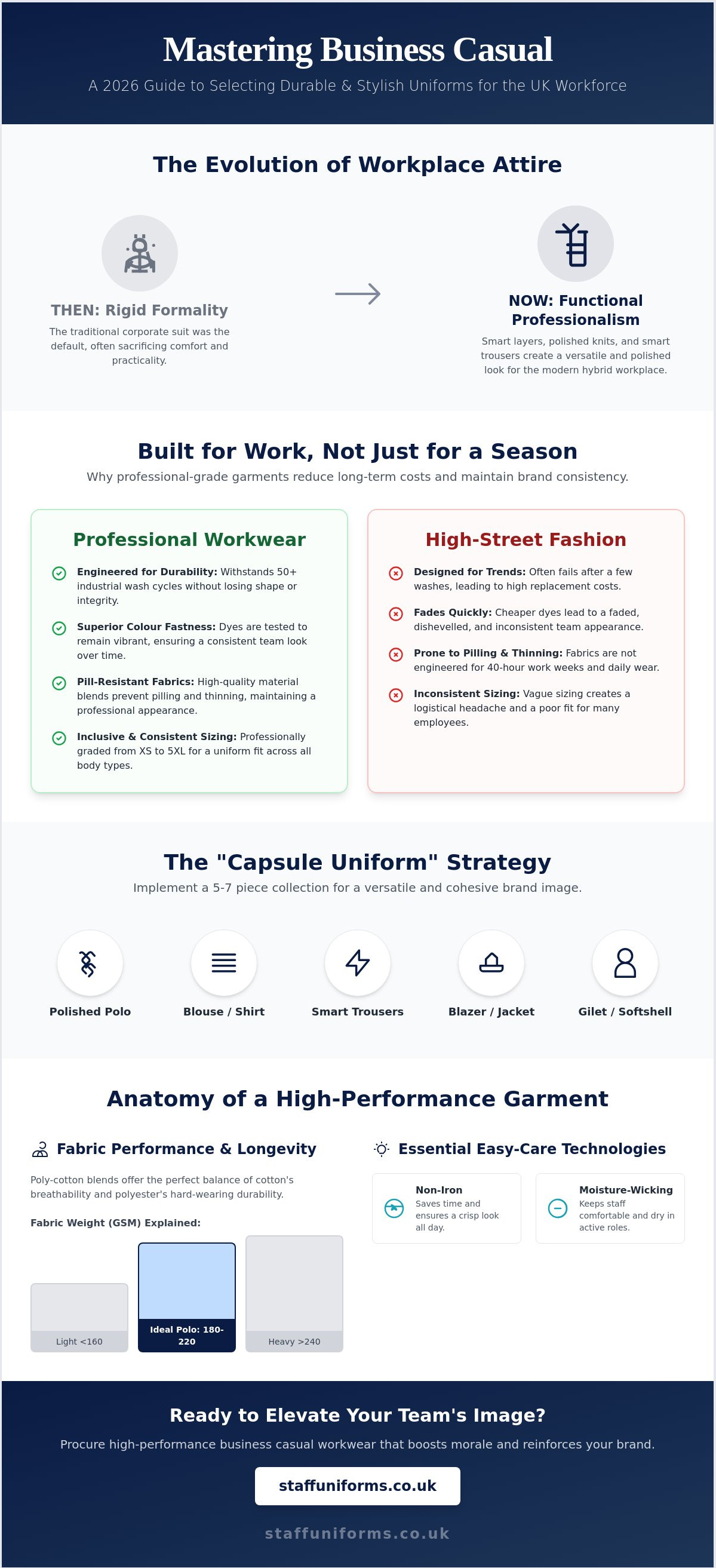
- Implement a "Capsule Uniform" strategy with 5-7 key pieces that allow employees to rotate outfits while maintaining a consistent look.
- Use subtle branding techniques like tonal embroidery to elevate your business casual workwear uk into a powerful professional tool.
- Optimise your procurement process by using physical sizing sets and managing clear delivery timelines for a seamless UK-wide rollout.
Defining Business Casual Workwear for the 2026 UK Office
The UK workplace is undergoing a fundamental transformation. Rigid formal requirements are fading. They are being replaced by functional professionalism. In 2026, the standard for business casual workwear uk isn't about dressing down. It's about dressing smarter for a versatile environment. This shift reflects a move toward efficiency. Professionals need clothing that works as hard as they do. Modern procurement involves selecting pieces that transition seamlessly between different environments.
Defining this standard involves more than just removing a tie. The 2026 benchmark relies on smart trousers, polished knits, and structured layers. Without a clear policy, many offices suffer from "casual creep." This occurs when boundaries blur and professional standards slip into weekend attire. A defined Business casual dress code provides the necessary guardrails. It ensures your team represents your brand's authority while remaining comfortable. Consistency is the key to preventing a fragmented team appearance. When every employee understands the standard, the collective image of the business remains sharp and dependable.
The Shift from Formal Suits to Functional Layers
The traditional corporate suit is no longer the default. It has evolved into a system of separates. We're seeing the rise of the "Third Piece." This involves using blazers, gilets, or softshell jackets to elevate base layers like polo shirts or blouses. For hybrid workers, this flexibility is vital. They need to transition from a home office to a client meeting without losing their professional edge. A structured layer ensures a polished on-camera presence for those essential video calls. It bridges the gap between total formality and everyday comfort. This modular approach allows for better temperature control and movement throughout the day. It's a practical solution for the modern professional.
Why Your Team’s Image Matters in a Modern Landscape
Image remains a primary tool for business success. In client-facing sectors like finance or real estate, brand authority is non-negotiable. High-quality business casual workwear uk help maintain this trust by presenting a reliable front. Beyond external perception, attire impacts internal culture. Gen Z and Millennial talent value authenticity and comfort. Providing a modern, stylish uniform helps with recruitment and retention. It also eliminates "dress code anxiety." Employees no longer have to guess what's appropriate. They can focus on their performance instead. A cohesive look fosters a sense of belonging. It reinforces the idea that every team member is a vital part of a professional whole. When your team looks like they mean business, they act like they mean business.
Essential Features to Look for in Professional Workwear
High-street fashion is built for fleeting trends. Professional attire is built for the daily grind. While a high-street chino might look acceptable on the rack, it often fails after just a few industrial wash cycles. Real business casual workwear uk must prioritise durability to reduce long-term replacement costs. High-street items often suffer from pilling, thinning fabric, and loss of shape because they aren't engineered for 40-hour weeks. In contrast, professional-grade garments maintain their integrity and professional appearance over months of rigorous use.
Colour fastness is a vital pillar of professional quality. Cheap dyes fade quickly, which makes a team look dishevelled and inconsistent. High-quality garments are specifically tested to ensure they remain vibrant after 50 or more wash cycles. This level of performance ensures your brand identity stays consistent across the entire workforce. Beyond aesthetics, inclusive sizing is a non-negotiable feature for a modern business. A professional range must look consistent across all body types, from XS to 5XL. This prevents "dress code anxiety" and ensures every team member feels confident in their uniform.
Fabric Performance and Longevity
The foundation of any durable uniform is the material choice. Poly-cotton blends are the industry standard for a reason. They combine the moisture-wicking breathability of cotton with the hard-wearing strength of polyester. When evaluating your options, pay close attention to the GSM (grams per square metre). A higher GSM indicates a denser, more opaque fabric that won't become see-through or lose its structure over time. For example, a quality polo shirt should typically sit between 180 and 220 GSM. Additionally, modern workwear often incorporates elastane. This small addition of stretch is a game-changer for business casual workwear uk, allowing workwear trousers and skirts to retain their shape without bagging at the knees or seat.
Fit and Comfort for All-Day Wear
Comfort directly influences employee productivity and morale. If a garment is restrictive or poorly ventilated, performance drops. Breathable fabrics are essential for staff who navigate heated offices or busy commutes. It's also important to understand the distinction between "Slim Fit" and "Tailored Fit." Slim fit follows the body's contours closely, while tailored fit provides a professional silhouette with more room for movement. Features like elasticated waistbands and stretch-fabrics provide the flexibility needed for active roles without sacrificing a sharp appearance. If you're looking to build a reliable foundation for your team, choosing high-performance workwear trousers and cargo pants is a practical starting point for your procurement strategy.
Key Pieces: Building Your Business Casual Collection
Building a successful business casual workwear uk collection requires a strategic shift from quantity to quality. The "Capsule Uniform" concept is the most efficient approach for modern procurement. This involves providing employees with 5-7 core pieces that they can mix and match throughout the week. This system simplifies the morning routine for your staff and ensures a unified brand image without the rigidity of a full suit. By focusing on a smaller selection of high-performance garments, businesses can invest in better materials that last longer and look sharper.
A cohesive collection relies on balance. You need base layers that are breathable, mid-layers for temperature control, and outer layers that provide a professional finish. This modular approach allows your team to adapt to different environments while maintaining a consistent aesthetic. It's about creating a toolkit of professional attire that empowers employees to represent the business with pride.
Versatile Layers: Blazers and Softshells
The traditional heavy overcoat is often too cumbersome for the modern professional. Softshell jackets have emerged as a superior alternative. They offer weather resistance and a sleek, modern silhouette that works well for site visits or commutes. Inside the office, the unlined blazer is a vital tool. It provides the visual authority of a jacket but offers the soft, breathable comfort of a cardigan. For open-plan offices where temperatures fluctuate, gilets are a practical solution. They provide core warmth without restricting movement, making them a favourite for active professionals.
The Foundation: Chinos and Smart Trousers
Smart trousers and chinos serve as the anchor for the entire 2026 look. Slim-fit work trousers are the definitive choice for a modern silhouette. They provide a clean, tapered line that works seamlessly with both polo shirts and formal blouses. When selecting a palette for your workforce, stick to neutral tones such as Navy, Charcoal, and Stone. These colours offer maximum versatility and are less likely to show minor wear. Durability is essential for these high-use items. Look for reinforced seams and bar-tack stitching at stress points to ensure the garments survive the demands of daily office life.
Professional Knits and Polo Shirts
We've moved beyond the basic cotton t-shirt. Professional environments now demand high-quality knits. Mercerised cotton and fine-gauge knitwear offer a more sophisticated texture and better shape retention than standard jersey fabrics. Quarter-zip jumpers have become the ultimate layer for UK professionals. They sit perfectly over a shirt and provide a modern, approachable aesthetic. A sharp appearance depends on the details. Ensure your chosen business casual workwear uk includes polo shirts with structured plackets and collars that won't curl after a few washes. These small technical details are what separate a professional uniform from weekend casual wear.
Customisation and Branding Your Team’s Look
Branding is the bridge between everyday apparel and professional equipment. Without strategic customisation, business casual workwear uk remains just a collection of clothes. Applying your corporate identity transforms these items into professional tools that foster team unity and external trust. In 2026, the trend has moved away from loud, high-contrast logos toward a more sophisticated, understated aesthetic. This approach aligns with the "polished casual" look that modern clients expect. It ensures your team looks like a unified force without appearing over-branded or clinical.
Subtlety is now the hallmark of premium branding. Tonal embroidery, where the thread colour closely matches the garment fabric, offers a sleek and modern finish. Placement has also evolved beyond the traditional left-chest position. Branding on the sleeve or the nape of the neck provides a contemporary feel that appeals to a younger workforce. These positions are visible during meetings and video calls but remain unobtrusive. High-quality custom staff uniforms UK ensure that these logos survive the entire lifespan of the garment without fraying, fading, or puckering.
The Impact of Logo Embroidery
Embroidery remains the gold standard for durability in a professional setting. Unlike print, which can crack or peel after repeated washing, embroidery is integrated into the fabric itself. A premium finish depends on high thread counts and stable backing materials. These technical details prevent the logo from sagging or distorting the garment's shape. Choosing the right thread is equally vital. It's a balance of matching your brand's specific Pantone colours while ensuring the thread type is compatible with the base material. This attention to detail reflects a business that values excellence in every facet of its operation.
Maintaining Brand Consistency Across Roles
Consistency doesn't mean every employee must wear the exact same outfit. It means creating a "Visual Hierarchy." You might choose different colourways for management versus front-of-house staff while keeping the logo placement identical. For team members who conduct site visits, you can integrate branded softshell & waterproof jackets to maintain a professional look in the field. Standardising these choices through a "kit list" is far more effective than a vague dress code. It removes all ambiguity. It ensures that regardless of the role or location, your brand authority remains intact. A well-executed branding strategy ensures your team carries their professional pride on their sleeve, quite literally.
Ready to elevate your team's professional image? Explore our range of customisable business casual options today.
How to Procure and Manage Your Staff Workwear
Procurement is where your strategy meets reality. Managing a rollout of business casual workwear uk across multiple sites requires logistical precision. It's not just a purchase; it's a managed process. Establishing a sizing set is the first vital step. While digital size guides are helpful, physical samples are essential for a professional rollout. Fabrics feel and drape differently in person. Providing samples ensures that the "polished casual" standard remains consistent across the entire team and significantly reduces return rates.
Lead times are a critical factor in your planning. Customisation like tonal embroidery adds time to the fulfillment process, so you must account for these windows to ensure your team is ready for office re-openings or brand relaunches. When it comes to budgeting, shift your focus from the initial purchase price to the cost-per-wear. A high-quality polo shirt with superior shape retention might cost more upfront, but its durability makes it the more economical choice over a two-year lifecycle. High-street alternatives often fail this test, leading to higher long-term expenditure.
Logistics for new starters should be seamless. Creating pre-assembled new hire packs ensures that staff feel like a valued part of the professional team from their first hour. This approach streamlines the onboarding process and removes the administrative burden from your HR and procurement departments. It turns a logistical task into a welcoming brand experience.
Sizing and Fitting Your Entire Workforce
Size guides are a useful baseline, but "Try-on" events are far more effective for morale and accuracy. They allow staff to find their perfect fit in a low-pressure environment. It's also the ideal time to address specific needs, such as maternity or plus-size requirements, ensuring the entire collection is inclusive. A professional range must look consistent on every body type to maintain brand authority. Implementing a feedback loop after the first month of wear helps you identify any issues with comfort or performance, ensuring long-term satisfaction.
Planning for Replacements and New Hires
Efficiency relies on automation. Setting up a dedicated "Uniform Portal" allows for easy repeat ordering and simple budget allocation per department. This system helps you manage stock levels for seasonal changes, ensuring summer polos are ready before June and winter knits are in place by October. Proactive management keeps your workforce looking sharp regardless of the weather. Ready to standardise your team's image? Browse the full Business Casual Collection here to find the foundation for your 2026 workforce.
Future-Proofing Your Workforce Identity
Establishing a modern dress code is more than a trend; it's a strategic investment in your team's professional pride. By prioritising high-performance fabrics and subtle branding, you ensure your workforce remains cohesive and authoritative in any setting. This guide has detailed how to move beyond fast fashion to find durable, functional solutions that stand up to the rigours of daily office life. As a trusted UK supplier since 2017, we understand the technical requirements of the modern workplace. Our business casual workwear uk range features durable fabrics specifically tested for professional environments, ensuring your investment lasts through every wash cycle.
We offer premium embroidery services to help you maintain a sophisticated corporate identity that resonates with both employees and clients. Taking control of your procurement process today will simplify your logistics and enhance your brand's reputation for years to come. Shop the complete Business Casual Collection for your team and equip your staff with the tools they need for success. Your workforce deserves a look that reflects their excellence.
Frequently Asked Questions
What exactly is business casual for a UK office in 2026?
Business casual in 2026 is defined by "polished casual" standards. This includes high-quality basics like well-cut blazers, mercerised cotton polo shirts, and smart trousers. It's a step above standard weekend wear. The focus is on fabric performance and a clean silhouette that works for both in-person meetings and video calls. It represents a balance between comfort and professional authority.
Can we use jeans in a business casual workwear policy?
Jeans are acceptable in most modern UK policies if they meet specific criteria. They must be dark-wash, free from distressing, and kept in excellent condition. Pairing dark denim with a structured blazer or a crisp blouse maintains the necessary professional edge for client-facing roles. It's vital to specify these standards clearly to avoid the policy slipping into overly casual territory.
How many sets of business casual uniforms should I provide per employee?
We recommend providing a "Capsule Uniform" of 5 to 7 core pieces per employee. This typically includes three tops and two pairs of trousers or skirts. This rotation prevents excessive wear and tear on individual garments. It also ensures your team always has a fresh, professional set of business casual workwear uk available throughout the working week.
Is embroidery better than printing for casual office wear?
Embroidery is superior for long-term professional use. Unlike printed logos that can crack or peel after repeated laundering, embroidery is stitched directly into the fabric. It offers a premium, three-dimensional finish that withstands industrial wash cycles. This makes it the most cost-effective choice for branding your team's office attire while maintaining a high-end appearance.
How do I ensure the uniforms fit all members of my diverse team?
Physical sizing sets are the most reliable way to ensure a correct fit for everyone. Don't rely solely on digital charts because different fabrics drape differently on various body types. Hosting a "Try-on" event allows staff to select their size with confidence. This reduces return rates and ensures every team member feels comfortable and looks professional in their business casual workwear uk.
What are the best colours for a professional business casual look?
Neutral palettes like Navy, Charcoal, and Stone provide the best foundation for a professional look. These colours are highly versatile and easy to coordinate across different roles. They also demonstrate better colour fastness over time compared to brighter hues. This ensures your brand identity remains consistent and your team looks unified even after 50 or more wash cycles.
How do I care for my business casual garments to ensure they last?
Proper garment care starts with following the manufacturer's temperature guidelines precisely. Avoid over-drying in tumble dryers as high heat can damage elastane fibres and cause shrinkage. For the 2026/27 tax year, employees can claim a flat-rate tax relief of £60 for uniform maintenance. This helps cover the costs of keeping garments clean and professional without relying on industrial laundry services.
Can I mix different brands within one business casual collection?
Mixing brands is possible but requires careful attention to detail. Slight variations in Navy or Charcoal shades between different manufacturers can make a team look fragmented. For the best results, procure your entire collection from a single source. This guarantees consistency in fabric weight, texture, and colour matching, which is essential for maintaining a strong and reliable corporate identity.