
What if the biggest threat to your corporate identity is simply a morning commute? By 11:00 AM, many teams lose their professional edge to unsightly creases and wilted collars. Selecting the right non-iron formal shirts for work is no longer just about convenience; it's a strategic procurement decision that impacts both brand perception and staff morale. You've likely seen high-quality uniforms fail because they're too difficult for employees to maintain at home, leading to an inconsistent look across your workforce.
We understand that you need a solution that stays crisp from the first meeting to the final flight. This guide shows you how to select high-performance garments that offer genuine long-term ROI and a sharp, uniform appearance. You'll learn to identify the technical markers of quality, such as an 18 stitch-per-inch construction for added durability and fabric blends that are 19 times more breathable than traditional cotton. We will break down the latest 2026 fabric technologies, including NASA-grade temperature regulation and the shift toward sustainable organic cotton blends, to ensure your team remains comfortable and professional throughout the longest shifts.
Key Takeaways
- Understand the technical difference between ammonia gas treatments and resin coatings to ensure your shirts stay wrinkle-free through repeated commercial cycles.
- Learn how to balance modern slim-fit aesthetics with workday comfort when selecting non-iron formal shirts for work for a diverse team.
- Identify the specific collar styles that best support your brand identity, from formal cutaway designs for ties to versatile button-downs for a casual edge.
- Implement a "Size Set" strategy to eliminate the logistical headache of mass returns and ensure every staff member receives a professional, well-fitted garment.
- Discover expert embroidery techniques that allow you to apply sharp, durable logos without compromising the specialized finish of the performance fabric.
The Business Case for Non-Iron Formal Shirts for Work
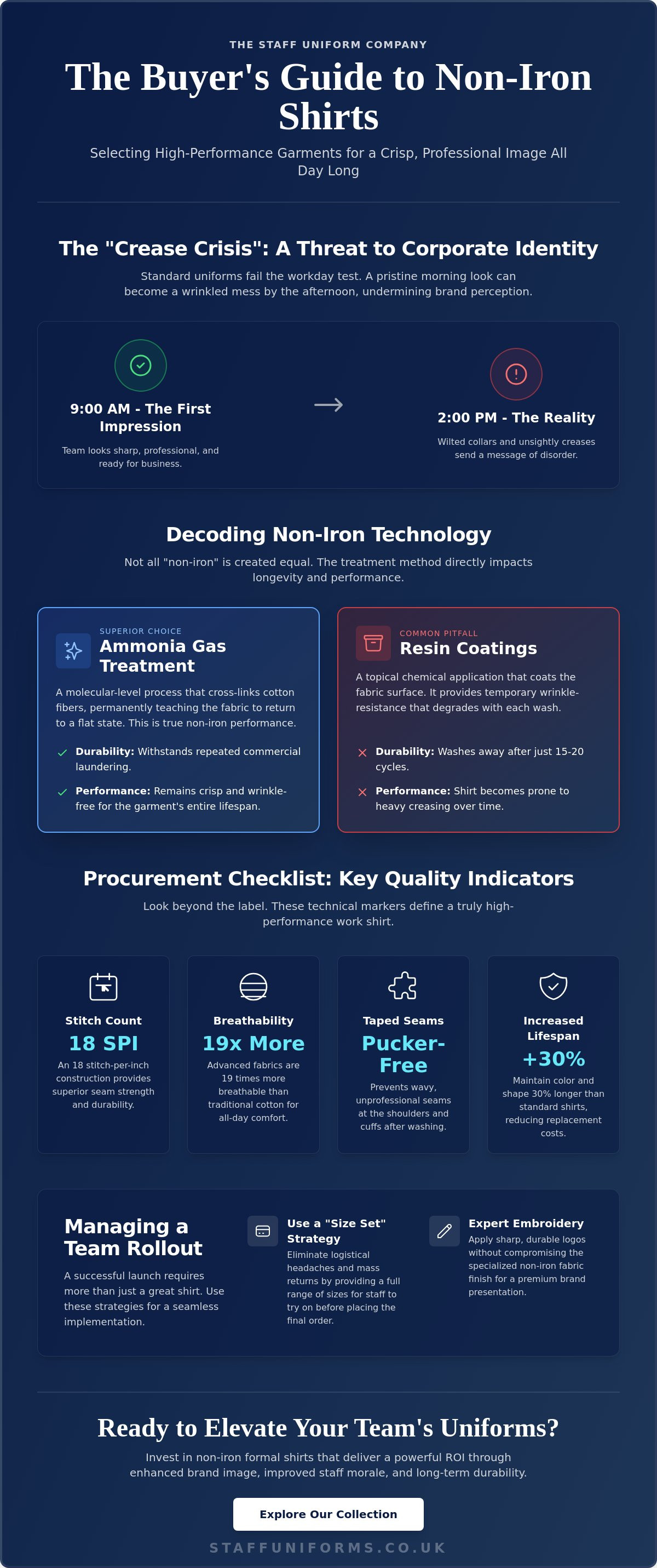
A professional image is a silent negotiator. It speaks for your company before a single word is exchanged in a boardroom. When your team arrives at a 2:00 PM meeting looking as though they've just stepped out of a dryer, it sends a message of disorder. This "Crease Crisis" is a common failure of standard cotton shirts, which lose their structural integrity within hours of wear. Choosing non-iron formal shirts for work isn't just about personal convenience; it's a strategic move to protect your corporate identity throughout the entire business day.
Modern garment technology has come a long way since the early history of wrinkle-resistant fabrics. While older versions relied on stiff, uncomfortable resins, today's high-performance shirts use molecular-level treatments to ensure the fabric "remembers" its flat shape. This means your staff stays crisp through long commutes, site visits, and back-to-back presentations. From a procurement perspective, the ROI is clear. Because these shirts require less heat and mechanical stress during laundering, they typically maintain their color and shape 30% longer than traditional office wear, reducing your annual replacement costs.
Maintaining Brand Consistency Across Teams
Consistency is often the hardest element to manage in a large workforce. When you leave uniform maintenance entirely to chance, you get a fragmented brand image. High-quality non-iron fabrics ensure every team member looks identical, regardless of their domestic routine. These shirts serve as the perfect foundation for our corporate suits and blazers, creating a sharp, cohesive aesthetic. It fosters a "ready-for-anything" culture where a sudden client visit doesn't cause a panic over a wrinkled collar.
Employee Benefits and Uniform Adoption
Staff morale is directly linked to the quality of the tools they're given, and a uniform is a tool for success. Employees genuinely prefer non-iron options because it removes the "hidden labor" of their job. Providing non-iron formal shirts for work saves each staff member approximately 75 minutes of ironing per week. This reduction in domestic maintenance leads to higher uniform adoption rates and better care of the garments. By investing in premium, low-maintenance clothing, you improve your employer brand and demonstrate that you value your team's time both inside and outside the office.
Understanding Non-Iron Technology and Fabric Blends
True non-iron performance isn't a surface coating; it's a structural change. At a molecular level, these garments undergo a process that cross-links the cellulose fibers in cotton. This prevents the fibers from shifting during the wash and dry cycle, allowing the fabric to return to its flat, original state. When sourcing non-iron formal shirts for work, you'll encounter two primary methods: ammonia gas treatments and resin coatings. Ammonia gas treatment is the superior choice for longevity. It alters the fiber structure itself, whereas resin is a topical application that often washes away after 15 to 20 cycles, eventually leaving the shirt prone to heavy creasing.
Safety and compliance are equally vital during the procurement process. High-quality manufacturers adhere to strict chemical limits to ensure wearer comfort. It's useful to consult the U.S. GAO report on formaldehyde in clothing to understand the safety standards that modern wrinkle-resistant technology must meet. Beyond the fabric itself, look for taped seams. This involves applying a thin adhesive tape inside the shoulder and cuff seams before stitching. This technique prevents "puckering," a common issue where the thread shrinks at a different rate than the fabric, causing the seams to look wavy and unprofessional.
A common myth is that non-iron technology creates a "plastic" feel that traps heat. In 2026, this is no longer the case. Advanced moisture-wicking finishes and open-weave constructions ensure that these shirts remain as breathable as traditional broadcloth. For businesses looking to upgrade their professional image, our selection of Formal Shirts & Blouses utilizes these modern technologies to keep your team cool and composed.
Pure Cotton vs. Cotton-Rich Blends
Pure 100% cotton non-iron shirts are the gold standard for executive branding. They offer a soft, luxurious hand-feel and maximum breathability. However, for high-rotation roles such as front-of-house or hospitality, cotton-rich blends (typically 80% cotton and 20% polyester) provide enhanced durability. These blends dry faster and resist fraying at the collar and cuffs, making them a practical choice for uniforms that undergo daily laundering.
Easy-Iron vs. True Non-Iron: Spotting the Difference
Don't let marketing jargon confuse your procurement strategy. "Easy-iron" garments are simply treated to make the pressing process faster; they will still look untidy if pulled straight from a dryer. A true non-iron shirt should meet the "wash-and-wear" standard, which we define as maintaining a Grade 4 smoothness rating after a 40-degree machine wash with zero manual pressing required. You can often identify true quality by the fabric weight; a slightly denser weave usually indicates a more robust non-iron treatment that won't fade over time.
Key Features to Look for in Professional Work Shirts
Selecting the right non-iron formal shirts for work requires a balance between aesthetic appeal and functional longevity. A shirt that looks excellent on a mannequin may fail in a high-pressure office environment if the technical details are overlooked. For procurement managers, the goal is to find a garment that accommodates a wide range of body types while maintaining a sharp, unified appearance. This starts with understanding the geometry of the shirt, from the spread of the collar to the construction of the cuffs.
Collar styles significantly impact the formality of the uniform. A classic point collar is the standard for tie-wearers, providing a structured frame for the knot. Conversely, cutaway collars offer a more contemporary look that works well for executive roles or open-collar policies. When it comes to cuffs, single cuffs provide the daily utility needed for administrative or front-of-house staff. Double cuffs, however, are reserved for senior leadership, adding a layer of prestige when paired with bespoke cufflinks. Another critical factor is fabric opacity. For white shirts, a fabric weight of at least 120gsm (grams per square meter) is essential to ensure professional modesty and prevent transparency under office lighting.
Fit Comparison for Diverse Workforces
One size never truly fits all in a national rollout. Slim fit options are ideal for younger teams or businesses aiming for a modern, high-energy brand identity. They offer a tapered silhouette that minimizes excess fabric. For a broader workforce, a tailored or regular fit provides the necessary comfort and range of motion for all-day wear. Inclusive sizing is a cornerstone of successful custom staff uniforms UK, ensuring that every employee feels confident and represented in their workwear.
Durability Check: Stitching and Buttons
The total cost of ownership is determined by how well a shirt survives the laundry cycle. Look for buttons that are lock-stitched; this technique uses a cross-stitch pattern that prevents the button from unraveling if a single thread snaps. High-quality non-iron formal shirts for work should also feature reinforced collars with permanent stays to maintain their shape after 50 or more industrial washes. Finally, prioritize OEKO-TEX Standard 100 certification. This ensures the fabric is free from harmful substances, which is vital for staff morale and safety during long, 10-hour shifts where skin irritation can become a major complaint.
Managing a Team Rollout: Sizing and Durability
Executing a successful rollout for non-iron formal shirts for work requires precise logistical planning. One of the most common pitfalls in procurement is relying on staff to self-report their sizes. Statistics show that approximately 15% of employees provide incorrect measurements when left to their own devices. To prevent the administrative burden of mass returns, we recommend the "Size Set" strategy. By providing a physical range of sizes for your team to try on before the final order is placed, you can reduce sizing-related returns by up to 90%. This ensures every team member feels confident in a garment that fits correctly from day one.
Consistency in supply is just as vital as the initial fit. When managing a growing workforce, you need a partner who maintains deep stock levels year-round. It's frustrating to hire a new starter only to find their specific collar size is out of stock for six weeks. For the UK climate, we typically recommend a fabric weight of 120gsm. This provides enough substance for winter layering while remaining breathable during the summer months. If you're ready to streamline your next rollout, you can view our full range of professional shirts to see our current stock availability.
Laundering for Longevity
While these garments are designed for zero maintenance, specific care steps will extend the life of the non-iron treatment. We advise staff to follow the "Low Tumble" rule. Contrary to popular belief, a small amount of heat is actually beneficial as it helps the fabric "reset" its wrinkle-free memory. However, excessive heat can damage the fibers. Staff should avoid fabric softeners; these chemicals coat the technical fibers and can eventually degrade the shirt's ability to shed creases. Hanging the garment immediately after a short tumble dry session usually eliminates the need for any manual touch-up ironing.
Bulk Procurement Logistics
For large-scale corporate orders, lead times are a critical factor in your timeline. Standard orders for non-iron formal shirts for work typically ship within 5 to 7 working days. If your project requires custom branding, allow an additional 3 to 5 days for our embroidery team to ensure a precision finish. These shirts are designed for seamless integration with our corporate suits, ensuring a unified aesthetic across all departments. For businesses with fluctuating headcounts, we offer warehousing and call-off solutions. This allows you to secure bulk pricing while only receiving stock as your team grows.
Custom Branded Non-Iron Shirts: The Staff Uniform Company Solution
Branding is the final, critical step in transforming high-quality garments into a powerful corporate tool. Applying a logo to non-iron formal shirts for work requires a higher level of technical precision than standard cotton alternatives. Because the fabric is treated at a molecular level to resist creases, the embroidery process must be carefully managed to avoid "pulling" or creating tension puckers around the design. Our production team uses specialized backing materials and calibrated needle tensions to ensure your logo sits perfectly flat, mirroring the crisp finish of the shirt itself.
Precision placement is vital for maintaining a professional aesthetic. While a traditional left-chest embroidery remains the most popular choice, we also offer discreet branding on collars and cuffs for a more contemporary, executive look. This attention to detail ensures your brand remains visible even when staff are wearing corporate blazers or knitwear. We manage the entire process through our all-in-one service, moving from initial design consultation to national delivery with a focus on speed and accuracy. This streamlined approach allows you to focus on your operations while we handle the complexities of garment customization.
Embroidery vs. Print for Formal Wear
In a professional office or front-of-house environment, embroidery is the gold standard. Unlike screen printing, which can feel heavy and eventually crack, embroidery offers a textured, high-definition finish that lasts the entire lifespan of the garment. We use high-tensile threads that are color-matched to your specific corporate brand guidelines, ensuring 100% consistency across your entire workforce. Most importantly, our embroidery techniques are designed to maintain the non-iron integrity of the fabric. We ensure the area behind the logo remains comfortable against the skin, which is a major factor in staff satisfaction during long shifts.
Start Your Team Transformation
Choosing the right uniform is a significant investment, and we want you to be confident in your decision. We encourage procurement managers to request a physical sample to test the fit, fabric weight, and non-iron performance in a real-world setting. Our dedicated account managers are available to consult on fabric selection, helping you decide between pure cotton or durable blends based on your specific industry needs. We take the guesswork out of the process, providing a clear roadmap from your first inquiry to the final rollout. If you're ready to upgrade your team's image, Contact The Staff Uniform Company today for a bespoke quote.
Future-Proof Your Corporate Identity
Managing a professional workforce requires attention to detail that extends beyond the initial purchase. By prioritizing ammonia-treated fabrics and implementing the "Size Set" strategy, you eliminate the daily "Crease Crisis" and costly sizing errors. High-performance non-iron formal shirts for work serve as a vital tool for business success; they ensure your team maintains a sharp, consistent image from the morning commute to the final meeting of the day.
The Staff Uniform Company has acted as a specialist UK supplier since 2017, providing the technical expertise needed for complex team rollouts. Our in-house professional embroidery services allow for precision branding that respects the integrity of modern performance fabrics. With reliable national delivery across the UK and Ireland, we manage the entire logistical journey from design to your office door. It's time to provide your team with workwear that mirrors their professional pride and dedication.
Explore our range of professional non-iron shirts and start your team's transformation today. We look forward to partnering with you to create a durable uniform program that drives your business forward.
Frequently Asked Questions
Do non-iron shirts actually work for a 12-hour shift?
Yes, modern non-iron garments are engineered to maintain a Grade 4 smoothness rating for up to 16 hours of continuous wear. The molecular cross-linking within the fibers prevents the fabric from collapsing into creases, even during high-activity roles. This ensures that staff in long-shift environments, such as hospitality or security, look as professional at 8:00 PM as they did at the start of the day.
Can you still iron a non-iron shirt if it gets accidentally creased?
You can use a cool iron if a shirt becomes compressed during travel or is stored incorrectly. It's vital to avoid high heat settings; temperatures exceeding 150 degrees Celsius can damage the specialized fiber treatments. A light steam or a low-temperature press is usually sufficient to remove stubborn storage marks without compromising the shirt's built-in wrinkle resistance.
How many washes does the non-iron treatment last?
High-quality ammonia-treated shirts maintain their wrinkle-free properties for at least 50 to 60 wash cycles. This duration typically covers over 12 months of weekly wear for most employees. While cheaper resin-coated options may fail after 15 washes, premium non-iron formal shirts for work provide a significantly better return on investment by retaining their crisp finish for the garment's entire lifespan.
Are non-iron shirts breathable enough for a busy office?
Modern 2026 fabric technology ensures these shirts are up to 19 times more breathable than traditional heavy cotton. We utilize open-weave constructions and moisture-wicking finishes that allow air to circulate freely around the body. This prevents the "plastic" feel often associated with older synthetic blends, keeping your team cool and comfortable in high-pressure boardroom environments or during a humid commute.
What is the best way to wash non-iron shirts to keep them crisp?
Wash the garments on a 40-degree cycle and tumble dry on a low heat setting for approximately 10 minutes. The moderate heat helps the fabric "reset" to its flat, original state. To avoid any manual pressing, you must hang the shirts on a high-quality hanger immediately after the dryer stops. Don't overfill the washing machine, as this creates mechanical pressure that can force deep creases into the fabric.
Can I get my company logo embroidered on a non-iron shirt?
Yes, our in-house team provides precision embroidery services specifically calibrated for performance fabrics. We use specialized backing materials to ensure the logo remains flat and doesn't cause the surrounding non-iron fabric to pucker. This professional finish ensures your brand is clearly visible on the chest, collar, or cuff while maintaining the shirt's low-maintenance characteristics for your staff.
Is there a difference between 'Easy Care' and 'Non-Iron'?
Yes, "Easy Care" shirts are only treated to make the ironing process faster; they still require a manual press to look professional. True non-iron formal shirts for work are designed for "wash-and-wear" performance. A non-iron garment is engineered to shed wrinkles entirely during the drying process, making it the superior choice for procurement managers looking to reduce the domestic maintenance burden on their teams.
What fabric blend is best for a durable staff uniform?
A blend of 80% organic cotton and 20% recycled polyester offers the optimal balance of luxury and longevity. This specific ratio provides the soft hand-feel of natural fibers while the polyester adds the tensile strength required for high-rotation uniforms. This blend dries three times faster than 100% cotton, making it a practical, durable, and sustainable choice for large-scale corporate rollouts.