
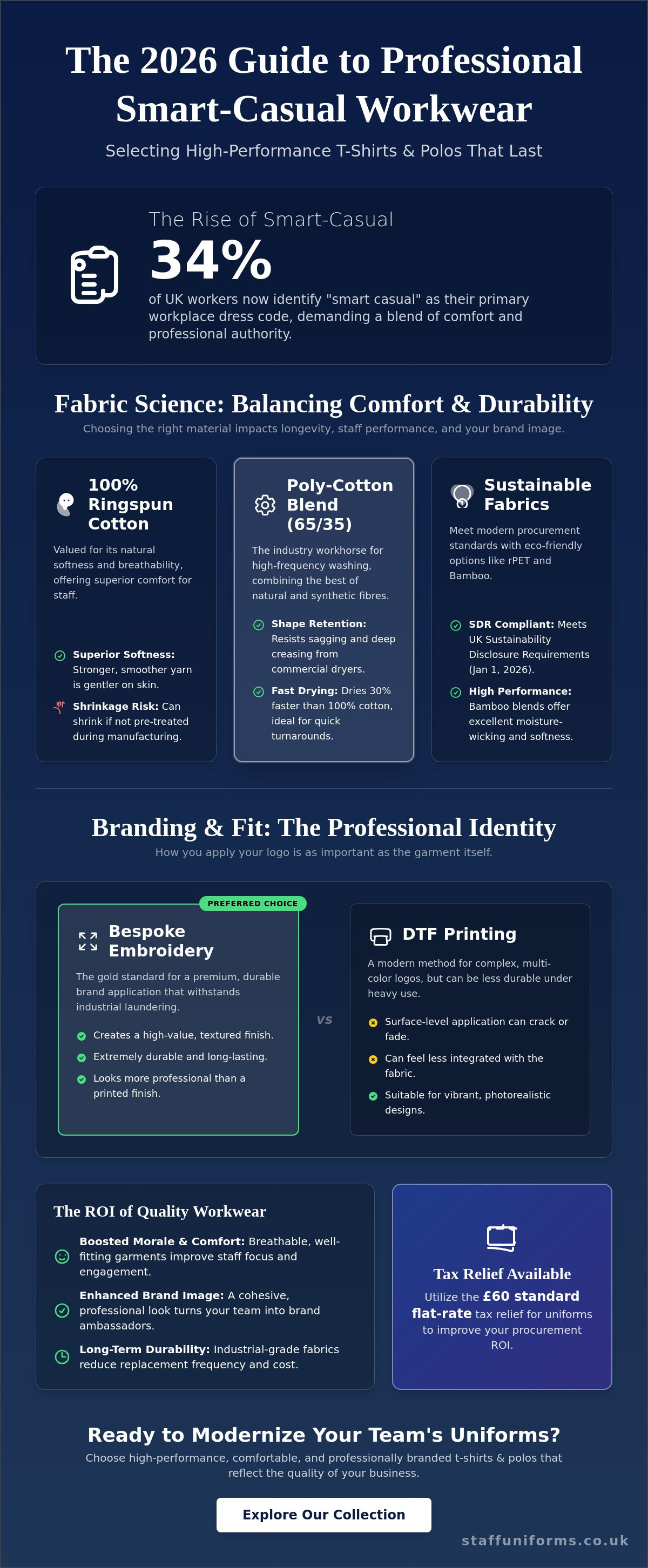
Did you know that 34% of UK workers now identify "smart casual" as their primary workplace dress code? While the shift toward comfort is clear, many procurement managers struggle to find casual work t-shirts & polos that don't look shabby after just five industrial washes. It's frustrating to invest in a new kit only to have staff complain about non-breathable fabrics or watch your brand identity fade alongside the dye. We understand that a uniform is a vital tool for business success, not just a garment.
You deserve a team appearance that reflects your professional authority without sacrificing the human element of comfort. This 2026 guide reveals how to select high-performance workwear that balances durable technical fabrics with a sharp, bespoke finish. You'll learn about the latest Sustainability Disclosure Requirements (SDR) effective since January 1, 2026, and how to utilize the £60 standard flat-rate tax relief to improve your ROI. We'll break down the specific garment technologies that ensure your team stays cool, comfortable, and consistently on-brand throughout the year.
Key Takeaways
- Learn how to select industrial-grade fabrics that prevent your uniform from looking worn while maintaining peak breathability for your staff.
- Discover why bespoke embroidery is the preferred choice for premium branding on casual work t-shirts & polos compared to modern DTF printing methods.
- Understand the technical material blends required to balance the natural softness of cotton with the durability needed for high-frequency laundering.
- Identify sector-specific solutions, such as stain-resistant hospitality wear or executive-style knitwear designed for professional corporate environments.
- Get a direct comparison of the leading 2026 workwear models, from luxury stretch options to high-volume value staples for large teams.
The Rise of Smart-Casual: Why T-Shirts and Polos Are the 2026 UK Workplace Standard
The UK workplace has undergone a significant transformation. By May 2026, the traditional suit and tie have largely been replaced by more versatile options in many sectors. Professional casual isn't about looking relaxed; it's about looking capable. In modern UK business environments, this means a clean, branded aesthetic that allows for physical movement. High-quality casual work t-shirts & polos now serve as the foundation for this look. They bridge the gap between "too formal" and "too relaxed," providing a uniform that works as hard as your team does.
Comfort has a direct psychological impact on your team. When staff aren't fighting with stiff collars or restrictive fabrics, their focus shifts entirely to the customer. A comfortable employee is a more engaged employee. This isn't just a theory; it's a practical reality for the 34% of the UK workforce currently operating under smart-casual dress codes. By removing the physical distraction of uncomfortable clothing, you improve customer service quality and staff retention. Furthermore, a relaxed dress code supports a more inclusive and diverse workforce. It allows for different body types and personal comfort requirements that rigid formal wear often ignores.
Breaking the 'Informal' Stigma
The perception of casual wear has shifted dramatically. A well-fitted, bespoke embroidered polo often looks more professional than a creased, poorly fitted formal shirt. The history of the polo shirt shows its transition from athletic gear to a corporate staple. Industries like technology, modern logistics, and boutique retail now prefer this standard because it projects energy and efficiency. Smart-Casual Workwear is a strategic blend of athletic comfort and corporate aesthetics. It signals that your team is ready for action, not just sitting behind a desk. When you choose high-quality casual work t-shirts & polos, you aren't lowering your standards; you're modernizing them.
The ROI of Employee Comfort
Investing in quality materials pays dividends in morale. Staff performance is intrinsically linked to garment breathability and freedom of movement. If your team moves between office desks and site visits, they need clothing that adapts to both environments. A standard t-shirt might fail after three washes, but a high-performance garment maintains its shape and professional edge. This longevity ensures a higher return on investment for your procurement budget. Choosing the right custom staff uniforms uk can bridge the gap between employee comfort and brand identity. It turns your workforce into a cohesive, mobile advertisement for your business. When staff feel good in what they wear, they represent your brand with genuine pride.
Fabric Science: Selecting Materials That Balance Comfort With Industrial Durability
Selecting the right material for your casual work t-shirts & polos is a technical decision that impacts both your budget and your staff's daily performance. The fabric acts as the primary interface between the employee and their environment. In a professional setting, this material must withstand the rigours of industrial laundering while remaining comfortable for an eight-hour shift. Choosing incorrectly leads to "shabby" uniforms that sag, pill, or fade within months, undermining your corporate identity.
100% Ringspun cotton remains a popular choice for its natural softness and skin-friendly properties. Unlike standard open-end cotton, the ringspun process twists the fibres together to create a stronger, smoother yarn. While it offers superior comfort, it's susceptible to shrinkage if not pre-shrunk during manufacturing. For teams requiring high-frequency washing, poly-cotton blends are the industry workhorse. A 65% polyester and 35% cotton mix provides the "best of both worlds." It retains its shape, dries 30% faster than pure cotton, and resists the deep creasing that often occurs in commercial dryers.
Sustainable fabrics are now a standard requirement following the UK’s January 1, 2026, Sustainability Disclosure Requirements (SDR). Procurement managers now frequently specify recycled polyester (rPET) or bamboo blends. Bamboo is particularly effective for customer-facing roles due to its natural anti-bacterial properties and silk-like drape. When reviewing specifications, pay close attention to the GSM (Grams per Square Metre). A 140-160 GSM fabric is ideal for lightweight t-shirts in hot environments, whereas a 200-220 GSM weight is the professional standard for durable, long-lasting polo shirts.
Performance Blends for Active Roles
Moisture-wicking technology has transitioned from the gym to the warehouse. Modern technical polos utilize 'Cool-dry' cross-section fibres that pull perspiration away from the skin to the garment's surface for rapid evaporation. This is vital for hospitality and logistics staff who move constantly. These performance blends often feature 'Easy-care' finishes. This chemical treatment ensures the fabric resists wrinkling, allowing your team to maintain a crisp appearance without the need for intensive ironing. It's a practical solution that saves staff time and keeps your brand looking sharp.
Durability and Colour Retention
Reactive dyeing is the gold standard for maintaining a professional image. This process ensures the pigment chemically bonds with the fabric fibres, preventing the premature fading common in dark-coloured uniforms. High-quality garments should maintain their vibrancy for at least 50 industrial wash cycles. Pilling resistance is another key metric; cheaper fabrics often develop small bobbles of fibre that make a uniform look old prematurely. If you want to ensure your investment lasts, you can browse our technical workwear range to find garments built for longevity.
Branding and Fit: Elevating Casual Wear Into a Professional Business Identity
Branding turns a standard garment into a powerful marketing tool. When you select casual work t-shirts & polos, the application of your logo determines the garment's perceived value. Embroidery remains the gold standard for polo shirts. It provides a three-dimensional, textured finish that signals premium quality and stability. For t-shirts, modern Direct to Film (DTF) technology has overtaken traditional screen printing. DTF allows for high-detail, multi-coloured designs that remain flexible and won't crack after repeated stretching. This ensures your brand looks as sharp on day 100 as it did on day one.
Fit is equally vital for maintaining a professional image. In 2026, we categorize fits into three distinct types to suit different workforce demographics. A 'Classic Work Fit' offers a generous cut for maximum range of movement, ideal for manual tasks. 'Contemporary Fit' provides a slightly tailored look that suits most body types, while 'Slim Fit' offers a modern, high-fashion aesthetic for boutique retail or tech environments. Achieving brand consistency means ensuring your logo size and placement remain proportional across the entire size run. A logo that looks perfect on a Medium might look lost on a 4XL; a professional partner manages these adjustments during the digitisation process to maintain visual balance.
Choosing Your Branding Method
The weight of your fabric dictates your branding options. Heavy embroidery on a lightweight, 140 GSM t-shirt often causes 'puckering,' where the fabric pulls and ripples around the stitches. We recommend high-definition prints for lighter t-shirts and reserved embroidery for heavier polos. Position matters too. While the left chest is the traditional choice, adding a small logo to the nape of the neck or the sleeve adds a modern, bespoke touch. For high-stretch technical fabrics, DTF is the superior choice. It bonds with the fibres, allowing the garment to move without distorting the brand's visual integrity.
Sizing for a Diverse Workforce
A cohesive team appearance requires more than just the same colour. Offering 'Lady-fit' options alongside Unisex garments shows a commitment to employee comfort and professional pride. Lady-fit garments feature shorter sleeve lengths and waist shaping to provide a more ergonomic fit for female staff. When managing bulk orders, use a structured size matrix to ensure you have adequate stock for new starters. If your team transitions between casual and formal environments, see our corporate suits guide for strategies on maintaining a unified brand identity across different garment tiers. This ensures your brand remains recognisable, whether your staff are in a polo shirt or a tailored blazer.
Sector-Specific Selection: Matching Garments to Your Team’s Daily Demands
Every industry places different physical demands on a uniform. Selecting the right casual work t-shirts & polos requires a deep understanding of your team's daily movements and environment. A garment that excels in a climate-controlled office will likely fail on a construction site or in a high-pressure kitchen. To ensure a high ROI, you must match technical specifications like seam reinforcement and fabric weight to the specific challenges of the role. This precision prevents premature garment failure and keeps your team looking sharp throughout their shift.
In healthcare and beauty settings, non-clinical staff such as receptionists or coordinators need to project a hygienic, approachable image. Casual options for these roles often favour pale blues, crisp whites, or soft greys in high-density weaves that remain opaque. These garments must withstand high-temperature washes to maintain hygiene standards without losing their shape. Similarly, corporate offices are increasingly adopting the 'Executive Polo.' These garments merge knitwear aesthetics with the comfort of a standard polo, featuring stiffened collars and fine-gauge fabrics that look professional under a blazer or on their own.
Hospitality and Front-of-House
Restaurant and bar environments are notoriously tough on clothing. Servers and bartenders require fabrics with high elastane content to allow for a full range of movement when carrying trays or reaching for stock. We recommend selecting dark-coloured, easy-care fabrics that effectively hide minor spillages and resist staining. It's also vital to choose polos with smooth finishes that won't pill when worn under aprons. For a fully coordinated look that stands up to the heat of service, you can consult with hospitality workwear suppliers to ensure your entire kit is fit for purpose.
Trade and Industrial Essentials
For logistics and trade roles, durability is the absolute priority. You should specify 'heavyweight' t-shirts with a minimum of 200 GSM to ensure the fabric doesn't tear under industrial stress. Look for garments with reinforced shoulder seams and twin-needle stitching, which prevent the uniform from pulling apart at high-stress points. A 'drop-tail' hem is a practical feature for staff who are frequently bending or reaching, as it ensures the shirt stays tucked in and provides continuous coverage. With outdoor work becoming more regulated in 2026, ensure your casual workwear includes built-in UV protection to safeguard your workforce. If you're ready to upgrade your team's kit, you can order your sector-specific workwear today to guarantee performance and protection.
Top Picks for 2026: Standout Casual Workwear From Our Collection
Selecting the right garments requires a careful balance between aesthetic appeal and long-term performance. Our 2026 collection features models specifically engineered to handle the technical demands of professional environments. The Tee Jays Luxury Stretch Polo stands as the gold standard for corporate casual. It utilizes a 95% ringspun combed cotton and 5% elastane blend. This specific composition ensures the garment retains its shape and professional silhouette even after a 12-hour shift. For businesses managing large workforces, the Uneek Classic Polo offers unbeatable value. It's a robust 220 GSM poly-cotton blend designed for high-volume teams who need consistency and durability across hundreds of employees.
If your brand demands a retail-inspired look, the Nimbus Harvard Polo is the premier choice. It features a sophisticated flat-knit collar and a tailored silhouette that mirrors high-end fashion while maintaining workwear strength. These selections represent the peak of modern garment technology. They ensure your team looks professional while staying comfortable throughout the working day. By choosing these proven models, you secure a higher ROI through garment longevity and improved staff morale.
Premium Polos for Client-Facing Roles
Our top-tier polos feature a high-density knit that provides an exceptionally smooth handle. This fabric stability is crucial for bespoke embroidery. A stable, heavy-gauge fabric prevents the logo from pulling or distorting the shirt front over time. These models often include reinforced plackets and permanent collar stays to maintain a crisp, upright appearance. We provide these garments in over 20 corporate-aligned colours. This variety ensures a perfect match for your existing brand guidelines without the need for custom dyeing. When your staff meet clients, these premium details reinforce your company's commitment to quality and professionalism.
Durable T-Shirts for High-Intensity Work
For high-intensity roles, our industrial-grade t-shirts focus on structural integrity and worker safety. We utilize twin-needle stitching on the sleeves and hem to prevent unravelling under physical stress. Taped neck and shoulder seams provide additional reinforcement. This prevents the garment from stretching out of shape after 50+ industrial wash cycles. These features are essential for staff in logistics or trade who require clothing that moves with them without failing at the seams. High-performance casual work t-shirts & polos are more than just clothing; they're essential tools for your team's daily success. You can browse our full range of casual work t-shirts & polos to find the ideal fit for your specific team requirements.
Ready to Modernise Your Team's Professional Identity?
Your team's uniform is more than just clothing; it's a vital tool for business success. We've explored how selecting the right fabric and branding method ensures your casual work t-shirts & polos maintain a sharp look after 50+ industrial wash cycles. By matching garment weight and tech features to your specific sector, you improve staff morale and project a consistent, professional brand to every customer. It's time to move beyond "shabby" workwear and invest in longevity and comfort.
With over 90 professional styles available, we provide the variety your business needs to stand out. Our expert UK-based logo embroidery and printing services ensure your corporate identity is in safe hands. Every garment we offer is constructed from durable fabrics tested for the rigours of industrial laundering. You can Shop the Casual Work Polos & T-Shirts Collection today to start your transformation. We're here to help you build a uniform that your team wears with genuine pride.
Frequently Asked Questions
What is the best fabric for a work polo shirt in a hot environment?
Moisture-wicking technical polyester or bamboo blends are the most effective choices for high temperatures. These fabrics utilize 'Cool-dry' technology to pull sweat away from the skin, allowing it to evaporate 30% faster than standard cotton. This prevents the heavy, damp feeling often associated with traditional workwear during summer shifts or in high-heat industrial settings.
How many t-shirts or polos should I provide for each staff member?
The professional standard for full-time employees is a minimum of 3 to 5 garments. This allocation ensures a clean rotation: one being worn, one in the wash, and one ready for the next shift. For hospitality or trade roles where soilage is frequent, providing 5 items per person significantly increases garment longevity by reducing the frequency of wash cycles for each individual piece.
Should I choose embroidery or printing for my company logo?
Bespoke embroidery is the superior choice for polo shirts because it adds a premium, three-dimensional finish that withstands industrial laundering. For lightweight casual work t-shirts & polos, high-definition DTF printing is often better. Printing avoids the 'puckering' effect that heavy embroidery can cause on thinner t-shirt fabrics, ensuring the garment hangs correctly while maintaining brand clarity.
What is the difference between a 160 GSM and 220 GSM t-shirt?
GSM stands for Grams per Square Metre, measuring the density of the fabric. A 160 GSM garment is a lightweight, breathable option ideal for summer use or indoor office environments. In contrast, a 220 GSM garment is a heavyweight, industrial-grade fabric that offers 40% more density. This heavier weight provides the durability required for manual labour and high-intensity roles.
How do I ensure my casual workwear doesn't shrink in industrial washes?
Select high-percentage poly-cotton blends or pre-shrunk ringspun cotton to minimize the risk of shrinkage. Poly-cotton blends are specifically engineered to remain dimensionally stable even at 60-degree wash temperatures. Always verify that your chosen casual work t-shirts & polos are rated for industrial laundry cycles to protect your procurement investment and maintain a consistent fit for your team.
Can I mix and match different brands within one uniform order?
You can mix brands to meet different price points or technical needs, but you must check for colour consistency. While two brands may both list a colour as 'Navy,' there can be a 5% to 10% variance in shade. We manage this process by comparing dye lots and fabric textures to ensure your team maintains a unified, professional appearance across all garment types.
What are the key differences between men's and women's fit polos?
Women's 'Lady-fit' garments are ergonomically designed with shorter sleeve lengths, a narrower waist, and a smaller collar. These adjustments provide a more professional silhouette for the 48% of the UK workforce who are female. Moving away from 'Unisex' sizing improves staff morale by providing clothing that fits correctly and looks intentional rather than oversized.
Are there sustainable casual workwear options available in 2026?
Sustainable options are now a mandatory standard following the UK’s January 1, 2026, Sustainability Disclosure Requirements (SDR). You can choose from recycled polyester (rPET), organic cotton, or bamboo blends that provide verifiable data on their environmental impact. These eco-friendly materials now comprise approximately 45% of our professional range, offering the same industrial durability as traditional virgin fibres.