
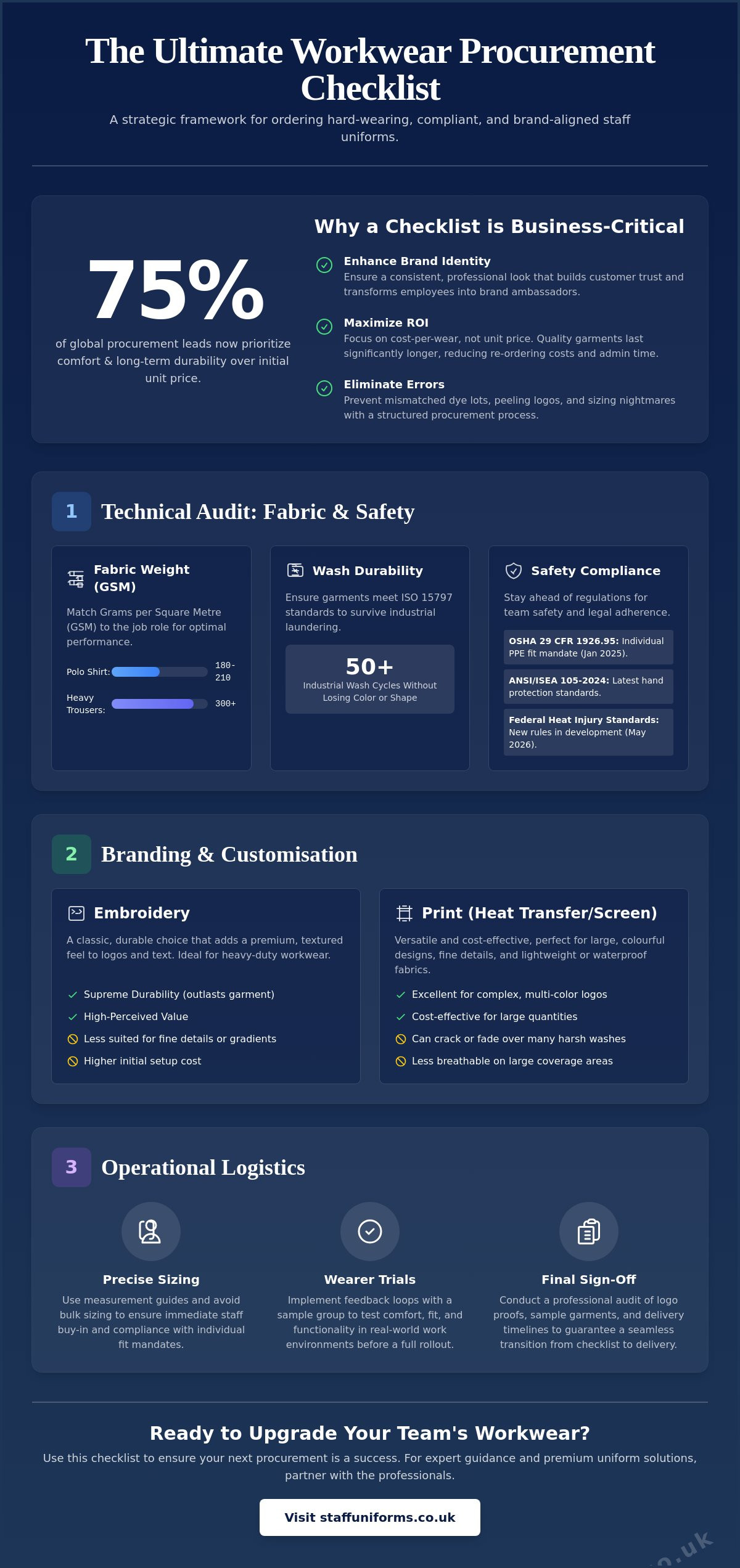
75% of global procurement leads now prioritize comfort and long-term durability over the initial unit price when selecting workplace fabrics. It's a shift driven by the reality that a cheap uniform is a false economy. You likely feel the pressure to get this right, especially with the fear of logos fading after a few cycles or the logistical nightmare of incorrect sizing for a large team. Managing these details requires more than a simple spreadsheet; it requires a comprehensive checklist for ordering new company workwear that accounts for both brand identity and technical performance.
We've developed this step-by-step framework to ensure your next order is hard-wearing, compliant, and a source of pride for your staff. You'll learn how to navigate the January 13, 2025, OSHA mandate (29 CFR 1926.95) regarding individual PPE fit and the latest ANSI/ISEA 105-2024 standards for hand protection. This guide moves from high-level branding strategy to granular specifications like moisture-wicking technology and embroidery that survives 50+ industrial washes. We'll also address the federal heat injury standards currently in rulemaking as of May 2026 to ensure your team stays safe and your business stays compliant.
Key Takeaways
- Understand how high-quality workwear functions as a strategic tool to improve staff morale and project a professional corporate identity.
- Identify technical benchmarks for fabric weight and weave to ensure garments withstand over 50 industrial washes without losing color or shape.
- Use our comprehensive checklist for ordering new company workwear to decide between embroidery and print based on your specific laundering requirements.
- Implement wearer trials and precise measurement guides to avoid the common pitfalls of bulk sizing and ensure immediate staff buy-in.
- Simplify the final procurement stage with a professional audit of logo proofs and delivery timelines to reduce friction and guarantee results.
Why a Comprehensive Workwear Ordering Checklist is Business-Critical
A robust procurement strategy starts with a plan. For UK businesses in 2026, a checklist for ordering new company workwear isn't just a shopping list; it's a strategic audit. It protects your budget and your brand. Inconsistent logos or poor fabric choices don't just look bad; they erode the trust of your clients. By following a structured framework, you eliminate the risk of sizing errors and ensure every garment meets the technical requirements of the specific job. Quality workwear is a vital tool for business success. It transforms an employee into a brand ambassador while ensuring they stay safe on the job.
The global workwear market is projected to reach USD 75.02 billion in 2026. This growth is fueled by companies moving away from disposable, low-quality garments. Using a checklist for ordering new company workwear allows you to join this trend, focusing on long-term value rather than short-term savings. When you standardize your process, you prevent the chaos of mismatched dye lots and peeling transfers that often plague rushed orders.
The ROI of Quality Workwear
True value is measured by the cost per wear, not the initial invoice price. Statistics from May 2026 show that 75% of global buyers now prioritize durability because it makes financial sense. Consider the lifespan of a basic polo shirt. A cheap garment might lose its shape or color after just three months of industrial washing. In contrast, a high-quality alternative designed for longevity can easily last two years. While the upfront cost might be higher, the long-term saving is significant. This approach also slashes the administrative burden of constant re-ordering. When you invest in professional attire, you're buying consistency and reducing the time spent managing returns.
Aligning Uniforms with Brand Identity
Your team is a walking billboard. Whether they are on a construction site or in a healthcare clinic, their appearance communicates your company values. The history of workwear shows that uniforms have always been about more than just utility; they denote expertise and authority. Ensuring your custom staff uniforms uk reflect this standard is essential for maintaining a cohesive look across departments. A warehouse operative and a regional manager should share a visual DNA. This consistency builds customer trust. People feel safer dealing with a business that looks organized and professional. A well-fitted, high-quality uniform improves staff morale because it shows the employer values their comfort. When staff feel proud of their appearance, productivity naturally follows. Using a checklist ensures these branding details are locked in before the first stitch is sewn.
Technical Audit: Assessing Fabric Durability and Safety Standards
Technical performance is the backbone of any professional procurement strategy. When you build your checklist for ordering new company workwear, you must move beyond aesthetics to technical specifications. Understanding GSM (grams per square metre) is vital for matching garments to job roles. For instance, a standard polo shirt usually sits around 180 to 210 GSM, while heavy-duty trousers require 300+ GSM to withstand industrial environments. Durability also depends on washability. We prioritize garments that meet ISO 15797 standards. This ensures they survive 50+ industrial washes without losing structural integrity or color vibrancy. A uniform that fades after ten washes isn't just a branding failure; it's a wasted investment.
Comfort is no longer a luxury; it's a productivity requirement. With 75% of global buyers prioritizing comfort, moisture-wicking fabrics have become the industry standard for active roles. These materials draw sweat away from the skin, keeping staff cool and focused throughout their shift. This is particularly relevant as OSHA continues to develop new federal heat injury standards in 2026. Following OSHA's PPE guidelines ensures your team is equipped with gear that fits properly. This is now a legal mandate following the January 13, 2025, revision to standard 29 CFR 1926.95, which requires PPE to fit each employee individually rather than using a one-size-fits-most approach.
Selecting the Right Material for the Environment
Choosing between polycotton blends and 100% cotton depends on your specific workplace needs. Polycotton offers superior strength and crease resistance. This makes it ideal for high-intensity roles where longevity is key. Conversely, 100% cotton provides natural breathability for lighter applications or sensitive environments. We're also seeing a significant shift toward sustainability. 49% of employers now invest in recycled polyester to meet corporate social responsibility goals. For specialized sectors, antimicrobial finishes are essential for healthcare, while flame-retardant materials are non-negotiable for electrical or welding work.
Safety and Regulatory Compliance
Compliance is the most critical part of your checklist for ordering new company workwear. For high-visibility requirements, you must specify the correct class under EN ISO 20471 based on the risk level of the work zone. Footwear must also meet current standards to protect your workforce. The active standard for 2026 is ASTM F2413-18. This requires impact resistance of 75 ft-lbs and compression resistance of 2,500 lbs. In clinical settings, the right scrubs uk play a vital role in infection control while maintaining a professional appearance. If you need help navigating these technical specs, our team can provide a bespoke workwear consultation to ensure your order is fully compliant and durable.
Branding and Customisation: Choosing Between Embroidery and Print
Your corporate identity is in safe hands when you understand the technical limits of branding. A professional logo is the final touch on any uniform; it's the difference between a generic garment and a vital tool for business success. When building your checklist for ordering new company workwear, the choice between embroidery and print is a technical decision, not just an aesthetic one. In 2026, embroidery remains the preferred method for premium workwear due to its professional finish and exceptional durability. However, the right choice depends on your specific fabric and laundering requirements.
Durability is the primary concern for any facility manager. Industrial laundry cycles often exceed 60 degrees Celsius to ensure hygiene. If you choose the wrong branding method, your corporate identity can peel or fade within months. Ensuring that branding doesn't compromise the fabric's integrity is essential for safety compliance. According to OSHA Personal Protective Equipment (PPE) standards, employers must maintain protective gear in a reliable condition. This includes ensuring that customisation methods do not degrade the flame-retardant or high-visibility properties of the garment. We always recommend a technical audit of your logo placement to maximise visibility without blocking pockets or ventilation zones.
The financial implications of customisation involve balancing setup costs against unit costs. Embroidery typically requires a one-off digitisation fee to convert your logo into a stitch file. Once this is done, the unit cost remains stable. Printing methods like screen printing often have setup costs per colour, making them more economical for high-volume orders with simple designs. For bespoke orders, we manage the entire process from design to delivery to ensure your checklist for ordering new company workwear stays on budget and on schedule.
The Case for Logo Embroidery
Embroidery is the gold standard for corporate suits, blazers, and heavy-duty polos. It offers a three-dimensional texture that creates a premium feel for client-facing staff. Because the thread is stitched directly into the fabric, the logo often outlasts the garment itself. It's the most reliable way to maintain a professional appearance over 50+ industrial washes. For businesses that value longevity and brand representation, embroidery is the most dependable choice.
When to Choose Screen Printing or Heat Transfer
Screen printing or heat transfers are better suited for lightweight T-shirts, hi-vis vests, and large back logos. These methods allow for fine detail and vibrant colours that embroidery can't always replicate on thin fabrics. However, there are technical limitations. Some waterproof fabrics have internal membranes that can be damaged by the high heat required for certain transfers. We provide specific printing techniques for technical outerwear to ensure your team stays dry while looking professional.
Operational Logistics: Sizing, Allocation, and Staff Feedback Loops
Logistics determine the ultimate success of your uniform rollout. Even the best-branded gear fails if it doesn't fit the people using it. Your checklist for ordering new company workwear must bridge the gap between procurement spreadsheets and the daily reality of your staff. We advocate for the "3-set rule" for every employee. This ensures one uniform is worn, one is in the wash, and one is ready for the next day. This rotation is essential for reaching the 50-wash durability benchmark. It also prevents the premature degradation of fibres caused by excessive daily wear and lack of recovery time for the fabric.
Managing a bulk order for a large team requires a structured approach to inventory. You must plan for staff turnover and new starters from the outset. Keeping a 10% buffer of common sizes in stock prevents delays when onboarding new talent. This proactive stance ensures your corporate identity remains consistent across the entire workforce, regardless of when an employee joined the firm. High staff adoption and morale are the direct results of a logistics plan that respects the user's needs.
Implementing a Successful Wearer Trial
Don't commit to a bulk order without a trial phase. Select a diverse group of 5% to 10% of your workforce to test the garments for at least 14 days. Ask specific questions about range of motion, pocket placement, and breathability in real-world conditions. This feedback allows you to adjust specifications before the final sign-off. It's a small step that prevents expensive mass ordering errors and ensures the final product is a tool for productivity rather than a hindrance.
Sizing and Fit Management
Generic S, M, and L labels are often insufficient for a diverse team. Inaccurate sizing is a leading cause of returns, which can impact up to 30% of a shipment if not managed correctly. Use professional size guides that focus on specific chest, waist, and inside-leg measurements. Providing "Tall" and "Plus" options isn't just about inclusivity; it's about ensuring every employee can perform their job without restriction. For high-end requirements, Email Sales@staffuniforms.co.uk · Tel 0333 090 8552 to ensure a perfect fit for your executive team.
Final Procurement Sign-Off: Transitioning from Checklist to Delivery
The final sign-off is the bridge between a strategic plan and a professional reality. At this stage, your checklist for ordering new company workwear moves from a theoretical document to a technical execution plan. Precision is non-negotiable. A single error in a logo proof or a misinterpreted fabric swatch can lead to a costly batch of unusable garments. We recommend a final audit of all branding files to ensure the embroidery or print specifications match your corporate identity guidelines exactly. This includes verifying pantone colours and stitch counts before the production line starts. It's about securing your investment and ensuring the end result mirrors the high standards of your business.
Setting realistic lead times is another critical factor in a successful rollout. While the global workwear market is projected to grow to USD 75.02 billion in 2026, supply chains can still experience friction. Managing expectations across your organisation prevents frustration. A national delivery for a workforce of 500+ employees typically requires a structured timeline from initial design to final distribution. We provide a transparent schedule that accounts for technical customisation and quality control phases. This ensures your team receives their gear exactly when they need it, without administrative delays.
Choosing Your Workwear Partner
An all-in-one partner reduces procurement friction by managing every step of the garment lifecycle. When evaluating providers, look for industry-specific expertise. For example, hospitality workwear suppliers must understand the unique demands of front-of-house aesthetics versus back-of-house durability. A dedicated account manager is invaluable for multi-site businesses. They act as a single point of contact to ensure consistency across every branch. Additionally, check your supplier's sustainability credentials. With 49% of employers now investing in recycled materials, your partner's ethics should align with your own brand values.
The Final Ordering Checklist
Before you click "order," perform one last sweep of the data. This 10-point checklist for ordering new company workwear ensures nothing is missed:
- Logo Proofs: Approved for colour, size, and placement.
- Fabric Swatches: Confirmed for weight (GSM) and texture.
- Safety Compliance: Verified against UK standards like EN ISO 20471.
- Sizing Data: Collected using professional fit guides to reduce returns.
- The 3-Set Rule: Verified that each employee has sufficient rotation.
- Delivery Logistics: Confirmed for centralised or individual site distribution.
- Replenishment Plan: Stock buffer calculated for new starters.
- Lead Times: Agreed and communicated to department heads.
- Sustainability: Recycled fabric options confirmed where required.
- Internal Launch: Plan in place to present the new uniform to the staff.
A successful launch generates staff excitement and pride. When the delivery arrives, establish a feedback loop to monitor garment performance over the first 50 washes. This data is essential for future replenishment and ensures your workwear remains a vital tool for business success.
Future-Proof Your Workforce Procurement for 2026
Building a professional uniform program is a strategic investment in your team's safety and your brand's reputation. By prioritising technical specifications like wash durability and adhering to the latest 2025 safety standards, you ensure your garments remain a functional tool for years. A structured approach eliminates the logistical friction that often leads to sizing errors or branding inconsistencies. It's about moving from a transactional purchase to a long-term branding partnership that values quality above all else.
Implementing this comprehensive checklist for ordering new company workwear transforms procurement from a chore into a competitive advantage. Success relies on both technical expertise and a focus on the human element of your business. When staff feel comfortable and proud of their appearance, productivity naturally follows.
We've served as a specialist UK supplier since 2017, providing a comprehensive range from bespoke corporate suits to high-performance medical scrubs. Our expert in-house branding services ensure your identity is applied with precision and longevity in mind. Request a professional workwear consultation from The Staff Uniform Company to start your next project today. Your team deserves gear that works as hard as they do.
Frequently Asked Questions
How many sets of uniforms should I provide for each employee?
We recommend providing a minimum of three sets per person. This follows the industry-standard "3-set rule" where one uniform is worn, one is in the wash, and one is ready for the next shift. Providing fewer sets leads to excessive laundering and fabric fatigue, which significantly shortens the garment's lifespan.
Should I choose embroidery or printing for my company logo?
Choose embroidery for items like polos, jackets, and corporate blazers that require high-temperature industrial washing. It's the gold standard for durability. Printing is better suited for lightweight t-shirts or large back logos on hi-vis vests where a flat finish is necessary to maintain the garment's flexibility.
What is the best fabric for durable workwear trousers?
A heavy-duty polycotton blend with a weight of at least 300 GSM is the most reliable choice for industrial environments. Polyester provides the essential tear strength and crease resistance, while the cotton content ensures breathability. For high-intensity roles, look for fabrics that meet ASTM D4157 standards for abrasion resistance.
How do I ensure the sizes I order will fit my diverse team?
Move away from generic "Small to XL" labels and use professional measurement guides for chest, waist, and inside leg. It's vital to include "Tall" and "Plus" size options to ensure inclusivity. Following the January 13, 2025, OSHA revision, employers must provide PPE that fits each employee individually to ensure safety.
Are company uniforms tax-deductible for UK businesses?
Yes, uniforms are generally tax-deductible if they are protective clothing or clearly identifiable as a company uniform with a permanent logo. HMRC rules state that ordinary clothing worn for work doesn't qualify. Using a checklist for ordering new company workwear helps you ensure all items meet these branding requirements for compliance.
What are the legal requirements for hi-vis workwear in the UK?
Hi-vis garments must meet the EN ISO 20471 standard to be legally compliant in the UK. You must select the correct class based on the risk level: Class 1 for low-risk areas, Class 2 for medium-risk zones like delivery routes, and Class 3 for high-risk environments such as motorways or construction sites.
How often should company workwear be replaced?
High-quality garments typically require replacement every 18 to 24 months when using a 3-set rotation. You should replace items immediately if the safety properties are compromised or if the branding has significantly faded. Reflective strips on hi-vis gear often degrade faster and may need more frequent audits to maintain visibility standards.
Can I get a sample of the workwear before placing a bulk order?
Yes, we provide fabric swatches and sample garments for wearer trials before you commit to a full production run. Testing samples is a critical step in your checklist for ordering new company workwear. It allows you to verify the fit, comfort, and branding quality in real-world conditions, preventing expensive ordering errors.