
The global corporate uniforms market is projected to reach $2.13 billion in 2026, yet many procurement managers still settle for garments that fade or fray after three washes. You likely understand the frustration of supply chain delays or inconsistent branding that undermines your professional image. It's time to stop viewing workwear as a recurring expense and start seeing it as a strategic investment. Learning how to choose a corporate uniform supplier is about finding a partner who values durability and staff comfort as much as you do.
This guide provides an expert framework to help you master the procurement process for a high-quality UK partner. You'll discover how to evaluate cost-per-wear to ensure long-term value and high staff morale. We'll cover everything from vetting technical expertise in embroidery to assessing sustainable fabric options like recycled polyester. By the end, you'll have a clear roadmap for establishing a dependable, long-term partnership that simplifies your replenishment process and protects your brand identity.
Key Takeaways
- Treat your uniform as a strategic asset that bridges the gap between your brand image and the daily reality of your staff.
- Master how to choose a corporate uniform supplier by vetting technical details like garment durability, fabric weight, and embroidery quality.
- Choose between stock-supported models for rapid replenishment or bespoke designs to create a completely unique identity for your team.
- Follow a structured procurement roadmap that uses functional briefing and hands-on sampling to eliminate supply chain risks before you commit.
- Leverage an all-in-one partner to handle everything from initial design to national logistics, keeping your corporate identity in safe hands.
Why Your Choice of Corporate Uniform Supplier is a Strategic Business Asset
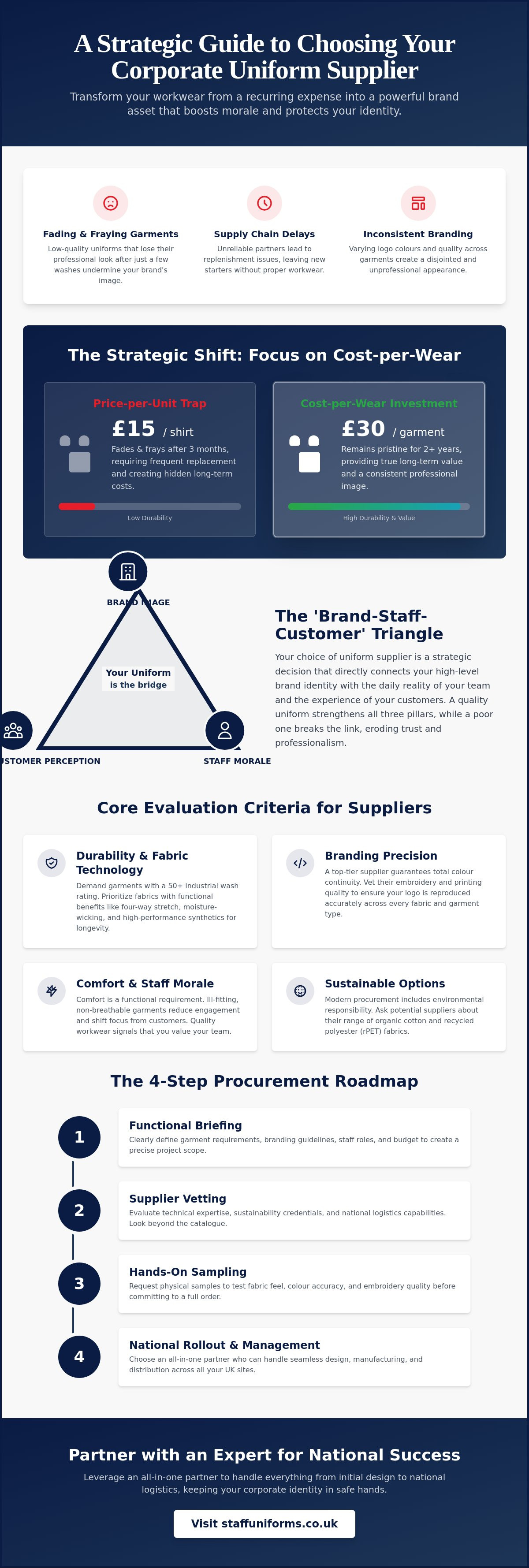
Selecting a workwear partner is one of the most significant branding decisions a procurement manager makes. A supplier isn't just a vendor; they're a strategic partner in your brand's longevity. When you understand how to choose a corporate uniform supplier, you're doing more than buying clothes. You're managing the 'Brand-Staff-Customer' triangle. This concept illustrates how uniforms bridge the gap between your high-level marketing image and the daily reality of your customer service. If the clothing fails, the brand promise breaks.
Procurement success in 2026 relies on 'Cost-per-Wear' rather than 'Price-per-Unit'. With the global corporate uniforms market projected to reach $2.13 billion this year, savvy businesses are moving away from disposable, low-cost garments. A £15 shirt that loses its shape after three months is far more expensive than a £30 garment that remains pristine for two years. Durable clothing provides psychological safety for your team. It allows them to focus on their roles without worrying about wardrobe malfunctions or unprofessional aesthetics.
The Link Between Uniform Quality and Staff Morale
Ill-fitting or low-quality garments are a fast track to decreased employee engagement. In high-pressure sectors like healthcare and hospitality, comfort is a functional requirement. If a nurse's scrubs restrict movement or a waiter's shirt doesn't breathe, their focus shifts from the patient or guest to their own physical discomfort. We define professional pride as the confidence an employee feels when wearing perfectly tailored corporate suits that reflect their expertise. High-quality workwear signals that a company values its people, which directly impacts staff retention rates.
Protecting Your Brand Identity Nationally
Inconsistent branding is a major risk for businesses with multiple UK sites. A logo that appears navy on a polo shirt but royal blue on a softshell jacket looks amateur and erodes customer trust. A reliable supplier ensures total colour continuity across every garment type in your range. This consistency is vital for the role of uniforms in corporate branding, as it creates a unified visual language from London to Edinburgh. When researching how to choose a corporate uniform supplier, you must prioritise their ability to reproduce your brand assets accurately across different textures and fabrics, such as corporate blouses and structured formal shirts. Consistent branding ensures your corporate identity remains in safe hands, regardless of where your staff are located.
Core Evaluation Criteria for Professional Uniform Companies
The global uniforms and workwear market is expanding rapidly, with a projected value of $89.71 billion in 2026. This growth means procurement managers have more options, but it also increases the risk of choosing a partner that lacks technical depth. When determining how to choose a corporate uniform supplier, you must look beyond the price tag. A dependable partner should align their processes with general procurement standards to ensure quality, safety, and regulatory compliance are met from day one.
Technical expertise is the foundation of a successful uniform program. You need a supplier that understands moisture-wicking properties for active roles and the structural requirements of formal attire. Branding precision is equally vital. Your corporate identity depends on the quality of your logo embroidery and screen printing. If the stitching pulls or the ink fades after a few months, your brand image suffers. You can explore our full range of durable workwear to see how high-specification branding and fabric technology work together.
Fabric Technology and Longevity
Durability is measured in the lab, not just the fitting room. For corporate blazers and trousers, look for wool-rich blends or high-performance synthetics that offer four-way stretch. The industry benchmark for 2026 is an 'industrial wash' rating of 50+ cycles. This ensures the garment maintains its shape, colour, and integrity over a year of heavy use. We're also seeing a massive shift toward sustainability. Standard requests now include organic cotton and recycled polyester (rPET). These materials provide the same longevity as traditional fabrics while meeting your company's environmental targets.
Ethical Sourcing and Compliance
In 2026, an ethical supply chain is a non-negotiable requirement for any professional business. You must verify a supplier's claims through recognised third-party audits like SEDEX or OEKO-TEX certifications. These frameworks prove that your garments are produced without exploited labour and are free from harmful chemicals. Transparency reduces your reputational risk and ensures your staff feel proud of what they wear. For specialised gear, such as hi-vis vests, ensure the supplier strictly adheres to UK safety standards. Knowing how to choose a corporate uniform supplier involves vetting these compliance documents as rigorously as you vet the fabric samples themselves.
Comparing Supply Models: Which Fits Your Business Needs?
The logistics of your uniform program are just as critical as the fabric quality. Understanding how to choose a corporate uniform supplier requires a deep dive into their delivery models. Stock-supported models are built for speed and reliability. They allow for rapid rollouts of essentials like polo shirts and trousers, often with lead times as short as 24 to 48 hours. This model is perfect for businesses that need to onboard new starters quickly without maintaining their own warehouse space.
Bespoke design offers total brand control but requires a different approach to planning. This model is the standard for high-end hospitality or luxury corporate roles where a unique visual identity is paramount. Many businesses now opt for hybrid models. These combine the cost-effectiveness of off-the-shelf garments with the professional finish of bespoke embroidery and tailoring. For larger organisations, managed services provide an all-in-one solution. Your partner handles everything from wearer-packing to national logistics, ensuring each employee receives a personalised kit directly to their door.
Stock-Supported vs. Bespoke: A Financial Breakdown
Your decision on how to choose a corporate uniform supplier should balance immediate availability with long-term exclusivity. Stock-supported models are the safe choice for growing teams because they don't require large upfront investments. You order what you need, when you need it. Bespoke manufacturing has a hidden hurdle: Minimum Order Quantities (MOQs). These often start at 500 units per style, which can tie up significant capital. Lead times for bespoke items typically range from 12 to 16 weeks. You must decide who holds the stock. If your supplier manages the inventory, it improves your cash flow and reduces the burden on your internal facilities team.
Sector-Specific Requirements
Different industries demand different supply dynamics. In high-turnover sectors like hospitality, you need a partner capable of rapid replenishment to handle frequent staff changes. Conversely, healthcare uniforms require a focus on technical compliance and antimicrobial properties. These garments must withstand rigorous industrial laundering at high temperatures without losing their structural integrity. Industrial workwear and safety footwear have even stricter requirements, often needing to meet specific UK safety standards for protection. A supplier that understands these nuances will ensure your team stays safe and compliant while maintaining a professional appearance across every department.
The Procurement Roadmap: From Samples to National Rollout
Successfully implementing a new uniform program requires a disciplined approach. When researching how to choose a corporate uniform supplier, you must look for a partner who offers a structured transition plan rather than a simple transaction. The roadmap starts with a precise functional brief. You need to define the specific demands of your environment, whether that involves high-temperature laundering or advanced moisture-wicking properties. Once the brief is set, the evaluation phase begins with physical samples. This is where you verify the weight of the fabric and the precision of the branding before moving to a larger commitment.
A professional rollout typically follows these five essential steps:
- Step 1: The Initial Brief — Defining sector-specific functional needs and brand guidelines.
- Step 2: Sample Evaluation — Hands-on testing of fabric feel, weight, and embroidery quality.
- Step 3: The Wearer Trial — Gathering real-world feedback from staff on the front line.
- Step 4: Sizing and Fitting — Utilising sizing sets to ensure every employee gets the right fit.
- Step 5: Contract and SLA Finalisation — Setting firm expectations for lead times and quality control.
The Critical Role of Wearer Trials
Staff feedback is the most effective insurance policy against a failed uniform launch. A wearer trial allows you to identify potential issues before you place a bulk order. For example, when selecting hospitality workwear, you must measure comfort and breathability during a full eight-hour shift. If a shirt restricts movement or the fabric doesn't breathe in a hot kitchen environment, your staff will feel the impact immediately. Gathering this data early ensures the final garments are tools for success rather than sources of frustration.
Sizing Accuracy and Inclusivity
Modern UK workforces are diverse, and your uniform range must reflect that. A broad size range from XS to 5XL is now the expected standard for inclusivity. When you understand how to choose a corporate uniform supplier, you'll prioritise those who provide physical sizing sets. These sets allow staff to try on garments before ordering, which significantly reduces the administrative burden of returns and exchanges. You should also distinguish between unisex cuts and gender-specific tailoring. Well-fitted garments improve staff morale and ensure your team looks professional regardless of their body type. If you're ready to start your own trial, you can request a sample pack from our specialist team to test our quality firsthand.
Finalising the procurement roadmap involves setting a Service Level Agreement (SLA). This document should clearly define delivery windows and quality benchmarks. It ensures your supplier remains accountable as you move from the initial sample phase to a full national rollout.
Partnering with The Staff Uniform Company for National Success
Selecting a partner for your 2026 uniform refresh requires a balance of technical expertise and logistical reliability. We understand that how to choose a corporate uniform supplier often comes down to who can guarantee consistency across every site in your network. Our commitment to UK-wide delivery ensures that whether your team is based in a single London office or spread across fifty regional hubs, the quality of the garment remains identical. We provide an all-in-one advantage that manages the entire lifecycle of your workwear, from the initial design and precision embroidery to complex national logistics.
Comprehensive Sector Coverage
Our expertise spans the full spectrum of professional industries. We manage complex, multi-departmental requirements for organisations that need everything from tailored formal blazers for front-of-house staff to antimicrobial medical scrubs and high-visibility safety gear for maintenance teams. This breadth of service allows you to consolidate your supply chain and maintain a singular point of contact for all your apparel needs. We take pride in our quiet confidence, delivering results-oriented workwear solutions that protect your brand identity while ensuring your employees feel valued. By managing these diverse requirements under one roof, we eliminate the risk of branding drift and ensure every department meets its specific safety and functional standards.
Streamlined Ordering and Support
B2B procurement is often bogged down by administrative friction, but our systems are designed to reduce that burden. We provide dedicated account management and technical advice to help you navigate the nuances of fabric technology and sizing inclusivity. This proactive support means you don't have to guess which blends will withstand 50+ industrial washes or how to manage a large-scale rollout. Our team acts as a trusted advisor, ensuring your corporate identity is in safe hands through every stage of the process. We focus on the functional flow of your business, providing clear, actionable solutions for replenishment and wardrobe management that keep your team looking sharp without draining your internal resources.
Your uniform is a vital tool for business success and a significant contributor to staff morale. If you're ready to master your procurement process and secure a dependable long-term partner, the next step is a professional consultation. We'll help you apply the expert framework discussed in this guide to your specific industry needs. You can contact our expert team today to request a bespoke quote and begin your 2026 uniform refresh with confidence. Knowing how to choose a corporate uniform supplier is the first step; partnering with a specialist who values longevity and brand representation is the final one.
Secure Your Brand Identity with Strategic Procurement
Your staff uniform is more than just a garment; it's a vital tool for business success and a primary driver of workplace pride. By shifting your focus from initial unit price to long-term cost-per-wear, you ensure your procurement decision adds measurable value to your bottom line. We've explored the essential roadmap from the initial functional brief to the critical wearer trial phase. Implementing these steps is the most effective way to master how to choose a corporate uniform supplier that aligns with your brand's standards and logistical needs.
Since 2017, The Staff Uniform Company has served as an independent UK specialist, providing a comprehensive range that spans from tailored corporate suits to high-performance medical scrubs. Our expert in-house logo embroidery and customisation services guarantee that your brand remains consistent across every department. We're ready to help you simplify your replenishment process and protect your professional image with garments your team will actually want to wear.
Contact The Staff Uniform Company for a Professional Procurement Consultation to begin your 2026 uniform refresh. Your workforce is your greatest asset; it's time to provide them with the professional attire they deserve.
Frequently Asked Questions
How do I know if a uniform supplier is truly sustainable?
Verify a supplier's sustainability claims by requesting their OEKO-TEX or Global Recycled Standard (GRS) certifications. In 2026, 65% of corporate clients now require documented proof of recycled polyester (rPET) or organic cotton usage in their garments. A truly sustainable partner provides a transparent supply chain audit and a published modern slavery statement. This ensures your workwear is ethically produced and free from harmful chemicals.
What is the typical lead time for custom embroidered staff uniforms?
Standard lead times for custom embroidered garments are typically 7 to 10 working days for stock-supported items. If you require bespoke manufacturing from the ground up, expect a timeline of 12 to 16 weeks. Suppliers with in-house branding capabilities usually offer faster turnaround times because they control the production queue. Fast delivery is essential for maintaining staff morale during peak hiring periods or seasonal refreshes.
Should I choose a local or a national uniform supplier in the UK?
Choose a national supplier if your business operates across multiple UK sites to ensure total brand consistency. National partners offer superior logistics and larger stock buffers, which are critical for 2026 supply chain security. When deciding how to choose a corporate uniform supplier, prioritise those with a proven track record of UK-wide distribution. Local vendors are often better suited for small, single-site teams with basic requirements.
What are the benefits of a managed uniform service vs. wholesale buying?
Managed services offer individual wearer-packing and online portals, which can reduce your internal administrative time by up to 40%. This model is ideal for large teams where logistics and replenishment are complex. Wholesale buying involves purchasing in bulk and managing your own inventory. While wholesale has a lower initial unit price, it requires significant storage space and internal staff resources to manage daily distribution.
How many sets of uniforms should I provide per employee?
Provide five sets of uniforms per full-time employee to ensure a professional appearance throughout the working week. This "one for every day" rule reduces the frequency of laundering, which extends the garment's lifespan by approximately 25%. For part-time staff, a ratio of three sets is usually sufficient. Providing enough sets prevents excessive fabric wear and ensures your team always has access to clean, high-quality workwear.
What should be included in a uniform supplier Service Level Agreement (SLA)?
Your Service Level Agreement (SLA) must include specific delivery windows, garment durability benchmarks, and branding accuracy standards. A robust SLA is a core component of how to choose a corporate uniform supplier effectively. It should also outline response times for account management queries and clear protocols for handling faulty items. Setting these metrics early ensures your corporate identity remains in safe hands and holds the supplier accountable.
How do I handle uniform returns and sizing exchanges efficiently?
Handle exchanges efficiently by using physical sizing sets during the procurement phase to reduce return rates by 85%. Most professional suppliers provide an online portal where managers can track orders and request exchanges in seconds. This digital approach eliminates the need for manual spreadsheets and reduces administrative errors. Clear communication during the initial fitting stage is the best way to avoid logistical bottlenecks during a rollout.
Can I get samples before committing to a large corporate order?
Reputable suppliers always provide physical samples so you can evaluate fabric weight, texture, and branding quality before committing to a contract. Testing a sample allows you to verify the 50+ industrial wash rating and ensure the colours match your brand guidelines exactly. This hands-on evaluation is a non-negotiable step for any procurement manager. It provides the confidence that the final rollout will meet your professional standards and staff expectations.