
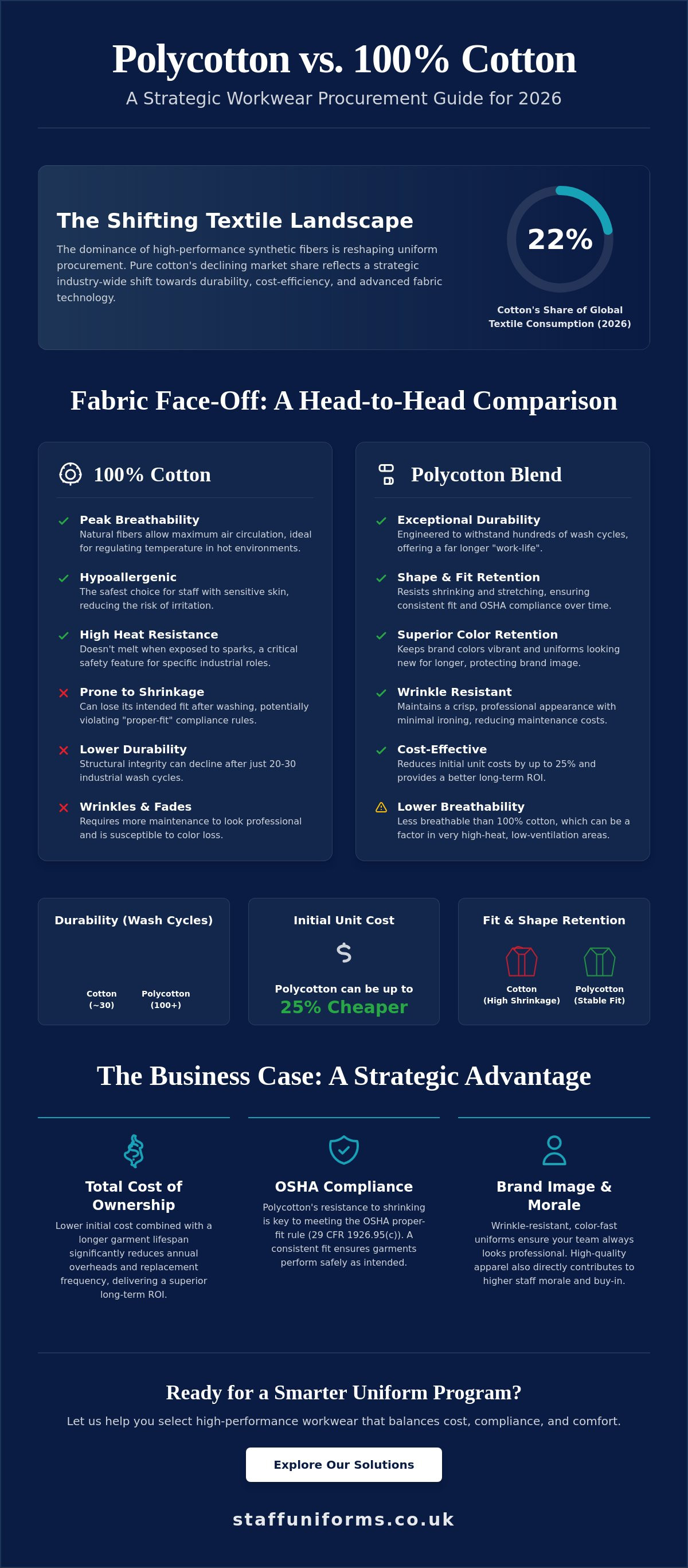
Did you know that cotton's share of global textile fiber consumption has fallen to just 22% in 2026? While pure cotton was once the undisputed industry standard, the dominance of high-performance man-made fibers is forcing a total rethink of procurement strategies. Choosing between polycotton vs 100% cotton workwear is no longer a simple matter of preference. It's a strategic decision that directly impacts your brand's image, your compliance record, and your annual overheads.
We understand the frustration of uniforms that shrink after three washes or staff complaining about heat stress during a long shift. Your team's comfort is just as vital as your company's professional appearance. This guide provides a technical comparison to help you select garments that balance durability with the latest safety requirements. You'll discover how polycotton blends can reduce your initial unit costs by up to 25% while ensuring you remain compliant with the OSHA proper-fit rule, 29 CFR 1926.95(c), which is a major enforcement priority this year.
We'll outline exactly which fabric wins on longevity, how to navigate the rising 63 cents per pound cost of raw cotton, and the best way to maintain high staff morale through high-quality apparel. By the end of this guide, you'll have a clear roadmap for a more cost-effective and professional uniform program.
Key Takeaways
- Identify the technical differences between natural plant-based fibers and synthetic blends to match the right fabric to your team's specific physical tasks.
- Compare the long-term ROI of polycotton vs 100% cotton workwear by calculating the total cost of ownership rather than focusing solely on the initial unit price.
- Evaluate how fabric weight (GSM) and moisture-wicking capabilities impact both garment longevity and your brand's professional image.
- Apply our 5-point procurement checklist to ensure your 2026 uniform policy aligns with the latest OSHA compliance and "proper-fit" mandates.
- Learn why wearer trials are essential for securing staff buy-in and ensuring a seamless transition during a large-scale uniform rollout.
Understanding the Basics: Natural Fibres vs. Synthetic Blends
The 2026 procurement landscape prioritises functional efficiency over traditional fabric preferences. Modern health and safety standards, specifically the updated OSHA proper-fit rule (29 CFR 1926.95(c)), demand that garments perform as well as they fit. When evaluating polycotton vs 100% cotton workwear, the choice begins with understanding the molecular difference between a harvested crop and a lab-engineered fibre. 100% cotton is a plant-based, fully biodegradable natural fibre. It remains a staple for industries requiring high breathability. Polycotton, however, is a strategic hybrid. By blending polyester with cotton, usually in a 65/35 or 50/50 ratio, manufacturers create a textile that offsets the weaknesses of each individual component.
This choice represents a fundamental trade-off. You're balancing the natural, soft hand-feel of cotton against the industrial resilience of synthetic fibres. To make an informed decision, procurement managers must look at textile performance metrics such as tensile strength, pilling resistance, and thermal conductivity. In 2026, "fit-for-purpose" is the guiding metric. A garment that feels great but fails after ten industrial wash cycles is a liability to your bottom line.
The Properties of 100% Cotton
Pure cotton is prized for its exceptional breathability. Its natural fibres allow air to circulate freely. This is critical for temperature regulation in high-heat environments or indoor settings where ventilation is limited. It's inherently hypoallergenic, making it the safest choice for staff with sensitive skin or dermatological conditions. Beyond comfort, cotton offers vital safety benefits. It has a higher natural resistance to heat and doesn't melt when exposed to sparks. This is why it remains the gold standard for specific industrial safety roles where synthetic melting is a hazard.
The Engineering of Polycotton
Polycotton is engineered for the rigours of a modern 40-hour work week. The polyester fibres act as a structural backbone. They prevent the garment from shrinking or stretching out of shape, even after frequent high-temperature laundering. This blend offers significantly better colour retention than pure cotton. Your brand's navy or black polo shirts will stay vibrant for much longer. Additionally, its wrinkle-resistant nature means your team looks professional without the need for constant industrial pressing. This saves both time and maintenance costs across the life of the uniform.
Choosing the right material ensures your team stays comfortable while your brand stays sharp. Whether you prioritise the organic softness of cotton or the rugged durability of a blend, the decision should always align with the daily physical demands of your workforce.
Performance Metrics: Comfort, Durability, and Maintenance
A garment's performance is measured by its ability to withstand the repetitive stress of a 40-hour work week. In the debate of polycotton vs 100% cotton workwear, the real winner is determined by your specific operational environment. While 100% cotton provides an unmatched initial softness, its structural integrity often declines after 20 to 30 high-temperature industrial washes. It's prone to significant shrinkage, which can compromise the professional fit required by modern UK health and safety expectations. Polycotton, by contrast, is designed for a longer "work-life." The synthetic fibres act as a stabilizer, ensuring the garment retains its original dimensions and professional silhouette over hundreds of laundry cycles.
Fabric weight, measured in Grams per Square Metre (GSM), plays a critical role here. A heavy-duty 300 GSM polycotton trouser will offer far superior abrasion resistance compared to a cotton equivalent of the same weight. When considering safety in high-risk environments, look for textile performance metrics that align with British Standards for flame and arc hazards. For standard commercial use, the primary maintenance concern is pilling. Low-quality blends often develop small bobbles of fibre on the surface, making uniforms look aged and unprofessional. Premium blends used by The Staff Uniform Company use long-staple fibres to prevent this, maintaining a crisp appearance for longer.
Breathability and Moisture Management
100% cotton is a natural "wicker" that absorbs up to 27 times its weight in water. In sedentary or high-heat roles, this keeps staff cool by pulling sweat away from the skin. However, in active roles, cotton stays damp and becomes heavy. Modern polycotton blends now incorporate moisture-wicking technology. These fabrics move moisture to the surface where it evaporates quickly. This eliminates the "clammy" feel often associated with older synthetic garments, making blends a superior choice for physically demanding outdoor work in the UK's unpredictable climate.
Longevity and Tear Strength
Polyester reinforcement significantly increases the tensile strength of a garment. This makes polycotton much harder to tear in high-pressure environments like warehouses or construction sites. Cotton fibres are shorter and more brittle; they break down faster in "high-rub" areas such as elbows, knees, and pocket edges. Because polycotton resists these common failure points, businesses often see a 30% reduction in replacement frequency compared to pure cotton alternatives. This durability is the cornerstone of a lower cost-per-wear model.
Industry-Specific Selection: Matching Fabric to Workplace Demands
Procurement isn't a one-size-fits-all exercise. Each role within your organisation faces unique physical demands. A warehouse operative requires different tensile strength than a receptionist. When deciding on polycotton vs 100% cotton workwear, you must map the fabric properties to the specific risks and movements of the job. Choosing the wrong material doesn't just lead to faster wear; it can impact staff morale and professional pride. A team that feels comfortable and safe in their clothing is a team that represents your brand with confidence.
Consistency is equally vital. Your brand image relies on a unified look across departments. This often means selecting a range where different fabric compositions share the same colour palette. This approach ensures a seamless visual identity while providing each employee with a tool specifically designed for their environment. It creates a sense of belonging and ensures that the "human element" of your business is presented professionally to every customer.
Healthcare and Hospitality
In the medical sector, scrubs UK providers heavily favour polycotton blends. These garments must withstand repeated 60-degree Celsius washes to maintain hygiene standards without losing their shape or colour. Conversely, the kitchen requires a different strategy. High-heat environments and open flames make 100% cotton the safer choice. It doesn't melt like synthetic fibres, protecting chefs from severe burn injuries. Leading hospitality workwear suppliers often recommend blended aprons for front-of-house staff, as the polyester content provides essential stain resistance against oils and liquids.
Corporate and Office Environments
For management and client-facing roles, the priority shifts toward aesthetics and comfort. High-quality corporate suits often use cotton-rich blends to achieve a premium, breathable feel that lasts through a full day of meetings. However, for high-turnover front-of-house roles, polycotton remains the standard. It offers the best balance between a crisp appearance and the durability needed for active service. It also handles the daily commute better, resisting the deep creases that can plague pure natural fibres by mid-morning.
Legal and safety requirements also dictate fabric choice in UK sectors. For example, roles involving sensitive electronics or flammable gases require non-static properties. In these cases, 100% cotton is often the baseline due to its low static generation, though specialized antistatic blends are also available. Always audit the specific safety standards for your industry before finalizing your 2026 procurement list to ensure full compliance with the latest health and safety mandates.
The Business Case: Cost-Efficiency, Longevity, and Branding
Procurement decisions often focus on the initial invoice, but for a sustainable 2026 budget, you must calculate the Total Cost of Ownership (TCO). While cotton prices for the 2026/2027 season are predicted to rise to 63 cents per pound, polycotton remains a more stable investment for large-scale workforces. Choosing between polycotton vs 100% cotton workwear is a choice between a high-maintenance luxury and a high-performance asset. A garment that retains its shape and colour for twice as long as a natural alternative effectively halves your annual replenishment spend.
Sustainability has moved from a "nice-to-have" to a core business requirement, with many UK firms now auditing the environmental footprint of their supply chains. While organic cotton is biodegradable, its water-intensive production can be a drawback for ESG (Environmental, Social, and Governance) reporting. Recycled polyester blends offer a compelling alternative. These fabrics provide the same synthetic resilience discussed earlier but utilise post-consumer plastic waste, allowing your business to meet green targets without sacrificing the longevity of the uniform.
Life-Cycle Cost and ROI
Data from April 2026 indicates that cotton-polyester blend t-shirts typically cost 15% to 25% less than their 100% cotton counterparts. This upfront saving is compounded by reduced indirect costs; polycotton garments require less industrial pressing and are less likely to be decommissioned due to fading. ROI in workwear is the balance between purchase price and replacement frequency. By selecting a fabric that resists the common "wash-fade" cycle, you ensure your capital expenditure translates into a longer period of professional representation.
Branding and Logo Integrity
Your logo is the most critical element of your corporate identity, and its appearance depends heavily on the underlying textile. When ordering custom staff uniforms UK, polycotton is often the preferred choice for high-density embroidery. The synthetic fibres provide a stable, non-stretch lattice that prevents the fabric from "puckering" around the stitches. While 100% cotton is excellent for traditional water-based screen printing, modern heat-transfer methods bond more effectively with blended fibres. This prevents the logo from cracking or peeling, ensuring your brand remains sharp for the life of the garment.
A well-branded uniform acts as a silent ambassador for your service standards. To ensure your team represents your company with the highest level of professional pride, you can view our full range of durable workwear and start building your 2026 procurement strategy today with a partner like The Staff Uniform Company.
Making the Final Decision for Your 2026 Uniform Policy
Finalising your choice between polycotton vs 100% cotton workwear requires a balance of technical data and staff feedback. By 2026, the global polyester fibre market is expected to reach USD 117.8 billion. This growth is driven by the demand for resilient, high-performance materials that withstand the rigours of modern industry. However, the 63 cents per pound cost of upland cotton remains a significant factor for those prioritising natural comfort and specific safety standards. To ensure your procurement strategy is robust, follow this 5-point decision framework:
- Workplace Hazards: Identify if your team faces heat, sparks, or chemical exposure where 100% cotton is the safer baseline.
- Maintenance Protocol: Determine if uniforms are laundered through an industrial facility or by staff at home.
- Branding Method: Ensure the fabric supports your logo application, as polycotton often provides a more stable base for embroidery.
- Staff Morale: Conduct wearer trials to gauge comfort, fit, and breathability across different roles.
- Total Cost of Ownership: Calculate the 12-month replacement frequency to find the true long-term ROI.
Wearer trials are the most effective way to prevent friction during a national rollout. Give a small group of employees the new garments for a two-week period. This allows you to identify potential issues with movement or temperature regulation before committing to a bulk order. It demonstrates that you value the "human element" of your workforce. A team that feels respected and comfortable in their clothing will always represent your brand with higher levels of professional pride.
Sustainability in 2026
Environmental impact is a core procurement pillar this year. While cotton is biodegradable, its farming remains water-intensive. Modern polycotton blends solve this by using recycled polyester. Brands like Regatta Honestly Made and Result Genuine Recycled are leading this shift, offering garments that reduce landfill waste without compromising on durability. Establishing an end-of-life recycling programme for your old uniforms is the final step in a truly sustainable 2026 strategy.
Customising Your Solution
The Staff Uniform Company understands that your requirements are bespoke. We don't just provide clothes; we manage the entire process from initial design to final delivery. This all-in-one service ensures your corporate identity is handled with quiet confidence and technical expertise. We help you find the perfect mix of fabrics for every sector, ensuring your site team has the durability they need while your office staff stays comfortable. Contact our team today to start your 2026 uniform transition with a partner you can trust.
Secure Your Professional Image for 2026
Navigating the choice of polycotton vs 100% cotton workwear requires a partner who understands the functional demands of your specific industry. Whether you're outfitting a healthcare team in high-performance scrubs or a corporate office in premium blends, the goal remains the same: a uniform that empowers your staff and protects your bottom line. By implementing the procurement framework discussed in this guide, you can move away from high replacement cycles and toward a more sustainable, cost-effective clothing program.
The Staff Uniform Company provides the expert UK-based support needed for successful national uniform rollouts. Our range features high-quality garments tested for 50+ industrial washes, ensuring your team looks as sharp on day 100 as they did on day one. With our full in-house branding and customisation services, we manage every detail to ensure your corporate identity is represented with absolute precision across every department.
Ready to transform your workforce's appearance? Explore our range of durable workwear and request a quote today. We're ready to help you build a uniform solution that drives professional pride and operational efficiency for years to come.
Frequently Asked Questions
Is polycotton better than 100% cotton for workwear?
Polycotton is generally the superior choice for general workwear due to its enhanced durability and colour retention. It resists the daily wear and tear of industrial environments much better than natural fibres. While 100% cotton is excellent for specific safety needs, polycotton's ability to withstand 50 or more industrial washes makes it the practical standard for most UK businesses.
Does 100% cotton shrink more than polycotton?
Yes, 100% cotton is prone to shrinking by up to 5% when laundered at high temperatures. Polycotton blends are engineered with synthetic fibres that prevent this contraction. This stability is crucial for maintaining a professional appearance and ensuring your uniforms continue to meet the latest 2026 proper-fit compliance standards over their entire lifecycle.
Which fabric is better for staff with sensitive skin or allergies?
100% cotton is the best option for staff with sensitive skin because it's a natural, hypoallergenic material. It doesn't trap heat or moisture against the skin as easily as some synthetic blends can. This reduces the risk of contact dermatitis or heat rashes, making it a safer choice for employees who suffer from eczema or other skin conditions.
Why do most healthcare scrubs use polycotton instead of pure cotton?
Healthcare scrubs rely on polycotton because it handles the rigorous 60-degree Celsius thermal disinfection process without losing its shape. Blended fabrics also offer better stain resistance against biological fluids. This ensures that medical staff look professional and stay protected while benefiting from a garment that dries significantly faster than a 100% cotton equivalent.
Which fabric is more breathable for summer uniforms?
Pure cotton is naturally more breathable because its organic structure allows air to pass through easily. It's highly effective at absorbing sweat in hot, dry conditions. However, for active roles where staff are moving constantly, a modern moisture-wicking polycotton blend might be more comfortable. These blends move sweat to the surface to evaporate, preventing the garment from becoming heavy and sodden.
How does fabric choice affect the quality of logo embroidery?
Fabric choice is critical for branding, and polycotton vs 100% cotton workwear comparisons often favour the blend for embroidery. The polyester content provides a stable, non-stretch surface that prevents the "bunching" or puckering often seen on pure cotton. This ensures your company logo remains flat, clear, and professional even after months of heavy use and frequent laundering.
Is polycotton more sustainable than 100% cotton in 2026?
Sustainability depends on the source, but recycled polycotton is often the greener choice in 2026. While cotton is natural, it requires vast amounts of water and pesticides to produce. Using blends that incorporate 100% recycled polyester reduces plastic waste and creates a garment that lasts longer. A longer-lasting uniform means fewer replacements, which significantly lowers your overall environmental footprint.
Which fabric is best for high-heat environments like kitchens?
100% cotton is the essential choice for kitchens and other high-heat zones. Synthetic fibres like polyester can melt when exposed to naked flames or extreme temperatures, which poses a severe burn risk to the wearer. Cotton is heat-resistant and will char rather than melt, providing a vital layer of protection for chefs and industrial workers in thermal environments.