
What if the budget-friendly uniform you just ordered is actually damaging your brand's reputation with every wash? It's a common frustration for procurement managers who invest in corporate shirts with company logo only to see embroidery pucker the fabric or colours fade after just a few cycles. You need a solution that balances a sharp visual identity with the practicalities of daily office wear.
We understand that your team's attire is a vital tool for business success, not just a line item in the budget. You deserve garments that maintain their shape and logo consistency across every single batch. This guide will help you master the art of selecting high-performance fabrics and precision branding techniques that enhance your professional image while ensuring staff comfort and durability.
We'll explore the latest 2026 textile trends, break down the technical differences between branding methods, and provide a clear roadmap for a seamless procurement process that guarantees long-term value.
Key Takeaways
- Learn how consistent branding across your workforce builds client trust and establishes your firm as a professional industry authority.
- Identify the technical differences between Oxford, Poplin, and Twill weaves to select the most durable fabric for your specific office environment.
- Master the procurement of corporate shirts with company logo by understanding why precision embroidery remains the gold standard for a high-end finish.
- Discover sector-specific solutions, ranging from stain-resistant hospitality fabrics to premium tailored fits for legal and financial services.
- Implement a fail-safe procurement strategy using our professional roadmap, including staff sizing audits and physical swatch verification.
The Strategic Value of Branded Corporate Shirts
A corporate shirt is the foundation of a modern professional uniform. It serves as the primary layer that defines a team's aesthetic before a single word is spoken. The Strategic Value of Branded Corporate Shirts extends far beyond simple identification; it's about establishing a baseline of quality that clients can trust. A branded corporate shirt is a mobile touchpoint for your business identity. It carries your logo into every meeting, site visit, and networking event, acting as a silent ambassador for your corporate values.
Consistency across your workforce builds authority. When clients see a unified team wearing high-quality corporate shirts with company logo, they perceive a business that is disciplined and reliable. This visual harmony is especially powerful when integrating shirts with other formal elements. We often discuss the "Final 10%" theory. While a corporate suit provides the structural frame of a professional look, the shirt is what completes the ensemble. A sharp, branded shirt fills that final gap, ensuring the brand identity is visible even when jackets are removed in the office environment.
Brand Recognition and Visual Cohesion
The Psychological Impact on Workforce Performance
The quality of a uniform directly affects the wearer's mindset. High-quality attire increases employee confidence and fosters a sense of professional pride. When staff wear corporate shirts with company logo that are well-fitted and made from premium materials, they feel valued by their employer. This psychological boost often translates into improved daily productivity. A structured uniform policy also reduces "decision fatigue." By providing a clear dress code, you remove the daily stress of outfit selection. This allows your team to start their day with a clear focus on their professional objectives rather than their wardrobe.
Selecting the Right Fabric: Oxford, Poplin, and Twill
Choosing the right textile is a technical decision that impacts both the longevity of your investment and the comfort of your team. In 2026, the focus has shifted towards fabrics that offer high performance without sacrificing professional aesthetics. When procuring corporate shirts with company logo, you must consider the weave, the weight, and the finish of the material to ensure it meets the specific demands of your workplace. Selecting the Right Fabric: Oxford, Poplin, and Twill requires an understanding of textile standards to ensure safety and durability across your workforce.
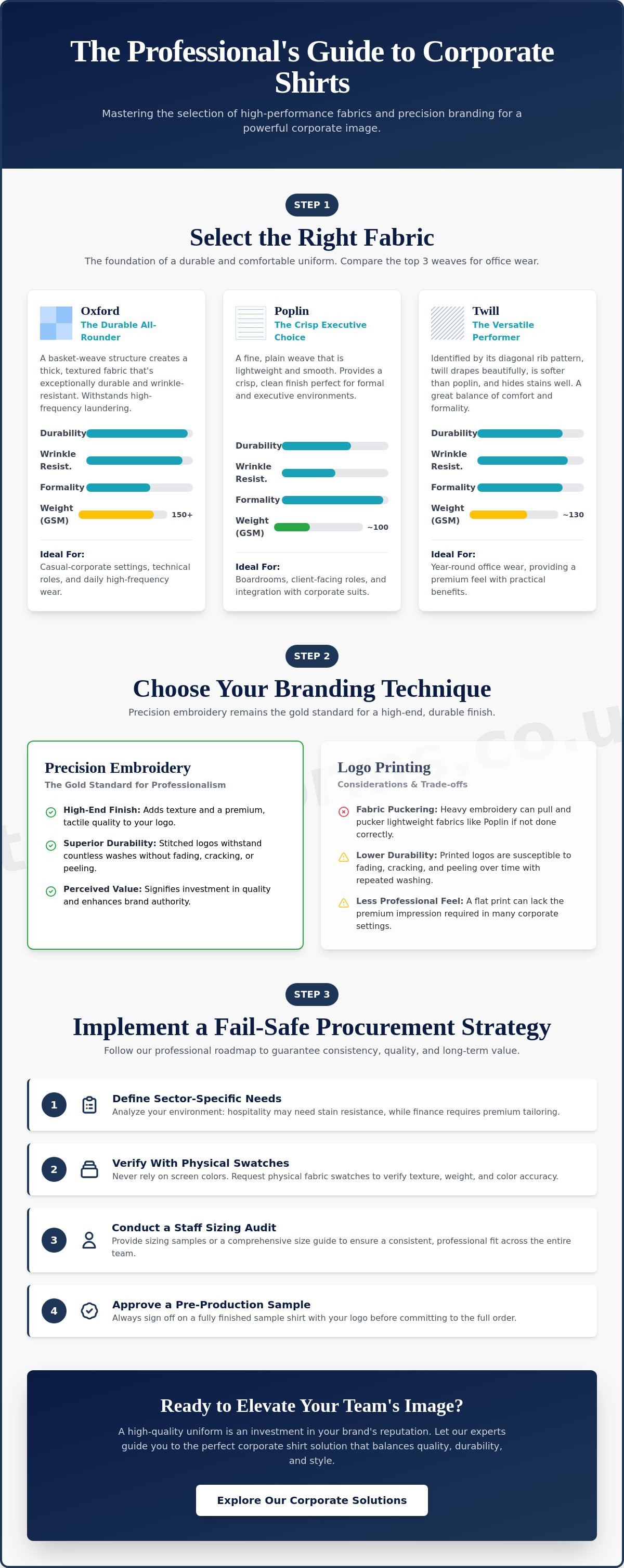
Weight is measured in GSM (grams per square metre). For UK office environments, a medium weight of 120 to 140 GSM is standard for year-round wear. Lighter poplins, usually around 100 GSM, suit summer climates or high-temperature service roles. Heavier Oxfords at 150 GSM or higher provide necessary warmth and structure during winter months. We're also seeing a significant move towards sustainable blends. Organic cotton and recycled polyester are no longer niche options. They're essential for companies meeting modern ESG targets. These materials provide the same durability as traditional blends while reducing your firm's environmental footprint.
Oxford Weave: The Durable All-Rounder
The Oxford weave uses a basket-weave structure where multiple warp threads cross over an equal number of weft threads. This creates a thicker, more textured fabric that's exceptionally durable and resistant to wrinkling. It's the industry standard for custom staff uniforms uk because it withstands high-frequency laundering while maintaining its professional shape. Oxford shirts are ideal for casual-corporate settings or technical roles where staff move frequently and need a garment that resists daily wear and tear.
Poplin and Twill: The Executive Choice
Poplin is a plain weave with a fine horizontal rib. It's lightweight, smooth, and provides a crisp, formal finish that's perfect for the legal and financial sectors. If you need a more luxurious feel, Twill is the superior choice. Its distinct diagonal weave creates a subtle sheen and a softer drape. Twill is naturally more resistant to creasing and is easier to iron, making it a practical favourite for senior management. For front-of-house roles, look for high-thread-count versions of these weaves to ensure a premium look that reflects your brand's excellence. If you aren't sure which weave suits your team's specific environment, you can view our full range of professional shirt options to compare technical specifications.
Modern non-iron treatments have also evolved. In 2026, these finishes are applied at the molecular level to ensure the shirt remains breathable while staying sharp throughout a twelve-hour shift. This technology reduces the maintenance burden on your staff and ensures every team member looks polished from their first meeting to their last.
Branding Techniques: Precision Embroidery vs. Logo Printing
The method used to apply your brand identity is as critical as the shirt itself. While a high-quality weave provides the canvas, the branding technique determines the final professional impact. For most organisations, corporate shirts with company logo require a balance between visual sharpness and long-term durability. Precision is non-negotiable. You must ensure that your specific Pantone colours remain consistent, whether they are rendered in thread or ink.
Technical considerations often dictate the choice. Stitch density is a primary factor. A high stitch count provides a dense, premium finish, but if applied to a lightweight 100 GSM fabric without the correct stabiliser, it will cause the material to pucker. Conversely, low stitch density can look sparse and unprofessional. Expert suppliers utilise specific backing materials to support the fabric during the embroidery process, ensuring the logo sits flat and maintains its integrity through hundreds of wash cycles. This level of detail separates a standard uniform from a true corporate asset.
The Art of Logo Embroidery on Formalwear
Logo embroidery is the gold standard for formal corporate attire. It offers a three-dimensional texture that printing cannot replicate. To manage the risk of "puckering" on lightweight poplin, machine tension must be adjusted and water-soluble or tear-away backings used depending on the fabric's weave. Positioning also plays a role in the brand's perception. While the left chest remains the traditional choice, there is an increasing demand for subtle branding on the cuff or the back of the collar. These placements offer a sophisticated touch for executive roles. Embroidery is exceptionally durable; it often outlasts the garment itself without fading or fraying.
Modern Printing for Complex Brand Identities
Not every logo is suited for thread. If your brand identity involves complex gradients or very fine lines, modern printing techniques like DTF (Direct to Film) are the superior solution. DTF allows for intricate, multi-coloured logos to be applied with a soft-hand feel that doesn't feel heavy on the chest. These prints are engineered to withstand high-temperature industrial laundering, ensuring they don't crack or peel over time. However, for senior management, subtle tonal embroidery often carries more "executive weight." It signals a quiet confidence that large, vibrant prints might lack. Choosing between these methods depends on your sector's expectations and the complexity of your visual identity.
Sector-Specific Guidance for Corporate Shirts
Every industry operates under different environmental and social pressures. A shirt that works in a climate-controlled legal office will often fail in the heat of a high-volume restaurant. Selecting corporate shirts with company logo requires a deep understanding of these sector-specific demands. It's about matching the textile's performance to the employee's daily reality. When you align fabric choice with function, you increase the lifespan of the garment and the comfort of your team.
In the finance and legal sectors, the trend for 2026 is a move away from "traditional" loose fits toward "contemporary slim" silhouettes. These sectors favour premium twill weaves for their subtle sheen and professional weight. Conversely, for events and sales teams, the priority is breathability. Moisture-wicking fabrics are essential for staff who spend long days on exhibition floors or travelling between client sites. In healthcare, we see a growing need for administrative staff to wear branded shirts that coordinate with the clinical teams wearing scrubs uk. This creates a unified visual identity across the entire facility.
Hospitality and Service Sector Durability
Working with professional hospitality workwear suppliers ensures your front-of-house staff look impeccable while remaining comfortable. In this sector, stain-resistant finishes are non-negotiable. Darker colours and patterned weaves, such as micro-checks, are highly practical as they mask minor spills during a busy service. Active service roles also require reinforced seams and double-stitched buttons to withstand the physical rigours of the job. These small technical details prevent premature garment failure and keep your team looking sharp.
Maintaining Authority in Corporate Environments
Consistency is the backbone of a professional image. Standardising fits across your workforce ensures that every employee, regardless of their role, represents the brand with equal authority. Collar styles also communicate brand values; a spread collar feels modern and progressive, while a button-down collar suggests a more traditional, established identity. It's vital to ensure that your chosen range offers consistent sizing and styling across both male and female garments. This avoids a fragmented team appearance and reinforces a sense of equality within the workforce. If you're ready to upgrade your team's professional image, you can browse our full range of corporate shirts and blouses to find the perfect fit for your sector.
Implementing Your Uniform Strategy: A Procurement Roadmap
Execution is where many uniform projects falter. You've selected the fabric and the branding method, but the logistical rollout determines whether your investment succeeds or becomes a source of administrative friction. A structured procurement roadmap ensures that your corporate shirts with company logo arrive on time, fit correctly, and maintain a consistent appearance across your entire workforce. This process requires a detail-oriented approach that treats your apparel as a vital business asset.
- Step 1: Conduct a staff audit. Don't rely on historical data or generic size charts. Collect current measurements and determine the exact quantity needs for each department, including spares for new starters.
- Step 2: Request physical fabric swatches. Digital screens often distort colours and textures. Verifying a physical sample is the only way to ensure the shirt meets your quality standards before committing to a full production run.
- Step 3: Develop a Brand Style Guide. Create a simple document that outlines how the uniform should be worn and maintained. This ensures a unified look and helps staff preserve the lifespan of the garments through correct laundering.
- Step 4: Establish a replenishment schedule. Uniforms are high-frequency items that require periodic replacement. Setting a schedule prevents your team's appearance from degrading over time.
The Dye Lot Risk and Long-Term Consistency
One of the most overlooked challenges in procurement is the "Dye Lot" risk. Fabric is dyed in large batches, and slight chemical variations or temperature shifts can cause subtle colour differences between these manufacturing runs. If you order a small batch today and another in six months, the shades might not match perfectly. Explaining how bulk-buying initial stock mitigates colour drift is essential for long-term brand integrity. By purchasing your total projected annual requirement in a single order, you ensure every shirt comes from the same dye lot. This strategy provides a buffer of consistent stock for new hires and replacements, protecting your visual identity from fragmented "mismatched" appearances in 2027 and beyond.
Fulfillment and Logistics for UK Businesses
Managing lead times is a critical component of your strategy. Bespoke embroidery adds a layer of complexity to the supply chain that plain stock does not. You should expect longer turnaround times for initial branding compared to off-the-shelf garments. To streamline this, many UK businesses are moving toward "portal" systems. These digital platforms allow department managers or individual staff members to re-order approved items easily, reducing the burden on your central procurement team. This level of transparency ensures your identity is handled with expertise from initial concept to final delivery. Ready to transform your team? Browse our corporate shirt collection to start building your professional uniform strategy today.
Future-Proofing Your Corporate Image
Securing high-quality corporate shirts with company logo is a strategic investment in your team's professional pride and your brand's authority. By selecting technical fabrics like durable Oxford or executive Twill, you ensure your workforce remains comfortable and polished throughout the day. We've explored how precision in embroidery and a structured procurement roadmap prevent common pitfalls like fabric puckering or inconsistent colour batches. These details are what separate a standard uniform from a vital tool for business success.
As expert UK uniform specialists since 2017, we understand the functional requirements of the corporate and hospitality sectors. Our team provides precision logo embroidery and exact Pantone matching to guarantee your visual identity is handled with expertise. Whether you're managing a small office rollout or a large-scale hospitality project, we have the specialist knowledge to support your journey from initial concept to final delivery.
Ready to transform your workforce? Explore Professional Branded Shirts at The Staff Uniform Company and take the first step toward a more cohesive corporate image. We look forward to helping your team look their best.
Frequently Asked Questions
What is the best fabric for a corporate shirt that doesn’t need ironing?
Twill is the most effective choice for a professional shirt that requires minimal ironing. Its diagonal weave structure naturally resists creasing more effectively than plain weaves like poplin. Most modern non-iron shirts utilise a high-quality twill treated with an easy-care finish, allowing the fabric to remain crisp and sharp throughout a long shift with very little maintenance required from your staff.
Can you match my company logo colours exactly to a Pantone reference?
Yes, we match your brand colours to specific Pantone references using precision embroidery threads or digital ink mixing. For embroidery, we select the closest thread match from comprehensive industry charts to ensure visual consistency. This process is vital when ordering corporate shirts with company logo, as it ensures your identity remains uniform across different garment batches and varied fabric types.
Is it better to embroider or print a logo on an Oxford shirt?
Embroidery is the superior choice for Oxford shirts due to the fabric's heavy, textured basket-weave. This substantial material provides an excellent foundation for high-density stitching, which won't lose its shape over time. Printing can often appear uneven on the textured surface of an Oxford weave, whereas embroidery creates a durable, premium finish that complements the rugged nature of the garment.
What is the minimum order quantity for custom branded corporate shirts?
Minimum order quantities for custom branded corporate shirts typically start at 10 to 12 units per order. This threshold ensures that the technical setup of embroidery machinery or printing screens remains cost-effective for your business. Ordering in these quantities allows us to maintain high quality standards while providing the best value for professional procurement managers across the UK.
How do I ensure the logo doesn’t make the shirt pucker or pull?
We prevent puckering by using specialised stabilising backings that are matched to the specific weight of the shirt fabric. Lightweight poplin requires a different tension and backing material than a heavier twill or Oxford weave. By calculating the correct stitch density for your logo, we ensure the branding sits flat against the chest without distorting the surrounding fabric during wear or laundering.
How many shirts should I provide per employee for a full-time role?
We recommend providing a minimum of three to five shirts for every full-time employee. This "wash, wear, and spare" approach ensures that staff always have a clean, professional garment ready for their next shift. Providing a sufficient rotation reduces the frequency of laundering for each individual item, which significantly extends the overall lifespan of your uniform investment and maintains a better appearance.
What is the difference between a tailored fit and a classic fit corporate shirt?
A tailored fit is cut closer to the body and sleeves to create a contemporary, streamlined silhouette. It's the standard choice for modern office environments where a sharp, fitted look is preferred. A classic fit offers a more traditional, generous cut through the chest and waist. This provides extra room for movement, making it a practical choice for staff in active service or hospitality roles.
How long does it typically take to deliver branded shirts in the UK?
Delivery for branded shirts in the UK usually takes between 7 and 14 working days following the final approval of your logo artwork. This timeframe allows for the precision setup of your branding and a thorough quality control check before dispatch. While plain stock items can be delivered faster, bespoke branding requires this dedicated window to ensure your corporate identity is rendered with absolute accuracy.