
That high-end corporate blazer you just bought for your team isn't a uniform if it lacks a permanent, conspicuous logo. Without branding, it's a taxable perk that could trigger a 15% Class 1A National Insurance charge for your business. Most managers want their staff to look professional, but the fear of an unexpected HMRC audit or a complex P11D filing often makes procurement feel like a legal minefield. It's frustrating when a simple branding decision determines whether your investment is a tax-deductible tool or a costly benefit in kind.
This guide simplifies the corporate uniform tax implications uk for the 2026/27 tax year. We'll show you exactly how to navigate HMRC’s rules to ensure your workwear remains compliant while maximizing your savings. You'll learn how to reclaim 20% VAT on your purchases and how your employees can claim their standard £60 flat-rate laundry relief. We provide a clear framework for selecting durable, branded garments that protect your bottom line and your professional reputation. From embroidery requirements to Corporation Tax deductions, we've broken down the technical details so you can make procurement decisions with confidence.
Key Takeaways
- Learn the specific "recognisability" tests HMRC uses to distinguish between professional branded workwear and everyday clothing.
- Understand the corporate uniform tax implications uk to avoid Class 1A National Insurance charges and successfully reclaim VAT on your garment procurement.
- Identify how your staff can claim flat-rate tax relief for laundry and maintenance, improving morale without increasing your payroll costs.
- Discover how permanent, conspicuous branding overcomes the "duality of purpose" rule that often makes corporate suits a taxable benefit.
- Gain a clear framework for choosing tax-efficient fabrics and branding methods that meet the legal threshold for business expense deductions.
What Qualifies as a Uniform for HMRC? The 2026 Definitions
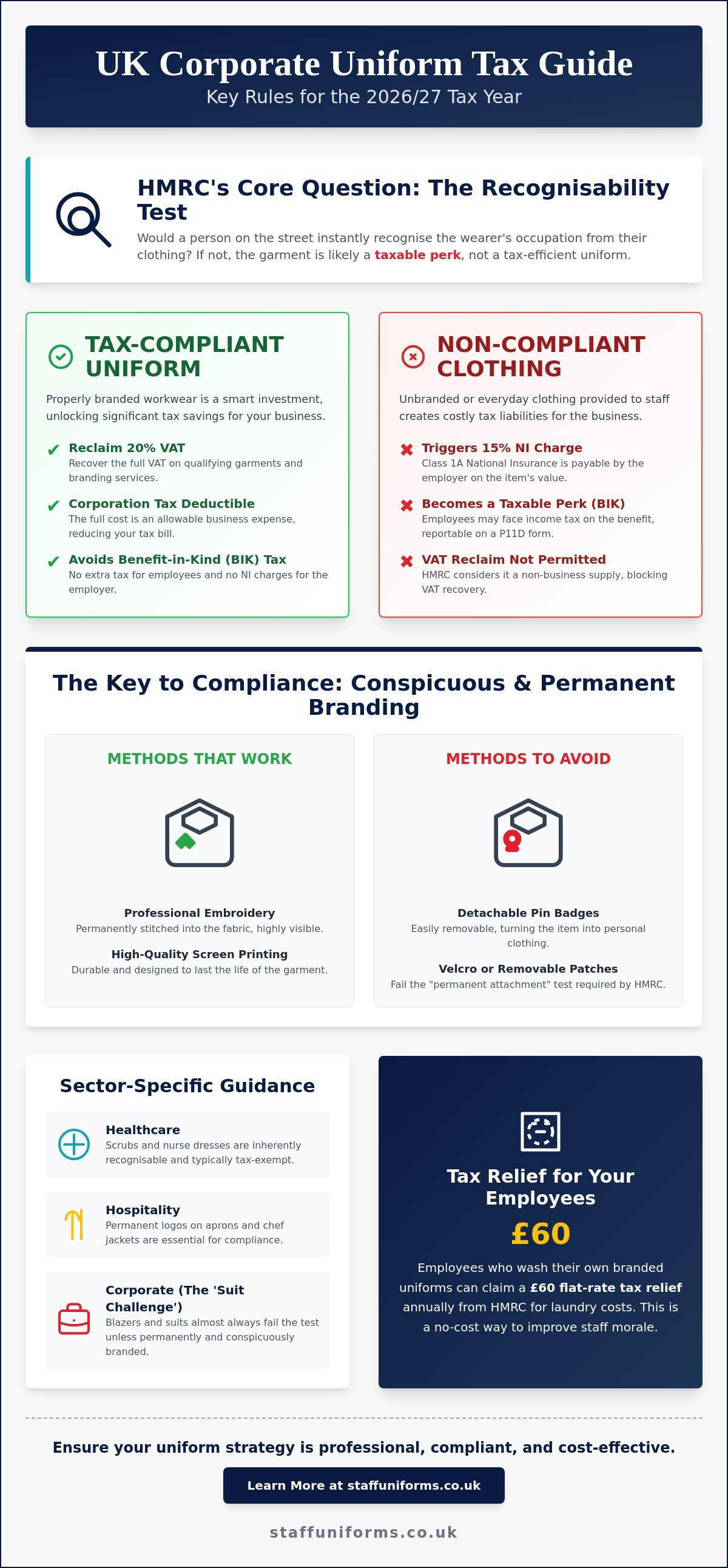
HMRC doesn't care about your company's aesthetic preferences. They care about whether the clothing is "wholly and exclusively" for work. To understand the corporate uniform tax implications uk, you must first pass the recognisability test. HMRC asks a simple question: would a person in the street identify the wearer's job just by looking at them? If the answer is no, you're likely providing "ordinary clothing," which is a taxable benefit for the employee and a National Insurance liability for you.
There's a critical distinction between specialist clothing and a standard uniform. Specialist items, often referred to as Personal Protective Equipment (PPE), are designed for safety and are almost always tax-exempt. A high-vis jacket or steel-toed boots fall into this category. However, What Qualifies as a Uniform for tax purposes depends heavily on branding. Simply requiring staff to wear a specific colour, such as a plain black polo shirt or a blue blouse, isn't enough. Without a permanent logo, HMRC views these as items your employees could wear to the supermarket or a weekend lunch. It's the branding that transforms a "dress code" into a "uniform."
The 'Conspicuous and Permanent' Rule
For a garment to qualify as a tax-free uniform, the branding must be conspicuous and permanent. It needs to be visible from a reasonable distance. A small, discreet tag on a side seam won't suffice. For 2026, HMRC guidelines suggest that the logo should be clearly associated with the employer and permanently attached. Detachable elements like pin-on badges or Velcro patches fail this test because they can be removed, turning the item back into everyday wear. We recommend professional embroidery or high-quality screen printing. These methods ensure the branding lasts the life of the garment, securing its status as a non-taxable business tool.
Sector-Specific Identification Examples
- Healthcare: Certain garments are inherently recognisable. Professional medical scrubs and nurse dresses are rarely used outside of a clinical setting, making them easier to justify as non-taxable.
- Hospitality: Transforming generic items into uniforms requires strategy. Adding a permanent logo to hospitality aprons or chef jackets creates a clear occupational identity that satisfies the "person in the street" test.
- Corporate: This is the most difficult area to navigate. Providing corporate suits or blazers without a permanent logo is almost always considered a Benefit-in-Kind. To keep these items tax-efficient, branding must be integrated into the fabric or prominently embroidered on the chest.
Compliance starts with the design. By choosing permanent branding over temporary fixes, you protect your business from unexpected National Insurance charges. Understanding these corporate uniform tax implications uk ensures your procurement strategy remains both professional and cost-effective.
Tax Implications for Employers: VAT, BIK, and Corporation Tax
Efficiently managing the corporate uniform tax implications uk transforms a standard procurement task into a strategic tax saving opportunity. For most businesses, the cost of providing branded workwear is an allowable expense. This means you can deduct the full value of the order from your taxable profits before Corporation Tax is calculated. For the 2026/27 financial year, this represents a significant saving, whether your company falls under the 19% Small Profits Rate or the 25% Main Rate.
VAT recovery is another immediate benefit. You can generally reclaim the full 20% VAT on uniforms and PPE, provided the items are used exclusively for work purposes. Proper documentation is vital here. Ensure your invoices clearly itemise the garments and any branding services. While you are reviewing your own savings, it is also good practice to inform your team that they may be eligible for Employee tax relief for uniforms if they maintain the garments themselves. This proactive approach builds trust and ensures everyone benefits from the policy.
Corporation Tax and Capital Allowances
Uniforms are typically treated as revenue expenditure rather than capital assets. This allows you to write off the total cost in the year of purchase. Whether you are investing in an initial rollout of corporate suits or a scheduled replacement cycle for polo shirts, the tax treatment remains consistent. In 2026, HMRC continues to reward businesses that prioritise durability. Choosing high-quality fabrics that last longer reduces your long-term taxable profit by minimising the frequency of non-deductible emergency replacements.
Benefit-in-Kind (BIK) Avoidance Strategies
Providing clothing can backfire if it is classified as a Benefit-in-Kind. If HMRC determines the clothing has "private use" value, you must report it on a P11D form. This triggers a 15% Class 1A National Insurance charge for the employer. To avoid this, the clothing must be a contractual requirement and must be clearly branded. Investing in custom staff uniforms UK is the most reliable way to prove to HMRC that the garments are professional tools rather than personal perks. Permanent embroidery or screen printing removes the "duality of purpose" that often complicates office-wear tax status.
Ready to secure your tax-compliant wardrobe? You can view our range of branded corporate wear to find the right fit for your team.
Tax Relief for Employees: Maintenance and Laundry Claims
Employees often don't realise they can get money back from HMRC just for keeping their work clothes clean. This rebate isn't a gift. It's a legitimate tax deduction designed to offset the cost of maintaining professional standards. Understanding the corporate uniform tax implications uk from an employee's perspective is vital for any business owner. By helping your team claim what they're owed, you improve staff morale without adding a single penny to your payroll budget. It's a practical way to show you value their professional appearance.
The rules for eligibility are straightforward. To claim, the employee must be responsible for cleaning, repairing, or replacing their uniform themselves. If you provide a laundry service or a dedicated washing facility on-site, they aren't eligible. It's also important to note that you can't claim for the initial cost of buying the clothes. HMRC treats the provision of the garment and its maintenance as two separate issues. For a deeper look at how the provision of garments is treated for employers, check the official guidance on Benefit-in-Kind on clothing. Once the uniform is provided, the ongoing care is where the employee relief kicks in.
How Employees Can Claim Tax Relief in 5 Steps
- Verify the clothing: Ensure it meets the "recognisability" test. It must be a dedicated uniform, not everyday wear.
- Check for employer services: Confirm that no free laundering or maintenance service is provided by the company.
- Identify the rate: Determine if your specific job title qualifies for a higher industry-specific allowance.
- Use the GOV.UK tool: Navigate to the "Check if you can claim" service to confirm eligibility in minutes.
- Submit the claim: Complete a P87 form online or adjust your tax code through a Self Assessment return.
Industry-Specific Flat Rate Deductions
HMRC uses Flat Rate Expenses (FRE) to simplify the process. For the 2026/27 tax year, the standard rate for most workers is £60. This means a basic-rate taxpayer gets £12 back, while a higher-rate taxpayer receives £24. However, some professions have significantly higher allowances due to the nature of their work. For example, ambulance staff can claim £185, while pilots and co-pilots have a substantial allowance of £1,022. Even if your staff fall under the standard £60 rate, they can backdate claims for up to four previous tax years. This can result in a helpful lump sum for long-serving team members. As an employer, providing a simple one-page guide on how to claim these corporate uniform tax implications uk benefits is a high-value, low-cost way to support your workforce.
The 'Corporate Suit' Challenge: Overcoming the Duality of Purpose
HMRC's default position is that a plain business suit is "everyday clothing." Even if you force your team to wear it, the tax office argues that the wearer needs to be clothed for warmth and decency anyway. This is the "Duality of Purpose" rule. If a garment serves a private purpose alongside a business one, it's usually taxable. This creates a significant hurdle for firms wanting to project a high-end image without incurring Benefit-in-Kind charges. To manage the corporate uniform tax implications uk, you must prove the garment is a professional tool, not a personal perk.
Historical tax disputes have cemented this strict interpretation. In the landmark Mallalieu v Drummond case, the court ruled that even though a barrister only wore specific black clothing for court, the clothes still fulfilled the basic human need for cover. This meant the expenditure wasn't "wholly and exclusively" for business. To navigate these rules successfully, the suit must be transformed into a recognisable uniform. The most effective way to do this is through permanent, conspicuous branding that makes the item unsuitable for private social events like weddings or funerals.
Branding Formalwear Without Sacrificing Style
You don't have to ruin a well-tailored blazer with a gaudy logo. The goal is to make the garment "recognisable" as part of a specific occupation. Subtle but permanent embroidery on the lapel or a discreet logo on the breast pocket often satisfies HMRC's requirements. Some firms opt for bespoke branded linings or custom buttons to reinforce the corporate identity. These details ensure the garment is clearly part of a professional kit. When you choose high-quality corporate suits, you're investing in a tool that balances elite style with tax efficiency.
The 'Requirement to Wear' Clause
Documentation is your best defence during an HMRC audit. Your staff handbook must explicitly state that the uniform is a mandatory requirement of the role. It's also vital to include a clause prohibiting private use outside of work hours. HMRC inspectors often look for evidence that the employer actually enforces these rules. Regular internal checks of your team's attire help demonstrate that the clothing is strictly for business. This administrative trail, combined with permanent branding, solidifies the suit's status as a tax-exempt uniform and helps you master the corporate uniform tax implications uk.
Professionalism shouldn't come with a surprise tax bill. You can order tax-compliant corporate suits today to ensure your team looks the part while staying on the right side of HMRC.
Practical Implementation: Procuring a Tax-Efficient Uniform
Selecting the right garments is the final step in mastering the corporate uniform tax implications uk. Procurement isn't just about finding the lowest price; it's about building a compliant business asset. When you choose high-quality, durable fabrics, you're doing more than just outfitting your team. You're creating a paper trail that justifies "repair and replace" tax claims. HMRC is far more likely to accept these deductions when the garments are clearly professional tools designed for longevity rather than disposable fashion. Durable workwear represents a long-term investment in your company's professional identity and its tax efficiency.
Working with a specialist supplier ensures that your garment choices align with the 2026/27 tax regulations. A partner who understands the functional requirements of your industry can help you avoid the common pitfalls of "ordinary clothing" classification. By creating a unified brand image that doubles as a tax-deductible tool, you protect your bottom line while enhancing staff pride. This strategic approach to procurement ensures that every pound spent on workwear contributes to both your brand equity and your tax savings.
Choosing the Right Branding Strategy
Branding is the legal bridge between a taxable perk and a tax-exempt uniform. Embroidery remains the gold standard for permanent corporate branding. It's durable, professional, and impossible to remove without damaging the garment, which satisfy's HMRC's "permanent" requirement. For industrial or safety wear, heat-seal transfers are an excellent alternative. They're particularly useful for waterproof jackets or hi-vis vests where traditional stitching might compromise the fabric's protective qualities. Regardless of the method, the logo must be conspicuous enough to pass an audit. A tiny, hidden tag won't cut it; the branding must clearly identify the wearer as a representative of your business.
Future-Proofing Your Uniform Policy for 2026
As we move through 2026, uniform management is becoming increasingly technical. Many forward-thinking firms are now using digital tracking, such as QR codes or RFID tags, to manage their uniform stock. This provides an airtight audit trail for HMRC, proving exactly when garments were issued and replaced. Sustainability is also playing a larger role. Choosing "green" uniform options made from recycled fabrics can sometimes align with broader corporate tax incentives for sustainable business practices. To ensure your current policy is fully optimised, you should Contact The Staff Uniform Company for a compliant procurement audit. We'll help you navigate the corporate uniform tax implications uk while ensuring your team stays protected and professional.
Securing Your Professional Image and Tax Compliance for 2026
Navigating the corporate uniform tax implications uk doesn't have to be a burden for your business. By shifting from a generic dress code to a legally recognisable uniform, you protect your company from unnecessary National Insurance charges and complex P11D filings. Permanent branding is the essential bridge that transforms a simple garment into a powerful, tax-deductible business tool. Whether you're outfitting a clinical team or an executive board, the right procurement strategy ensures your investment is both professional and financially sound.
At The Staff Uniform Company, we act as your trusted partner in navigating these complex rules. Our team provides expert guidance on HMRC-compliant branding and high-quality embroidery to ensure your garments meet every legal requirement. As specialist suppliers to the healthcare, hospitality, and corporate sectors, we combine durable garment technology with a deep understanding of tax-efficient procurement. We handle the technical details so you can focus on leading your team with pride. Design your tax-compliant corporate uniform with our expert team today and take the first step toward a more efficient, professional future for your workforce.
Frequently Asked Questions
Can I claim tax relief on a suit I only wear for work?
No, you can't claim relief on a standard business suit even if it's reserved strictly for office use. HMRC applies the "duality of purpose" rule, which assumes a plain suit provides basic cover and warmth suitable for private life. To qualify for tax relief, the suit must feature permanent and conspicuous branding that identifies it as a recognisable uniform.
Is branded PPE tax-deductible for my business?
Yes, branded Personal Protective Equipment (PPE) is fully tax-deductible as a legitimate business expense. Because these items are required for health and safety, they aren't considered a taxable benefit for your employees. Adding your company logo reinforces your professional identity while maintaining the garment's status as a non-taxable tool.
How much is the uniform laundry tax rebate in 2026?
The standard flat-rate laundry rebate for the 2026/27 tax year is £60. For a basic-rate taxpayer, this results in a £12 rebate, while higher-rate taxpayers receive £24 back. It's important to check if your specific industry has a higher allowance, as some specialist roles can claim significantly more.
Do I need to report staff uniforms on a P11D form?
You only need to report uniforms on a P11D if the clothing is classified as a taxable Benefit-in-Kind. If the garments meet HMRC's strict definition of a uniform with permanent branding, they are exempt from reporting. Providing non-branded clothing usually requires a P11D filing and triggers a 15% Class 1A National Insurance charge for the employer.
Can I claim VAT back on all staff clothing?
You can only reclaim the 20% VAT on garments that are used exclusively for business purposes, such as branded uniforms or PPE. Ordinary clothing that lacks a permanent company logo typically doesn't qualify for VAT recovery. To ensure compliance, your invoices should clearly show the cost of the garments and the branding services applied.
What happens if my employer provides a laundering service but I don't use it?
You cannot claim the flat-rate laundry tax relief if your employer offers a free maintenance service or on-site washing facilities. HMRC rules state that relief is only available when the employee is required to incur the maintenance costs themselves. Choosing to wash your uniform at home when a company service is available disqualifies you from the claim.
Is there a limit on how much I can spend on tax-deductible uniforms?
HMRC doesn't set a specific monetary limit, but the expenditure must be "wholly and exclusively" for business. The costs must be reasonable and proportional to the requirements of the job role. If the spending appears excessive or the garments have high private-use value, HMRC may challenge the corporate uniform tax implications uk during an audit.
Do the same tax rules apply to home-based employees?
Yes, the corporate uniform tax implications uk remain the same for home-based or remote staff. If your employment contract requires you to wear a branded uniform for video calls or client visits, the rules for BIK and maintenance relief apply exactly as they would for office-based workers. The status of the garment is determined by its branding and use, not the wearer's location.