
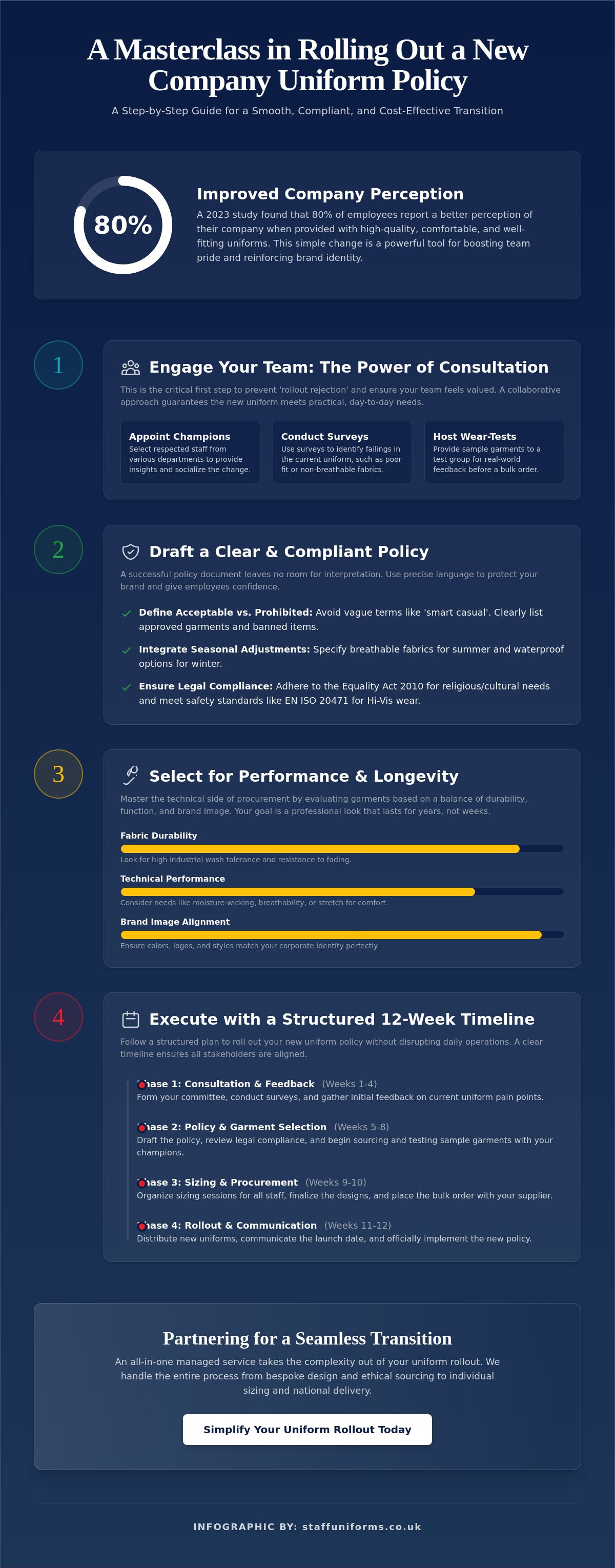
Did you know that 80% of employees report a better perception of their company when provided with high-quality, comfortable, and well-fitting uniforms? While this 2023 study proves the value of professional attire, many managers still fear the logistics of a changeover. You might be concerned about staff resistance or wasting your budget on non-durable clothing that loses its shape. Learning how to roll out a new company uniform policy doesn't have to be a source of friction. When done correctly, it's a powerful tool for reinforcing your brand identity and boosting team pride simultaneously.
We understand that you need a transition that's both smooth and cost-effective. This guide provides a masterclass in introducing a new workplace dress code, focusing on a strategy that balances technical garment engineering with genuine staff consultation. You'll learn how to navigate the 2026 legal landscape, including the Fair Work Agency's latest standards, and how to select bespoke garments like moisture-wicking polos or durable cargo pants. We'll walk you through a step-by-step process to ensure your new policy delivers a professional image that lasts for years, not just weeks.
Key Takeaways
- Identify why staff consultation is the critical first step to prevent resistance and ensure your team feels valued during the transition.
- Learn how to draft a legally compliant policy that uses clear, unambiguous language to define acceptable attire and eliminate grey areas.
- Master the technical side of procurement by evaluating fabric longevity, from industrial wash tolerance to moisture-wicking performance.
- Follow a structured 12-week timeline that details exactly how to roll out a new company uniform policy without disrupting daily operations.
- Discover how a managed all-in-one service takes the complexity out of design, sizing, and national delivery for a seamless experience.
The Strategic Foundation: Why Staff Consultation is Essential
A uniform rollout is a managed transition of corporate identity through functional workplace attire. It's a strategic move that aligns your team's appearance with your business goals. When you're considering how to roll out a new company uniform policy, start with the people who will wear the garments every day. Consultation isn't a courtesy; it's a necessity for operational success. Skipping this step often leads to 'rollout rejection', where employees feel disconnected from the brand's new image because their practical needs weren't met.
Your first task is to define the objective. You might be aiming for a complete rebrand or perhaps you're updating gear to meet new safety standards. Identifying this 'why' early helps you choose the right garments, from hi-vis safety vests to bespoke corporate blazers. To bridge the gap between management and the front line, appoint 'Uniform Champions'. Select respected staff members from various departments to act as a sounding board. They provide essential insights into the practicalities of their roles and help socialise the change among their peers.
Identifying Sector-Specific Pain Points
Different industries face unique challenges that a generic policy won't solve. In healthcare, your team needs medical scrubs or nurse dresses that prioritise fluid movement and meet strict infection control standards. Hospitality staff require a balance between aesthetic appeal and technical performance, such as heat resistance in kitchens or high wash-durability for hospitality aprons. For corporate environments, professional suiting and blouses must remain comfortable for all-day office wear. A firm grasp on understanding workplace dress codes helps align these functional needs with your brand's visual standards.
Managing Staff Feedback Loops
Don't guess what your staff needs. Ask them. Use surveys to identify failings in your current uniform, such as poor fit or fabrics that don't breathe. Before you commit to a bulk order, host wear-test trials. Give a small sample group your new polo shirts or workwear trousers to test in real-world conditions for a week. This data is invaluable. According to a 2023 study, 80% of employees report a better perception of their company when they receive high-quality, well-fitting uniforms. This collaborative approach is the most effective way to learn how to roll out a new company uniform policy that actually sticks. Finally, always link the new policy to professional pride. When staff understand that a high-quality uniform is a vital tool for business success, buy-in follows naturally.
Drafting a Professional Uniform Policy: Key Elements and Legal Compliance
A successful policy document leaves no room for interpretation. When you are finalising how to roll out a new company uniform policy, the language must be precise and direct. Vague terms like 'smart casual' often lead to inconsistent brand representation across different teams. Instead, define exactly what constitutes 'Acceptable' attire, such as company-issued formal shirts or beauty tunics, and clearly list 'Prohibited' items like faded denim or non-branded outerwear. This clarity protects your brand and gives employees confidence in their professional appearance.
Your policy should also account for the UK's shifting climate. Integrate seasonal adjustments by specifying breathable, moisture-wicking fabrics for summer and waterproof softshell jackets for the winter months. Beyond the initial launch, define the replacement cycle. State clearly how often staff can request new garments and the process for ordering through your approved supplier. This prevents budget wastage on unnecessary replacements while ensuring the team always looks sharp. A structured ordering window helps you manage procurement costs without compromising the professional image of your workforce.
Compliance, Safety, and Equality
Legal compliance is the backbone of any professional dress code. Under the Equality Act 2010, your policy must not discriminate against protected characteristics. This includes making reasonable adjustments for religious or cultural requirements, such as allowing headscarves that match the corporate colour palette. Safety is equally critical. If your roles require Hi-Vis vests or jackets, these must meet EN ISO 20471 standards and be provided at no cost to the worker. Be mindful of the Fair Work Agency, which began enforcing employment rights on April 7, 2026. You must ensure any uniform deductions don't push take-home pay below the National Minimum Wage, especially as this is a key focus for modern regulatory audits.
Uniform Care and Presentation Standards
A uniform is a vital tool for business success, but only if it's well-maintained. Set clear expectations for personal grooming and garment care to ensure consistency. While we don't provide laundry services, we recommend specific wash temperatures to preserve the lifespan of technical fabrics and high-quality embroidery. This focus on longevity is a core part of a wider custom staff uniforms UK strategy. If you need help drafting these technical specifications, our team can provide a bespoke uniform consultation to ensure your policy is as durable as the clothing itself. This proactive approach ensures you understand how to roll out a new company uniform policy that balances legal requirements with practical, everyday wearability.
Selecting Garments for Longevity: Technical Performance vs. Brand Image
Choosing the right garments is the bridge between a policy on paper and a successful team in the field. When you're deciding how to roll out a new company uniform policy, technical specifications should lead the conversation. High-quality workwear isn't just about the visual impact; it's about how the fabric performs under the pressure of a twelve-hour shift. Evaluate fabric technology through the lens of daily utility. Moisture-wicking fabrics keep staff cool during active tasks, while stain-resistant finishes and high industrial wash tolerance ensure garments don't look tired after just a few months of use.
Think about the Total Cost of Ownership (TCO) over a 12 to 24-month period. A cheaper polo shirt might save money today, but if it shrinks or fades within ten washes, you'll pay more in replacements than if you'd invested in durable, high-quality pieces initially. This long-term view is the most effective way to learn how to roll out a new company uniform policy that stays within budget. Staff morale also hinges on fit. A 'one-look-fits-all' approach rarely works across diverse body types. Offering tailored options or modern, ergonomic cuts can significantly improve employee happiness and confidence.
Branding methods must match the garment's purpose and material. High-density embroidery is the gold standard for corporate suits and blazers. It provides a premium, textured finish that withstands regular wear and cleaning. Conversely, screen printing or heat transfers are often more suitable for hi-vis vests or waterproof jackets. These methods maintain the fabric's integrity and visibility without puncturing the material with needles. Selecting the right customisation technique ensures your brand remains sharp and professional for the entire lifespan of the clothing.
Sector-Specific Fabric Selection
In healthcare, antimicrobial fabrics are essential for scrubs UK wide to support infection control and hygiene. For those working with hospitality workwear suppliers, poly-cotton blends offer the perfect mix of breathability and durability for hot kitchen environments. Industrial teams require workwear trousers with reinforced stitching and tear-resistant fabrics to handle the rigours of construction or logistics safely.
Branding and Customisation Techniques
Embroidery offers a sophisticated, long-lasting look for blazers and formal shirts, ensuring your logo remains crisp. Screen printing is the most cost-effective solution for large logos on cotton t-shirts, especially for high-volume orders. For softshell jackets or complex, multi-coloured designs, heat transfer provides a versatile finish that doesn't compromise the garment's weatherproofing or stretch.
Executing the Rollout: A Step-by-Step Implementation Timeline
Precision is key. A fragmented approach leads to delays and frustrated staff members who aren't sure when their new gear will arrive. When planning how to roll out a new company uniform policy, you need a structured 15-week roadmap to ensure every department moves in unison. This timeline provides the clarity required for large-scale procurement while respecting the daily operational needs of your business.
- Phase 1: Announcement and Strategy (Weeks 1-4): Set the vision for the new look. Use this time to introduce your 'Uniform Champions' and explain the 'why' behind the change. This initial month is about building anticipation and transparency.
- Phase 2: Procurement and Fitting (Weeks 5-12): This is the most technical stage. Organise sizing sessions for all staff to ensure a perfect fit for items like corporate suits or medical scrubs. Once measurements are finalised, place your bulk order with the supplier.
- Phase 3: Distribution and Education (Weeks 13-14): Garments are issued to individuals. This period includes policy training to ensure everyone understands the new standards of presentation.
- Phase 4: The 'Go-Live' Date and Feedback Collection (Week 15+): The entire team switches to the new attire on a single, unified date. Collect feedback immediately to address any minor sizing or comfort adjustments.
Following this schedule prevents the 'half-and-half' look where some teams are in old gear while others have transitioned. It creates a professional, high-impact launch that reinforces your brand's commitment to quality.
Logistics and Distribution Management
Efficient distribution is often the hardest part of the process. We recommend utilizing 'Man-Pack' services to simplify the handover. This involves individually bagging each staff member's complete uniform set, labelled with their name and department. It eliminates the chaos of sorting through bulk boxes and ensures every employee receives exactly what they ordered. Set up a dedicated distribution point away from high-traffic areas to avoid workplace disruption. If you're managing a national rollout, our bespoke logistics planning can help you coordinate deliveries across multiple sites simultaneously. This structured approach ensures you master how to roll out a new company uniform policy without logistical headaches.
Training and Policy Reinforcement
The rollout doesn't end when the clothes are delivered. Host a 'launch event' or a brief presentation to showcase the new look and boost morale. Provide every employee with a written 'Care Card'. These cards should detail washing instructions and maintenance tips specifically for technical fabrics like moisture-wicking polos or softshell jackets. Finally, ensure the new policy is immediately integrated into your new-starter induction process. This ensures that the high standards you've set on day one are maintained by every future hire, protecting your brand's image for the long term.
Partnering for Success: How The Staff Uniform Company Simplifies Your Transition
Successful implementation is more than just a logistics exercise. It's a branding partnership. When you're learning how to roll out a new company uniform policy, the complexity of managing sizes, designs, and delivery can quickly become overwhelming. We simplify this through an all-in-one service that manages the entire lifecycle of your project. From the initial design phase to final national delivery, we act as a trusted advisor to ensure your corporate identity remains consistent and professional.
Our technical expertise spans across diverse sectors. Whether you need antimicrobial healthcare scrubs or high-performance industrial safety vests, we understand the specific functional requirements of your industry. A dedicated account manager serves as your single point of contact for large-scale national rollouts. They oversee the granular details of logo placement and colour matching across every garment type. This ensures that your brand looks exactly the same on a bespoke blazer as it does on a moisture-wicking polo shirt. We handle the technical procurement so you can focus on running your business.
Bespoke Solutions for National Businesses
We provide scalable procurement models designed to grow alongside your business. As your headcount increases, our access to a wide inventory of durable workwear essentials ensures you're never left waiting for stock. We believe a uniform is a vital tool for success. By focusing on professional pride and the human element of workwear, we help improve staff morale and enhance how customers perceive your business. This partnership approach is the most reliable way to understand how to roll out a new company uniform policy that delivers long-term value and brand consistency.
Next Steps for Your Business
Ready to begin your transition? Start by requesting a garment sample pack. This allows you to test the quality, fit, and feel of our fabrics in your actual work environment before making a commitment. You can also consult with our branding experts to determine whether embroidery, screen printing, or heat transfer is the best fit for your specific needs and garment types. Taking these logical steps ensures the experience feels manageable and transparent. Contact The Staff Uniform Company today to begin your managed rollout and ensure your team reflects the excellence of your brand.
Transform Your Corporate Identity with Precision
Success in a uniform transition comes down to balancing employee comfort with technical garment performance. By prioritising staff consultation and following a structured 15-week timeline, you eliminate the risks of resistance or budget wastage. You've learned that a professional dress code is more than just a policy; it's a vital tool for business success and a reflection of your brand's commitment to quality. Applying these strategic steps ensures you understand how to roll out a new company uniform policy that enhances your team's professional pride and long-term efficiency.
Staff Uniforms has been a specialist UK supplier since 2017. We pride ourselves on providing expert logo embroidery and branding that withstands the rigours of the modern workplace. Our national delivery and man-pack services ensure that your rollout is managed with quiet confidence and zero disruption to your operations. We take the complexity out of procurement so you can focus on leading your team.
Start your professional uniform rollout with The Staff Uniform Company today. Your corporate identity is in safe hands, and we look forward to helping you achieve a seamless, high-impact transition for your workforce.
Frequently Asked Questions
How long does a typical company uniform rollout take?
A standard company uniform rollout usually takes between 12 and 15 weeks from the initial strategy phase to the final go-live date. This timeframe allows for thorough staff consultation, garment wear-testing, and the technical procurement of custom-branded items. Larger national rollouts may require additional time for regional fitting sessions and complex logistics planning to ensure every site is ready simultaneously.
What should be included in a company uniform policy?
Your written policy must include clear definitions of acceptable and prohibited attire to remove any ambiguity for your team. It should also detail specific care instructions for technical fabrics, the process for requesting replacements, and seasonal adjustments for summer and winter. Including health and safety requirements, such as Hi-Vis standards, ensures the document serves as a comprehensive operational guide for all departments.
Can an employer force an employee to wear a uniform in the UK?
Employers in the UK can legally require staff to wear a uniform if it's explicitly stated in the employment contract. However, you must ensure the policy complies with the Equality Act 2010 by making reasonable adjustments for religious, cultural, or medical needs. It's also vital that any deductions for uniform costs don't push an employee's pay below the National Minimum Wage, especially following 2026 regulatory updates.
How do I handle staff who refuse to follow the new dress code?
Start by identifying the root cause of the resistance through direct consultation with the individual. Often, refusal stems from concerns about fit, comfort, or practical utility in their specific role. If the uniform meets all legal and safety standards but a staff member still refuses to comply without a valid medical or religious reason, you may follow your company's standard disciplinary procedures for breach of contract.
How many sets of uniforms should each employee be given?
For full-time employees, the industry standard is to provide between three and five complete sets of uniforms. This "one on, one in the wash, one in the cupboard" approach prevents excessive wear and ensures staff always have a clean, professional set ready for their shift. Part-time staff should receive a pro-rata allocation based on the number of days they work per week to maintain garment longevity.
Is the cost of a company uniform tax-deductible for the business?
Yes, the cost of purchasing and branding staff uniforms is generally a tax-deductible business expense in the UK. To qualify, the clothing must be a functional requirement of the job and clearly display your company logo or name. This branding distinguishes it from "everyday" clothing, which helps the business claim tax relief while establishing a professional corporate identity that customers can trust.
How do I ensure the new uniform is inclusive for all body types?
Move away from a "one-size-fits-all" mentality and offer a range of fits, such as tailored, slim, and relaxed cuts. Providing gender-neutral options and a broad size range ensures every team member feels comfortable and confident. When you understand how to roll out a new company uniform policy effectively, you'll prioritise ergonomic designs that accommodate diverse body shapes without compromising on your brand's professional aesthetic.
What is the best way to distribute new uniforms to a remote or national workforce?
Utilizing a "man-pack" service is the most efficient way to distribute uniforms across multiple sites or to remote workers. Each pack is individually bagged and labelled for a specific employee, containing their exact sizes and quantities. This method reduces internal sorting time and ensures that every member of your national team receives their gear simultaneously. This is a crucial logistical step in how to roll out a new company uniform policy for large-scale organisations.