
The most expensive custom-designed uniform might actually be the biggest risk to your brand reputation in 2026. While bespoke garments offer unmatched prestige, a sudden 20% increase in your workforce can leave new starters waiting 12 weeks for the right kit. You likely agree that a professional image is non-negotiable, yet the frustration of inconsistent sizing or discontinued lines in stock ranges makes procurement feel like a constant battle. Balancing a high-end aesthetic with a reliable supply chain is the ultimate challenge for any UK facility manager or business owner.
This requirement for design continuity and high-performance durability is also why sports organizations prioritize custom apparel. Specialists like sUperstar provide bespoke teamwear for rugby and GAA, demonstrating how tailored quality can elevate a group's identity and foster a sense of belonging, much like a corporate uniform.
This guide breaks down the essential off the shelf vs bespoke uniforms pros and cons to ensure your team looks sharp without the logistical headaches. You'll learn how to navigate lead times, manage your budget in GBP, and maintain brand consistency over long-term contracts. We explore the critical differences in garment technology and cost-effectiveness to help you build a uniform policy that supports your business growth and boosts staff pride.
Key Takeaways
- Understand why modern stock-supported ranges offer high-quality, cost-effective solutions for businesses prioritising speed and rapid scalability.
- Explore the psychological impact of bespoke tailoring on staff morale and how exclusive designs can elevate your total brand experience.
- Learn how to implement the "Hybrid Model" by personalising premium stock items to achieve a high-end look without long manufacturing lead times.
- Weigh the off the shelf vs bespoke uniforms pros and cons against your specific headcount and budget to find your ideal procurement strategy.
- Use our 3-year uniform lifecycle framework to plan your investment and ensure your professional image remains consistent as your business grows.
Defining the Uniform Landscape: Off-the-Shelf vs Bespoke
Selecting the right workwear is a critical procurement decision that directly impacts your brand's physical presence and your team's daily performance. The choice between Defining Uniforms through ready-made stock or commission-based custom designs involves balancing speed, cost, and creative control. By 2026, the technological gap between these two options has narrowed significantly. Modern fabric innovations mean that choosing a stock-supported range no longer requires a sacrifice in quality or durability. Instead, the decision now rests on your specific operational requirements and how closely you need the garment to mirror your corporate colour palette.
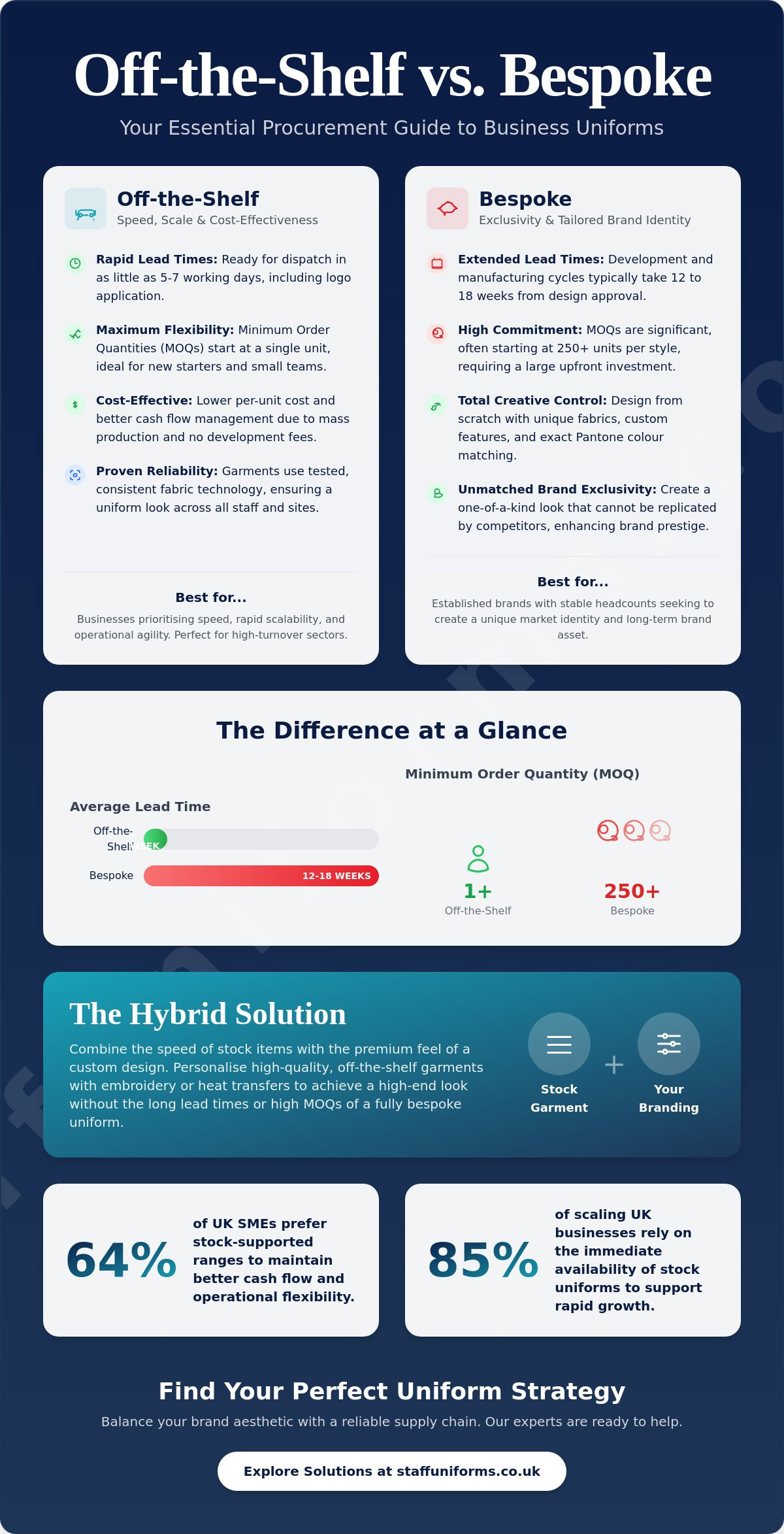
Understanding the off the shelf vs bespoke uniforms pros and cons is essential for any business owner or facility manager. A 2024 industry report indicated that 64% of UK SMEs now prefer stock-supported ranges to maintain better cash flow, while larger enterprises often lean toward bespoke solutions to secure a unique market identity. Brand identity plays a massive role here. A uniform isn't just a garment; it's a vital tool for business success that fosters professional pride and ensures your team is instantly recognisable to the public. You must weigh the immediate availability of stock items against the total design freedom offered by a bespoke contract.
What are Off-the-Shelf (Stock-Supported) Uniforms?
Stock-supported uniforms are pre-manufactured garments held in high volumes in UK warehouses, ready for immediate dispatch. These ranges offer standardised sizing and a set palette of colours that remain consistent year after year. They're designed for efficiency. You can easily add your corporate identity via high-quality embroidery or heat transfer. This route is ideal for businesses that need to onboard new staff quickly, as lead times are often as short as 5 to 7 working days. Because these items are produced in massive quantities, minimum order quantities (MOQs) are frequently as low as a single unit, providing maximum flexibility for smaller teams.
What are Truly Bespoke Uniforms?
Bespoke uniforms are garments designed and manufactured from scratch specifically for your organisation. This process allows for total customisation, including unique fabric blends, specific pocket configurations, and exact Pantone colour matching to your brand guidelines. It's a ground-up approach where every stitch serves a purpose. However, this level of detail requires a longer commitment. Development cycles typically range from 12 to 18 weeks, and factories generally require higher MOQs, often starting at 250 units per style. This path is best suited for established brands looking for a completely exclusive look that cannot be replicated by competitors. When weighing the off the shelf vs bespoke uniforms pros and cons, remember that bespoke is an investment in long-term brand exclusivity.
Off-the-Shelf Uniforms: Speed, Scale, and Cost-Effectiveness
Stock-supported ranges provide the operational foundation for approximately 85% of scaling UK businesses. These garments are pre-manufactured and held in high volumes, allowing companies to bypass the lengthy lead times associated with custom production. When evaluating off the shelf vs bespoke uniforms pros and cons, the primary advantage of stock lines is the ability to support rapid growth without the burden of inventory management. You don't need to commit to massive minimum order quantities (MOQs) to get started; you simply order what you need, when you need it.
Mass-produced lines rely on proven fabric technology. Whether it's 200gsm poly-cotton blends for durability or advanced moisture-wicking fabrics for active roles, these materials undergo rigorous testing for consistency. Every batch of a stock-supported polo shirt or cargo trouser will meet the same technical specifications, ensuring your team looks uniform across multiple sites. This reliability is vital for maintaining a cohesive dress code and brand identity as your headcount expands from 10 to 500 employees.
The Advantages of Immediate Availability
In high-turnover sectors, waiting twelve weeks for a custom waistcoat or tunic isn't an option. Off-the-shelf solutions typically offer a 7-10 day turnaround, including logo application. This "just-in-time" model means you can order a single unit for a new starter on Monday and have them fully branded by the following week. For detailed insights into sector-specific stock options, consult our guide on Hospitality Workwear Suppliers. This agility prevents the common pitfall of new staff working in their own clothes while waiting for a bespoke order to arrive.
Cost Management and Budget Flexibility
Choosing stock garments eliminates the "hidden" financial barriers of bespoke manufacturing. You won't face initial pattern-cutting fees, sample iteration costs, or the £1,000+ setup charges often required for unique designs. Lower unit costs free up your budget, allowing you to invest in higher-spec branding techniques like 3D embroidery or heat-applied vinyl. Pricing remains predictable for multi-year procurement plans, making it easier for facility managers to forecast annual spend accurately. There are no surprises; the price you see in the catalogue is the price you pay, regardless of whether you're ordering five items or fifty.
If you need a reliable solution that balances quality with quick deployment, browse our current professional workwear range to see how stock garments can elevate your team's image. Understanding the off the shelf vs bespoke uniforms pros and cons starts with recognizing that for most businesses, efficiency and cost-control are the ultimate priorities.
Bespoke Uniforms: Exclusivity and Tailored Brand Representation
A bespoke uniform acts as a strategic asset rather than a simple overhead. While the off the shelf vs bespoke uniforms pros and cons often focus on initial price points, the long-term brand equity of a custom range is unmatched. It creates a total brand experience that generic garments cannot replicate. When you control every stitch, you ensure your workforce becomes a living extension of your corporate identity.
Unrivalled Branding and Exclusivity
Custom-made clothing allows for absolute visual control. Pantone-matched fabrics ensure your corporate colours remain identical across global sites, whether your team is in London or Singapore. You aren't limited by a manufacturer's seasonal stock or standard colour palettes. This level of detail includes brand-specific elements like custom-embossed buttons, contrast linings, and unique pocket configurations. For a deeper look at how these elements fit into a broader corporate strategy, consult this Custom Staff Uniforms UK guide for 2026. This proprietary approach ensures your look is unique; competitors cannot simply buy the same items from a catalogue.
The Human Element: Staff Pride and Comfort
Employee retention remains a critical challenge for UK businesses. A 2024 industry survey indicated that 68% of staff feel more professional when wearing high-quality, well-fitted workwear. Bespoke design allows you to address specific comfort issues that off-the-shelf options ignore. You can integrate moisture-wicking fabrics for high-intensity roles or specify stretch panels for technicians who require a full range of movement. We treat the uniform as a vital tool for business success. It isn't just about appearance; it's about providing gear that helps your team perform their best every day.
Technical benefits of bespoke design often cater to niche roles that standard retail items overlook. Consider these functional advantages:
- Reinforced Tool Pockets: Specifically sized for the equipment your engineers use daily.
- Climate Adaptation: Selecting specific fabric weights for staff working in refrigerated environments versus those in heated showrooms.
- Integrated Tech: Designing pockets specifically for tablets or scanners used in modern logistics.
The long-term value of a bespoke range lies in its continuity. When you own the design patterns, you aren't at the mercy of a supplier discontinuing a specific line. This stability is a major factor when weighing off the shelf vs bespoke uniforms pros and cons for a five-year procurement plan. It guarantees a consistent look for every new hire, regardless of when they join the company. This consistency builds trust with your clients and fosters a sense of belonging within your team.
The Practical Middle Ground: Personalising Stock-Supported Garments
For most UK businesses in 2026, the decision isn't a simple binary choice. The 'Hybrid Model' has become the dominant strategy for approximately 65% of corporate firms. This approach uses high-end, stock-supported garments as a foundation, which are then elevated through sophisticated customisation. It effectively bridges the gap when assessing off the shelf vs bespoke uniforms pros and cons, offering the agility of ready-made clothing with the prestige of a custom build.
High-end stock items are no longer synonymous with generic styling. Manufacturers now produce 'blank' ranges specifically designed for secondary modification. By selecting these premium bases, you avoid the 12 to 16-week lead times required for bespoke manufacturing. Instead, you can deploy a fully branded, professional range in under 15 working days. When weighing up off the shelf vs bespoke uniforms pros and cons, many procurement managers realise they need the speed of stock combined with the identity of custom design.
Advanced Branding Techniques
Modern branding goes far beyond a simple heat-pressed logo on the left chest. To create a 'pseudo-bespoke' look, we utilise 3D embroidery which adds depth and a tactile, luxury finish to blazers and knitwear. Strategic placement is also vital; branding the nape of the neck or a cuff can subtly signal quality without being overbearing. Details like custom zip pullers and contrast stitching on buttonholes can transform a standard jacket into a unique corporate asset. These small touches signal to your clients that you value detail and precision.
Tax-tabbing is a critical component of this model for UK businesses. Tax-tabbing is a method of sewing a small, visible brand label into the external seam of a garment to make it tax-compliant as a professional uniform while adding a discreet mark of quality. This ensures your staff don't incur benefit-in-kind tax hits while keeping your team looking sharp and professional.
Curating a Multi-Brand Uniform Wardrobe
A sophisticated uniform doesn't have to come from a single catalogue. You can mix and match items from different specialised ranges to create a look that's unique to your business. The secret lies in maintaining colour continuity across different fabric types. For example, pairing high-performance trousers with premium Corporate Suits ensures your front-of-house team looks cohesive even if their garments serve different functional roles.
Consistency is the hallmark of professional branding. When you curate from established stock brands, you gain the security of long-term availability. If you hire a new starter in 2027, you can order the exact same navy blazer you bought in 2026. This level of reliability is why the hybrid model remains the most practical solution for growing British companies that value both image and efficiency.
Procurement Strategy: Which Route Suits Your Business Goals?
Selecting the right clothing strategy requires a clinical look at your operational goals. Evaluating off the shelf vs bespoke uniforms pros and cons depends on your specific business trajectory. A decision made today will impact your budget and brand perception for at least the next 36 months. You must balance immediate needs with long-term scalability to ensure your team remains professional and protected.
Decision Matrix: Bespoke vs Off-the-Shelf
Your choice often hinges on three variables: headcount, branding requirements, and your launch date. Use this framework to identify your path.
- Choose Bespoke if: You manage 500 or more staff members. You require specific Pantone-matched fabrics or unique pocket configurations. You have a lead time of 16 to 24 weeks for the initial rollout. Bespoke offers total control over the garment's DNA.
- Choose Off-the-Shelf if: You are a rapidly growing SME or need a solution in under four weeks. You prioritize lower upfront costs and the ability to order single replacement items instantly. This route is ideal for businesses with high staff turnover or limited storage space.
Future-proofing your choice is vital. For bespoke orders, ensure your contract guarantees fabric continuity for at least three years. For off-the-shelf, stick to "never out of stock" core ranges from established UK manufacturers. This prevents the frustration of a discontinued line leaving half your team in old gear and the other half in new styles.
The 3-Year Uniform Lifecycle
Don't view a uniform as a one-time purchase. View it as a revolving asset. Most industrial garments have a functional lifespan of 12 to 18 months, while corporate tailoring may last 24 months. A 3-year lifecycle plan allows you to calculate the Total Cost of Ownership (TCO). While bespoke garments might have a higher initial price point, their tailored durability often results in a lower TCO over three years compared to cheaper, lower-quality off-the-shelf alternatives that require frequent replacement.
Partnering for Success
Managing a uniform rollout is complex. Choosing an all-in-one partner who handles everything from initial design and wearer trials to embroidery and final delivery is critical for efficiency. You need a trusted advisor who understands that a construction site requires different garment technology than a healthcare clinic. This holistic approach reduces the administrative burden on your procurement team and ensures a consistent brand image across all departments.
Before you start your next tender, use this final checklist:
- Headcount Audit: Total number of wearers plus a 10% buffer for new hires.
- Lead Time: Can you wait 6 months for bespoke, or do you need stock in 14 days?
- Branding Needs: Is a simple embroidered logo enough, or do you need custom buttons and linings?
- Budget: Have you set a firm per-wearer annual allowance?
A professional uniform is more than just fabric; it's a tool for business success and staff pride. Explore our professional uniform solutions to find the perfect fit for your organisation's future.
Securing Your Brand’s Professional Edge
Selecting the right workwear requires balancing immediate operational needs with long-term brand strategy. This guide to off the shelf vs bespoke uniforms pros and cons highlights that while off-the-shelf garments offer unmatched speed for rapid scaling, bespoke designs provide the exclusivity required for premium brand positioning. Many UK firms now opt for a hybrid approach; they use our full in-house branding and customisation service to transform high-quality stock items, achieving a tailored look without extended manufacturing lead times. It's a strategy that works across all sectors, from high-pressure healthcare environments to fast-paced hospitality venues.
Staff Uniforms simplifies this complex procurement process by providing expert UK-wide delivery and logistics. We leverage specialist sector knowledge to ensure every garment meets industry standards and enhances staff morale. Whether you're managing a local clinic or a national hotel chain, our team handles the technical details so you can focus on running your business. Email Sales@staffuniforms.co.uk · Tel 0333 090 8552 today and let's build a wardrobe that reflects your company’s success. Your team deserves workwear that performs as hard as they do.
Frequently Asked Questions
What is the minimum order quantity for bespoke uniforms in the UK?
Minimum order quantities for bespoke uniforms in the UK typically start at 100 to 250 units per garment style. This threshold allows manufacturers to source specific fabrics and set up dedicated production lines efficiently. For smaller teams, stock-supported items with high-quality embroidery remain the more viable financial choice. You'll find that these limits vary depending on whether the garments are manufactured domestically or overseas.
How long does it take to design and deliver a custom staff uniform?
A bespoke uniform project generally takes 12 to 16 weeks from the initial concept to final delivery. This timeline accounts for design consultations, fabric sourcing, wearer trials, and production cycles. Planning at least four months ahead ensures your team isn't left without kit during seasonal transitions or rebranding phases. Rapid stock-supported options are better if you need a solution in under 14 days.
Can I mix bespoke items with off-the-shelf garments in one uniform range?
You can easily mix bespoke items with off-the-shelf garments to create a unique yet cost-effective range. Many businesses pair a custom-designed jacket or waistcoat with stock trousers and shirts to balance brand identity with budget. This hybrid approach helps you manage the off the shelf vs bespoke uniforms pros and cons by focusing your investment on high-impact, visible pieces while saving on basics.
Is it cheaper to buy off-the-shelf uniforms for a large workforce?
Off-the-shelf uniforms are usually cheaper for immediate procurement because they benefit from massive economies of scale. However, for a workforce exceeding 500 employees, bespoke options often become price-competitive. Custom manufacturing allows you to control fabric durability and specific design features. This can reduce your replacement cycles by 20 percent over a three-year period, leading to lower long-term costs for the business.
What happens if a stock-supported uniform style is discontinued?
If a stock-supported style is discontinued, reputable suppliers typically provide 6 to 12 months of notice to help you transition. You'll need to select a close match from the new range or buy buffer stock to cover new starters during the changeover. Most major UK workwear brands ensure their new styles remain compatible with previous color palettes to maintain visual consistency across your entire team.
Do bespoke uniforms really improve staff morale more than stock items?
Bespoke uniforms significantly improve staff morale because they're designed specifically for the wearer's daily tasks and body shapes. When employees feel comfortable and look professional, their productivity and brand pride increase. A 2023 industry survey indicated that 72 percent of workers feel more valued when provided with high-quality, tailored workwear rather than generic, ill-fitting alternatives that don't suit their specific roles.
How do I ensure my off-the-shelf uniforms don't look generic?
You can prevent off-the-shelf uniforms from looking generic by using advanced branding techniques like 3D embroidery, heat-seal transfers, or custom tax tabs. Adding bespoke buttons or contrasting zips transforms a standard garment into a professional brand asset. Evaluating the off the shelf vs bespoke uniforms pros and cons shows that smart customisation provides the custom look your business needs without the high minimum order requirements.
Which option is better for sustainability and ethical sourcing?
Bespoke uniforms offer superior sustainability because you control the entire supply chain, from GOTS-certified cotton to recycled polyester blends. You can specify ethical manufacturing standards and reduce carbon footprints by choosing UK-based factories for production. While many stock ranges now include eco-friendly lines, bespoke allows for a 100 percent circular design approach tailored specifically to your company's internal ESG goals and reporting requirements.