
Most healthcare procurement failures happen long before the first box arrives, usually at the moment a spreadsheet of guessed sizes is submitted. If you're tasked with ordering scrubs for a whole department, you know the stakes go beyond simple aesthetics. It's about avoiding the logistical nightmare of returns and the frustration of uniforms that shrink or fade after just a few industrial cycles. We understand that your time is valuable and your budget must be protected from avoidable waste.
It's exhausting to manage individual staff requests while worrying about brand consistency and modern infection control standards. This guide provides a professional framework to master the complexities of bulk healthcare uniform procurement. You'll learn how to implement a "sizing-first" strategy, select technical fabrics that withstand 12 to 24 months of heavy use, and navigate the latest 2026 industry shifts to ensure your team looks unified and stays protected. We'll break down the transition from concept to final delivery, ensuring your procurement process is as efficient as your clinical operations.
Key Takeaways
- Understand the critical 8-12 week planning timeline required to manage the logistics of diverse clinical roles effectively.
- Implement a "try before you buy" sizing set protocol to eliminate the risk of costly returns when ordering scrubs for a whole department.
- Master technical fabric requirements, including GSM and 60-degree wash durability, to ensure garments survive high-volume clinical use.
- Compare branding techniques like embroidery and heat transfer to ensure your logo maintains professional integrity through 50+ industrial wash cycles.
- Learn how a managed service model with dedicated quality assurance reduces administrative burden and ensures a unified team appearance.
The Logistics of Department-Wide Scrub Procurement
Ordering scrubs for a whole department is a logistical project that demands precision. It's not just about a bulk purchase; it's about matching garment specifications to the high-pressure demands of clinical environments. A successful rollout starts with defining the scope. A surgical team requires different pocket configurations and fabric weights than a physiotherapy unit. Understanding the history and use of medical scrubs helps procurement managers appreciate why specific design choices, like short sleeves for infection control, remain non-negotiable tools for safety.
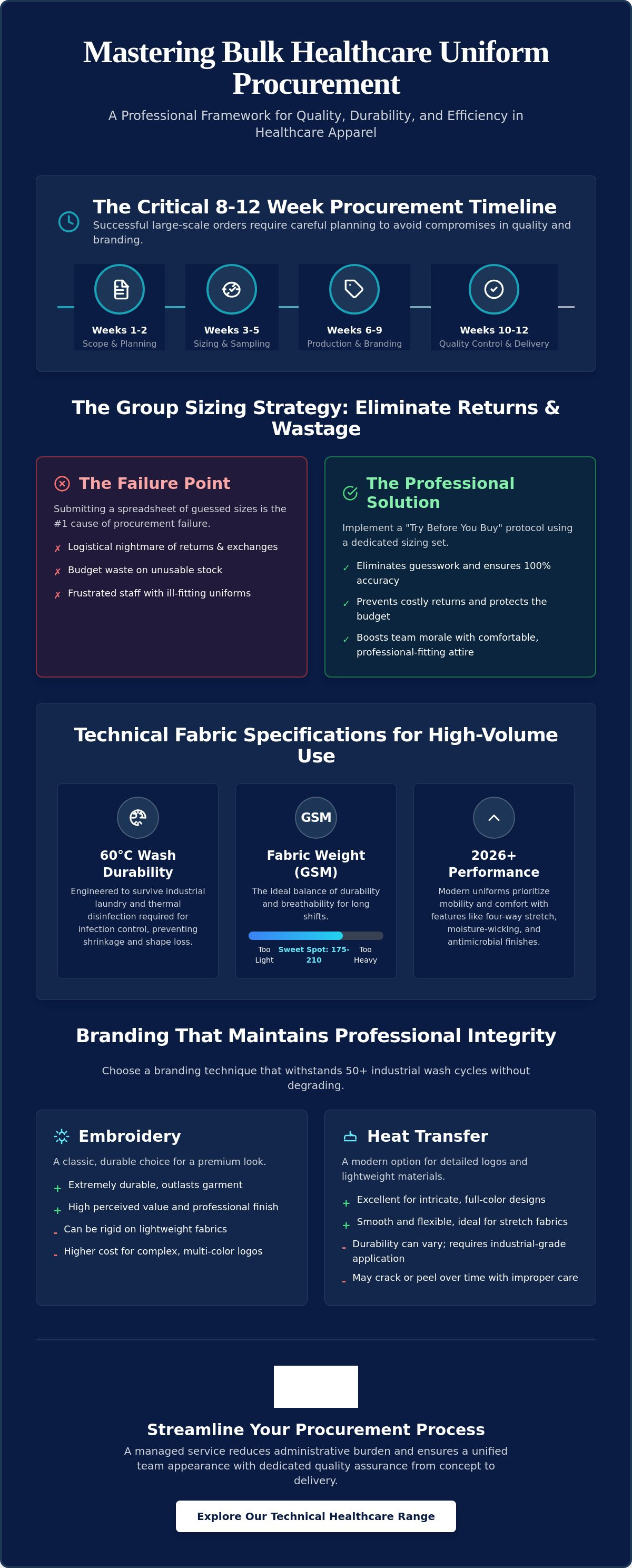
Timing is your most critical asset. You must plan 8-12 weeks in advance for large-scale orders. This window accounts for fabric sourcing, precise branding, and rigorous quality control. Rushing this process often leads to compromises in material quality or errors in the branding application. You also need to decide between centralised and decentralised ordering. Centralised models offer superior control over brand identity and volume discounts. Decentralised models allow individual units to manage their own replacements, but they often lead to fragmented visual standards and higher administrative overhead.
Budgeting requires a shift in perspective. The cheapest unit price usually results in the highest annual cost. If a garment fades or loses its shape after ten washes, your replacement frequency doubles. Investing in high-performance textiles ensures your team looks professional for 12 to 24 months. When ordering scrubs for a whole department, calculating the cost-per-wear provides a more accurate picture of value than the initial invoice total.
Audit Your Current Uniform Inventory
Examine your existing stock to identify recurring failure points. Look for seams that split or fabric that pills after industrial washing. Survey your staff to gather feedback on breathability and pocket utility. These practical insights prevent you from repeating past procurement mistakes. Establish a clear replacement cycle based on shift patterns. Full-time staff typically require three to five sets to manage laundry rotations without causing excessive wear on the garments.
Setting Procurement Objectives for 2026
Your goals should align with current scrubs uk standards for performance and safety. In 2026, the focus has shifted toward antimicrobial finishes and fabrics that support thermal disinfection. Prioritise features like four-way stretch for mobility and moisture-wicking properties for comfort during long shifts. Clearly define your hierarchy of needs. Durability and infection control compliance must always sit at the top of your list to protect both your staff and your patients.
Selecting the Right Fabric and Specification for High-Volume Use
Industrial laundry is the ultimate test for healthcare apparel. When ordering scrubs for a whole department, you aren't just buying clothes; you're investing in equipment that must survive thermal disinfection. In the UK, infection control protocols often require a 60-degree wash to ensure safety. Fabrics that haven't been pre-shrunk or tested for high-heat stability will degrade rapidly. This leads to "short-scrub syndrome," where trousers shrink and tops lose their shape, forcing early replacements and wasting your budget. High-quality reactive dyes are equally important. They ensure that your team's uniforms don't fade into inconsistent shades after just a few weeks of use.
Understanding GSM (Grams per Square Metre) is essential for long-term comfort and professionalism. A weight between 175 and 210 GSM provides the ideal balance of durability and breathability. Go too light, and the garments lack the structure needed for heavy pockets; go too heavy, and your team will overheat during 12-hour shifts. While basic polyester-cotton blends are the traditional choice for their durability, advanced four-way stretch blends are becoming the 2026 standard. These materials survive the industrial dryer without losing their elasticity, provided they are engineered for commercial use. If you are currently reviewing your material requirements, you can browse our technical healthcare range for detailed fabric performance data.
Material performance is not just about comfort; it's a safety requirement. While FDA standards for medical textiles primarily focus on barrier protection for gowns, the same principles of fluid resistance and fabric integrity apply to high-specification scrubs. When ordering scrubs for a whole department, you must ensure the fabric can withstand the mechanical stress of high-volume use without compromising its protective qualities. Choosing the right blend from the start eliminates the need for mid-year emergency replacements.
Technical Specifications for Healthcare Environments
In high-pressure clinical settings, moisture-wicking technology is no longer a luxury. It moves perspiration away from the skin, keeping staff dry and focused. For bulk orders, look for reinforced stitching and bar-tacking at stress points like pocket corners and side vents. These small details prevent the mechanical failures that typically trigger a return. High-quality yarn selection also prevents pilling, ensuring the fabric surface remains smooth and professional even after 50 or more laundry cycles.
Standardising Your Colour Palette
Colour consistency is vital for maintaining a clear departmental hierarchy. Ensure your supplier guarantees batch consistency across different garment types, such as scrubs and nurse dresses. Standardising your palette helps patients identify roles quickly. For example, mapping navy to senior nursing staff and teal to support roles improves navigation and safety. Consistent shades across the entire department reinforce a sense of professional pride and ensure that new hires always match the existing team.
The Group Sizing Strategy: Eliminating Returns and Wastage
Relying on standard size charts is the primary cause of procurement failure. A "Medium" from one manufacturer rarely matches a "Medium" from another, especially with the rise of athletic-fit technical fabrics in 2026. When ordering scrubs for a whole department, these inconsistencies lead to a cycle of returns that stalls your rollout and inflates costs. Staff members who feel uncomfortable in their uniforms are less productive and more likely to request early replacements. To avoid this, you must move away from self-reported measurements and implement a physical verification process.
Managing the resulting data requires a robust departmental sizing matrix. This is more than just a list of names and sizes. It's a living document that tracks specific fit preferences, required trouser lengths, and maternity needs. By centralising this information before placing the bulk order, you create a "single source of truth" that prevents transcription errors. This proactive approach ensures that when the shipment arrives, every set is ready for immediate use, allowing your clinical team to focus on patient care rather than garment exchanges.
The 5-Step Sizing Protocol
Precision in sizing is a project management task. Follow these steps to ensure total accuracy across your team:
- Step 1: Request a full-size run (XS to 4XL) from your hospitality workwear suppliers or healthcare vendor to serve as your master set.
- Step 2: Set up a 48-hour "Fitting Station" in a staff breakroom or dedicated office space to allow all shift rotations to participate.
- Step 3: Use a standardised recording sheet that captures top and trouser sizes separately, as many staff require split sizing.
- Step 4: Cross-reference these physical results with the manufacturer’s specific 2026 fit guide to account for any fabric-specific elasticity.
- Step 5: Finalise the matrix and have a department lead sign off on the total quantities before submission.
Inclusive Sizing and Gender-Neutral Options
Modern healthcare departments are moving toward inclusive sizing to support a diverse workforce. While unisex scrubs offer a simplified ordering process, they often fail to provide the correct fit for all body types. Ensure your order includes tall and petite lengths. Trousers that are too long aren't just unprofessional; they're a tripping hazard in fast-paced clinical environments. If you're transitioning between athletic and classic fits, remember that athletic styles often require staff to size up. Accounting for these nuances during the initial phase of ordering scrubs for a whole department prevents the "baggy or tight" complaints that undermine team morale.
Branding and Customisation for Large Healthcare Teams
Branding is the final step in establishing a professional identity. When you're ordering scrubs for a whole department, the method of customisation determines whether that identity lasts six months or two years. Embroidery remains the gold standard for healthcare. It withstands 50 or more industrial washes at 60 degrees without losing its integrity. Heat transfers, while cost-effective for promotional wear, often crack or peel under the mechanical stress of medical laundering. A stitched logo provides a tactile, high-quality finish that reflects the excellence of your clinical services.
Placement requires a functional approach. Most departments opt for the left chest, but you must ensure the embroidery doesn't compromise pocket utility. If your chosen scrub style features a top pocket, the logo should sit slightly above it or on the sleeve. You also need to manage the balance between role identification and individual names. While individual names add a personal touch that aids patient rapport, they increase the complexity of the re-order process. Many facilities find that embroidering the department name and role title offers the best balance of professional clarity and logistical simplicity.
The psychological impact of custom staff uniforms uk shouldn't be underestimated. A unified appearance fosters a sense of belonging and collective pride. It signals to patients that they're in the hands of a cohesive, organised team. This visual consistency reduces patient anxiety and establishes immediate authority. When every team member wears the same high-standard branding, it removes hierarchy-based friction and reinforces a shared mission of care. If you're ready to define your team's look, contact us for a custom branding consultation.
Logo Digitisation and Thread Selection
Precision starts with digitisation. This process converts your logo into a stitch file that accounts for the fabric's texture. High-sheen polyester threads are essential for scrubs because they're resistant to the bleaching agents often used in clinical washes. Whether your team wears ripstop, twill, or stretch blends, the thread must maintain its colour and tension. We ensure your brand guidelines are met by matching thread colours across every garment in your order, maintaining a consistent visual identity regardless of the base fabric colour.
The Logistics of Personalisation
Managing names for a large team requires a "Master Branding Sheet." This document tracks every staff member's name and title alongside their verified size. This level of detail prevents errors and ensures that the right garment reaches the right person. Keep in mind that customisation adds time to the initial lead period. However, once your logo is digitised and your branding sheet is set, the re-order process for new hires becomes significantly faster. Bulk embroidery is always more efficient than individual branding, so consolidating your departmental needs into a single project is the most cost-effective strategy.
Streamlining the Bulk Ordering Process with The Staff Uniform Company
Managing the logistics of ordering scrubs for a whole department shouldn't fall on the shoulders of clinical leads or department heads. We provide a dedicated project lead for every large-scale healthcare account to act as a strategic partner. This single point of contact oversees the entire lifecycle of your procurement, from the initial fabric selection to the final distribution. Our quality assurance process is rigorous. We inspect bulk shipments for stitch integrity, branding accuracy, and batch colour consistency before they reach your facility. This meticulous approach reduces the administrative burden on your team and ensures that the first day of a new uniform rollout is seamless and professional.
Our Dedicated Bulk Order Framework
We've designed our procurement process to be as efficient as the clinical teams we serve. It starts with an initial consultation to define your technical requirements and branding goals. Once the scope is set, we facilitate the sizing protocol by delivering physical sample sets to your facility. This allows your staff to validate fit and fabric performance in person before the main production run begins. Finally, we offer consolidated delivery options. We can organise shipments by specific ward or sub-department, with individual sets clearly labelled. This removes the "logistical nightmare" of sorting through hundreds of garments in a hospital loading bay.
Why Strategic Partnership Beats One-Off Purchasing
A strategic partnership with a specialist vendor guarantees consistency that one-off purchasing cannot match. By working with us, you gain access to our exclusive 2026 healthcare collections and the latest fabric innovations, such as advanced antimicrobial finishes and high-heat stable stretch blends. We focus on the granular details of material performance so you can focus on patient care. Our goal is to ensure your department remains professional, compliant, and comfortable throughout the year. Enquire about a departmental scrub order today to see how our managed service can simplify your procurement journey.
Future-Proof Your Departmental Uniform Strategy
Successful procurement transforms a logistical burden into a strategic asset for your clinical team. By prioritising a "sizing-first" protocol and selecting technical fabrics engineered for thermal disinfection, you protect your budget from the hidden costs of early replacements and returns. For departments looking to combine durability with environmental responsibility, the Sale of sustainable medical apparel and workwear provides a future-proof solution. We've seen how the combination of precise fit and durable branding doesn't just improve outward perceptions; it elevates internal morale and reinforces a sense of professional pride across the ward.
Since 2017, we've supported the NHS and private healthcare providers with high-performance uniforms specifically tested for the rigours of industrial laundering. Whether you're managing a single unit or ordering scrubs for a whole department, our expert embroidery services ensure your identity remains sharp and compliant. We're here to handle the logistical complexities, providing a managed service that respects your time and your standards. We look forward to helping you build a uniform programme that stands the test of time and supports your team's vital work.
Request a Personalised Bulk Quote for Your Department today and take the first step toward a more efficient, unified team appearance.
Frequently Asked Questions
How many sets of scrubs should we order per staff member?
We recommend ordering three to five sets per full-time staff member. This ensures they have a fresh uniform for every shift while allowing for a realistic laundry rotation. Providing a sufficient quantity prevents individual garments from being over-washed, which extends the overall lifespan of your departmental investment to the 12-24 month range.
Can we get different colours for different roles within the same department?
Yes, we can facilitate role-based colour-coding within a single bulk order. Many healthcare providers use specific shades, such as navy for senior nurses and royal blue for juniors, to help patients navigate the clinical environment more easily. We ensure batch consistency across all selected colours so your team maintains a professional and organised appearance.
What is the typical lead time for a bulk order of 100+ embroidered scrubs?
The typical lead time for large-scale orders is between 8 and 12 weeks. This window allows for fabric sourcing, logo digitisation, and our rigorous quality assurance checks. We recommend starting your procurement process early to avoid the surcharges often associated with rush orders in the healthcare sector.
Do you offer sizing samples before we commit to a full department order?
We provide full-size runs as part of our "Sizing Set" protocol. This allows your team to physically try on the garments before you finalise the order. Physical fitting is the most effective way to eliminate the frustration of returns and ensure that every staff member feels comfortable and confident in their new uniform.
Are your scrubs compatible with NHS industrial laundry standards?
Our healthcare garments are specifically engineered to withstand 60-degree industrial washes. This temperature is the standard for thermal disinfection in clinical settings. Our fabrics and high-sheen polyester threads are tested to ensure they don't shrink, fade, or degrade under these intense mechanical and thermal stresses.
How do we handle new starters after the main departmental order is complete?
We keep your specific departmental requirements, including your digitised logo and colour palette, on a secure master record. This makes ordering for new hires straightforward. You can place top-up orders that match your existing team's uniforms perfectly, ensuring continuity of your professional brand identity as your department grows.
What is the best way to collect sizing information from a large team?
The most accurate method for ordering scrubs for a whole department is using a centralised sizing matrix. Instead of relying on self-reported measurements, set up a 48-hour fitting station with our master sizing set. This hands-on approach removes the guesswork and provides a clear "single source of truth" for your final procurement spreadsheet.
Do you provide discounts for bulk departmental orders?
We offer bespoke, volume-based pricing for large healthcare accounts and departmental rollouts. Our quotes are tailored to the specific scale of your project, accounting for total quantities and branding requirements. This strategic approach ensures you receive the best possible value for high-performance garments that are built to last.