
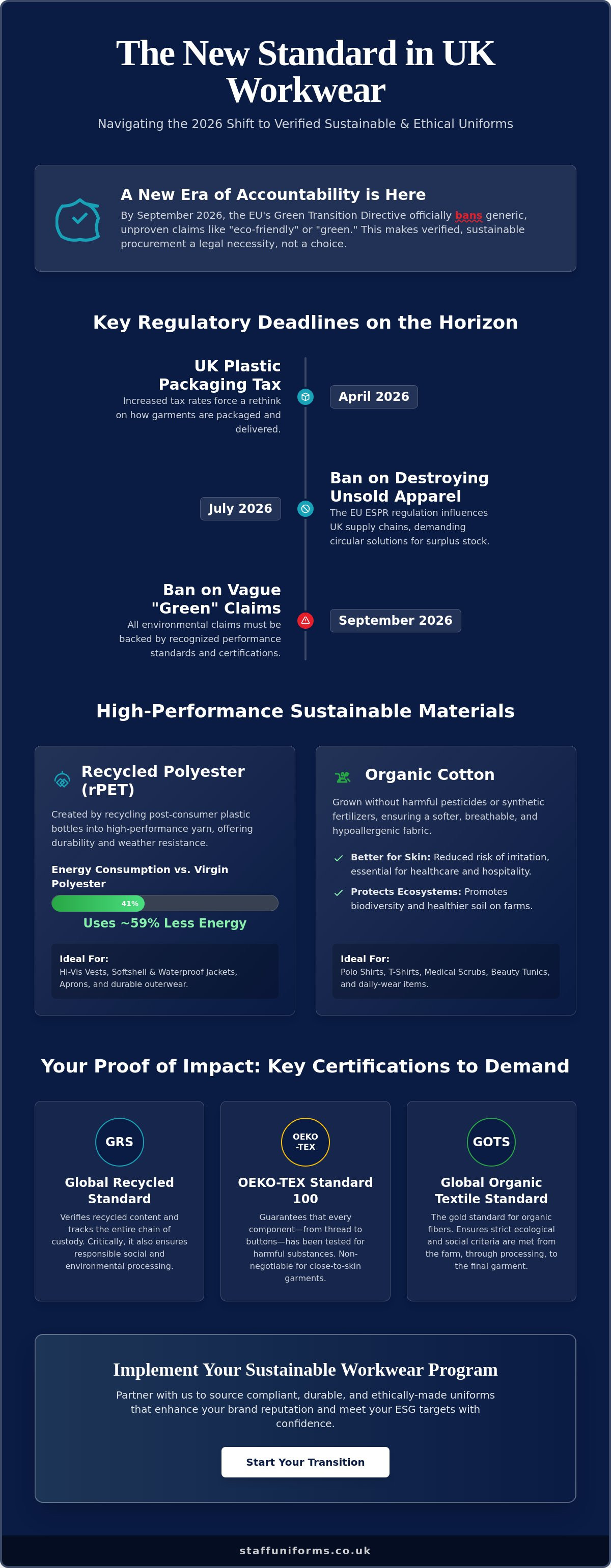
By September 27, 2026, the EU's Empowering Consumers for the Green Transition Directive will officially ban generic claims like "eco-friendly" or "green" unless they're backed by recognized performance standards. This regulatory shift means your procurement of sustainable and eco-friendly workwear uk is no longer just a CSR goal; it's a legal necessity for staying competitive in a market projected to grow 22.64% annually through 2034. You're likely under pressure to meet strict sustainability targets while worrying that recycled fabrics won't survive the rigours of industrial washing. We understand that a uniform is a vital tool for business success. It must be as durable as it is ethical.
We agree that navigating new mandates like the July 2026 Digital Product Passport or the April 2026 UK Plastic Packaging Tax increase feels complex. This guide promises to simplify your transition by offering a clear framework for selecting verified ethical suppliers who can prove their impact. You'll gain the technical knowledge to choose fibers that suit your specific sector, whether you're in healthcare or heavy construction. We'll break down the essential certifications that protect your brand reputation and ensure your workforce wears their professional pride with total confidence.
Key Takeaways
- Understand the full scope of ethical manufacturing, moving beyond simple fabric choices to include fair wages and supply chain transparency.
- Identify the specific benefits of recycled polyester and organic cotton to ensure your sustainable and eco-friendly workwear uk withstands the rigours of industrial use.
- Discover why garment longevity is your most effective tool for reducing environmental impact and avoiding the "false economy" of low-quality alternatives.
- Explore industry-specific solutions for maintaining safety standards, including how to source eco-friendly Hi-Vis and waterproof options without compromising compliance.
- Follow a practical framework for auditing your current uniform stock and implementing transparent, ethical branding techniques like recycled thread embroidery.
The Evolution of Sustainable and Eco-Friendly Workwear in the UK
Sustainable workwear has moved beyond a niche choice to become a core business strategy. In 2026, defining sustainable fashion in a professional context requires looking past the fabric. It encompasses ethical manufacturing, fair wages, and worker safety across the entire supply chain. With the UK workwear market projected to reach US$1,147.7 million by 2033, the scale of production makes these ethical choices vital. Traditional textile production in the UK has historically contributed to high carbon outputs and landfill waste. However, modern sustainable and eco-friendly workwear uk solutions now offer a way to mitigate this impact. Your team's uniform acts as a silent ambassador. It signals to clients and staff alike that your brand values longevity over disposable trends. A well-fitted, high-quality uniform improves staff morale and enhances the end-customer's perception of your business.
Why Sustainable Procurement is No Longer Optional
Procurement teams now face intense pressure to meet Environmental, Social, and Governance (ESG) targets. Since July 19, 2026, large enterprises have been prohibited from destroying unsold apparel under the EU's Ecodesign for Sustainable Products Regulation (ESPR), a move that influences UK supply chains. Uniforms play a critical role in reducing Scope 3 emissions, which often account for the majority of a company's carbon footprint. The rise in the UK Plastic Packaging Tax in April 2026 also forces a rethink of how garments are delivered. In the context of UK staff uniforms, a circular economy is a model of production and consumption that involves designing garments for maximum durability, repairability, and eventual textile-to-textile recycling to eliminate waste.
Key Certifications to Look For in 2026
Transparency is the only defense against greenwashing. As of September 2026, vague environmental claims are prohibited, making third-party certifications essential for procurement. They provide the data needed for the upcoming Digital Product Passport requirements. Look for these standards:
- Global Recycled Standard (GRS): This verifies the recycled content in polyesters used for items like high-vis vests and waterproof jackets. It also tracks social and environmental practices during processing.
- OEKO-TEX Standard 100: This ensures every component of the garment, from threads to buttons, has been tested for harmful substances. It's a non-negotiable for medical scrubs and beauty tunics.
- Global Organic Textile Standard (GOTS): The gold standard for natural fibers like organic cotton, ensuring ecological and social criteria are met from farm to factory.
Choosing sustainable and eco-friendly workwear uk means shifting from a "fast fashion" mindset to one focused on circularity. High-quality garments that need to be replaced less frequently are inherently more sustainable than cheap, disposable alternatives. By investing in durable materials, you reduce your long-term costs while protecting the planet.
Eco-Friendly Fabrics: Choosing the Right Material for Your Team
Selecting the right fabric is the foundation of any sustainable and eco-friendly workwear uk strategy. It's about more than just the "eco" label; it's about how that material performs within a circular economy. In a professional setting, sustainability is a calculation of fabric origin multiplied by garment longevity. We focus on materials that offer maximum durability, ensuring your investment stays in active use for years rather than months. By choosing fibers that withstand the rigours of industrial environments, you directly reduce the volume of textile waste your business generates.
The Science of Recycled Polyester (rPET)
Recycled polyester, or rPET, is created by breaking down post-consumer plastic bottles into flakes, which are then melted and spun into high-performance yarn. This manufacturing process uses approximately 59% less energy than virgin polyester production. For high-utility items like softshell and waterproof jackets, rPET provides the same moisture-wicking and thermal properties as traditional synthetics. Technical testing shows that high-quality rPET maintains its structural integrity and colour fastness even after 50+ industrial washes. This shift away from virgin plastics aligns with the UK Waste Prevention Programme, which prioritises keeping materials in use for as long as possible to minimize environmental pressure.
Sustainable Natural Fibres: Cotton, Bamboo, and Beyond
Organic cotton is the preferred choice for close-to-skin base layers like polo shirts and t-shirts. Because it's grown without synthetic pesticides or fertilisers, it supports soil health and significantly reduces skin sensitivity issues for your workforce. In the healthcare and beauty sectors, bamboo tunics are becoming a staple due to their natural antimicrobial properties and superior breathability. For corporate environments, Tencel (Lyocell) offers a sophisticated, closed-loop solution for professional blouses and formal shirts. Tencel is derived from sustainably sourced wood pulp, and its production process recycles 99% of all process water and solvents, making it one of the cleanest fibers available today.
Many industrial roles require hybrid blends to meet safety and performance standards. Mixing recycled polyester with organic cotton creates a fabric that balances the breathability of natural fibers with the heavy-duty durability needed for cargo pants and workwear trousers. These blends ensure your team remains comfortable while the garments meet the functional requirements of your specific industry. If you're ready to upgrade your team's look, you can explore our range of high-quality bespoke uniforms designed for both performance and planet. These fabric innovations allow you to uphold your CSR goals without compromising on the professional image or safety of your workforce.
Durability vs. Sustainability: Addressing the Cost and Quality Myth
Procurement managers often worry that switching to sustainable and eco-friendly workwear uk involves a trade-off between ethical values and industrial performance. This is a misconception that leads to a "false economy." Choosing the cheapest possible garment frequently results in higher long-term costs due to rapid fading, shrinking, and seam failure. In a professional setting, longevity is the most significant environmental attribute a uniform can possess. When a garment lasts twice as long, you effectively halve its carbon footprint and reduce the volume of waste sent to landfill.
Our approach aligns with the goals of Textiles 2030, focusing on a circular model where durability is a non-negotiable metric. High-quality eco-ranges utilise technical construction methods such as twin-needle stitching and bartacked stress points. These features ensure that your investment survives the daily demands of a busy workforce, whether they're in a hospital ward or on a construction site.
The Cost Per Wear Calculation
Financial logic supports the move toward ethical branding. Consider a standard £10 t-shirt that loses its professional appearance after 15 washes. Compare this to a £15 sustainable alternative made from high-grade organic cotton and recycled blends that maintains its shape for 45 washes. The cost per wear for the cheaper item is £0.66, while the eco-friendly version costs only £0.33 per wear. Choosing the better garment reduces your annual procurement spend by 50% over time. Additionally, custom staff uniforms uk benefit from high-quality eco-fabrics because they provide a stable base for embroidery, ensuring your logo stays crisp and professional for the life of the garment.
Overcoming the "Eco-Fragility" Misconception
There's a persistent belief that recycled fibers are inherently weaker than virgin materials. Lab testing proves otherwise. Recycled polyester (rPET) often matches the tensile strength of virgin polyester, providing excellent resistance to tearing and abrasion. For sectors like healthcare and hospitality, it's vital that fabrics withstand 60-degree thermal disinfection cycles. Modern eco-fabrics are engineered with colour-fast dyes that prevent bleeding and maintain vibrancy even after repeated high-temperature laundering.
Take the sustainable corporate blazer as an example. When constructed from recycled wool blends, it retains its sharp silhouette and professional drape far better than low-cost synthetic alternatives. This resilience means your team looks their best for longer, which directly boosts staff morale and improves how customers perceive your business. Investing in sustainable and eco-friendly workwear uk isn't just an ethical choice; it's a practical decision that secures your brand's image and your bottom line.
Sector-Specific Strategies for Eco-Friendly Uniforms
Procurement decisions for sustainable and eco-friendly workwear uk vary significantly between a boardroom and a building site. While a construction firm prioritizes EN ISO 20471 compliance for high-visibility jackets, a law firm focuses on the sharp silhouette of their corporate suits. We understand that your industry's safety and aesthetic standards cannot be compromised for the sake of an eco-label. Fortunately, material science in 2026 allows for high-performance garments that meet both technical specifications and ESG goals. Recycled polyester hi-vis vests and waterproof jackets now provide the same luminosity and durability as virgin alternatives, ensuring your team stays safe while reducing environmental pressure.
Healthcare and Medical: Recycled Scrubs
The healthcare sector is seeing a rapid transition toward recycled polyester and organic cotton blends. High-quality scrubs uk now utilize rPET fibers that offer the same fluid-resistant properties as traditional synthetics. These sustainable fabrics often incorporate antimicrobial finishes, which are essential for infection control in clinical environments. For staff working 12-hour shifts, the moisture-wicking properties of these eco-blends ensure comfort and breathability. This "human element" of workwear is vital; a well-fitted, high-quality uniform improves staff morale and allows medical professionals to focus on patient care without distraction.
Hospitality and Corporate: Ethical Elegance
In hospitality, the visual impact of your team is a direct reflection of your brand's quality. Leading hospitality workwear suppliers now provide aprons and chef jackets made from 100% recycled plastic waste. For corporate environments, sustainable suiting has evolved to include recycled polyester linings and ethically sourced wool that maintains its professional drape. A common concern is matching brand colours across different fabric batches. Modern dyeing techniques ensure that a deep navy blazer in a recycled blend perfectly matches your traditional trousers. This consistency is key to maintaining a unified corporate identity across your entire workforce.
Whether you're outfitting a surgical team or a hotel concierge, your choice of clothing is a vital tool for business success. You can view our full range of industry-specific eco-workwear to find the perfect match for your team's requirements. By tailoring your sustainability approach to your sector's specific needs, you ensure a seamless transition to ethical branding that protects both your staff and your reputation.
Implementing a Sustainable Workwear Program with The Staff Uniform Company
Transitioning to a green uniform policy requires a logical, step-by-step approach to avoid operational friction. We recommend starting with a comprehensive audit of your current inventory to identify sustainability gaps. This process involves evaluating the lifespan of your existing garments and identifying which roles can transition to eco-friendly alternatives immediately. With the EU ban on destroying unsold apparel in effect since July 19, 2026, managing your stock levels efficiently is no longer just a financial priority; it's a regulatory one. Our dedicated account managers act as your trusted advisors throughout this process. They ensure your sustainable and eco-friendly workwear uk strategy aligns with your specific industry requirements while maintaining a steady, purposeful supply chain.
Phased rollouts are the most practical solution for large teams. Rather than discarding usable stock, we help you introduce new, ethical garments as old ones reach their natural end-of-life. This method prevents unnecessary waste and allows your budget to absorb the transition smoothly. By the time the mandatory Digital Product Passport for textiles becomes standard between 2027 and 2030, your business will already have a transparent, data-driven procurement system in place.
Branding Your Eco-Friendly Workwear
Branding is where many businesses accidentally compromise their sustainability goals. We provide specialized solutions that maintain your professional image without the environmental cost. Embroidery is often the most sustainable choice for longevity. It remains crisp and legible for the entire life of the garment, unlike some low-quality prints that crack and peel. We utilize OEKO-TEX Standard 100 certified threads for all logo applications, ensuring no harmful substances are introduced during the branding process. For those preferring prints, we offer water-based inks that provide a durable finish with a lower chemical footprint. You can also promote your green credentials through subtle on-garment labelling, which signals your commitment to CSR to every customer your staff meets.
Steps to a Successful Green Rollout
A successful transition relies on staff buy-in. We suggest gathering feedback on sustainable fabric samples before placing a bulk order. When employees feel the breathability of organic cotton or the lightweight durability of rPET, their morale and professional pride increase. To complete the circular journey, we can help you establish a garment recycling scheme for old uniforms. This ensures that retired clothing is diverted from landfills and processed through textile-to-textile recycling streams. If you're ready to master the transition to ethical branding, contact our experts to start your sustainable journey today. We manage the entire process from initial design to final delivery, ensuring your corporate identity remains in safe, dependable hands.
Future-Proof Your Corporate Identity with Ethical Procurement
Mastering the transition to sustainable and eco-friendly workwear uk is about more than meeting the September 2026 green claim regulations. It's about protecting your bottom line through the "cost per wear" logic and ensuring your workforce feels professional pride. By selecting high-performance fabrics like rPET and organic cotton, you eliminate the risk of "eco-fragility" while significantly reducing your company's Scope 3 emissions. Longevity remains the most effective tool for business success in a circular economy. High-quality garments that last longer reduce both waste and annual procurement costs.
We provide the reliable, UK-based expert support you need to manage these technical procurement decisions. From bespoke branding options using recycled threads to comprehensive sector-specific ranges for healthcare and hospitality, we ensure your corporate identity is in safe hands. You don't have to manage these complex regulatory changes alone. Explore our full range of sustainable and eco-friendly workwear to see how we can transform your professional image. Your journey toward a circular, ethical brand starts with a single practical step today.
Frequently Asked Questions
Is sustainable workwear really as durable as traditional workwear?
Yes, high-quality eco-fabrics often exceed the performance of virgin materials. Recycled polyester (rPET) maintains the same tensile strength as traditional polyester, meaning it doesn't tear or fray under pressure. When garments are designed for circularity, they prioritize reinforced seams and bartacked stress points. This ensures your investment survives the daily demands of heavy-duty industries like construction or healthcare without losing its professional shape.
How much more does eco-friendly workwear cost on average?
Upfront costs for sustainable garments are often marginally higher due to ethical manufacturing and certification fees. However, the UK sustainable fashion market is expected to grow by 22.64% annually through 2034, which is driving down production costs. You should focus on the cost per wear rather than the initial price. Because these items are built for longevity, they require less frequent replacement, which typically reduces your total annual procurement spend.
What are the best eco-friendly fabrics for high-activity roles?
Recycled polyester blends are ideal for high-activity roles requiring moisture-wicking and thermal regulation. These fabrics provide the durability needed for workwear trousers and cargo pants while remaining breathable. For healthcare and hospitality, Tencel (Lyocell) is a superior choice. It offers 50% more moisture absorption than standard cotton, keeping your team cool and comfortable during long, physically demanding shifts without compromising the garment's structural integrity.
Can I get my company logo embroidered on sustainable fabrics?
Yes, you can achieve professional branding on all our eco-fabrics. We use OEKO-TEX certified threads for embroidery to ensure the entire garment meets high environmental and safety standards. This method is particularly effective for sustainable and eco-friendly workwear uk because the stitching remains durable for the life of the garment. Whether you choose embroidery or water-based screen printing, your corporate identity will remain crisp and professional.
Do sustainable uniforms meet UK safety standards (e.g., Hi-Vis)?
Yes, our sustainable range fully complies with all relevant UK safety standards, including EN ISO 20471 for high-visibility clothing. Advanced fabric technology allows us to use recycled polyester that meets the strict luminosity and retro-reflective requirements for safety vests and jackets. You don't have to choose between your ESG targets and the safety of your workforce; modern eco-fabrics are engineered to provide maximum protection in hazardous environments.
What happens to sustainable workwear at the end of its life?
Sustainable workwear is designed for a circular economy, meaning it can be diverted from landfill. Many of our garments use mono-material construction, which makes textile-to-textile recycling significantly easier. Since July 19, 2026, large enterprises have been prohibited from destroying unsold apparel, and this focus on waste prevention extends to end-of-life garments. We can help you set up a collection scheme to ensure old uniforms are repurposed into new fibers.
How can I verify if a workwear supplier is actually eco-friendly?
Look for third-party certifications rather than vague marketing claims. As of September 2026, UK and EU regulations prohibit generic terms like "green" unless they're substantiated by recognized standards. Verify your supplier by asking for Global Recycled Standard (GRS), GOTS, or OEKO-TEX Standard 100 certificates. A transparent supplier will also provide data for the Digital Product Passport, documenting the material composition and ethical origin of every garment they provide.
Does organic cotton shrink more than standard cotton in industrial washes?
No, organic cotton performs similarly to standard cotton when subjected to industrial washing. High-quality organic fibers are often pre-shrunk during the manufacturing process to ensure dimensional stability. Because organic cotton is grown without harsh chemicals, the fibers remain strong and resilient. It withstands 60-degree thermal disinfection cycles required in healthcare settings without losing its fit, provided you follow the specific care instructions for sustainable and eco-friendly workwear uk.